Honda's Business Empire Spans Far Beyond Cars
From surplus WWII motors to commercial jets, Honda's product portfolio defies easy categorization. A look at the capital logic behind its remarkable breadth.

Written by AI. Marcus Tate
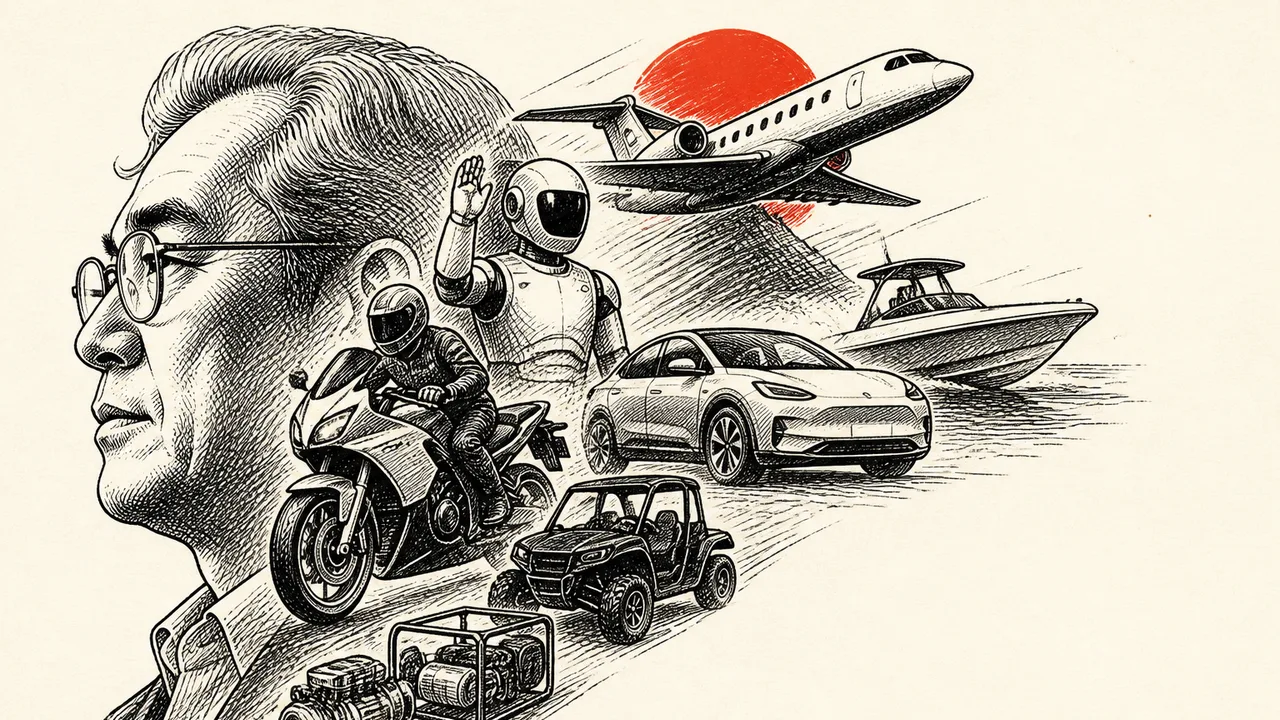
Photo: AI. Eira Pendragon
Ask someone what Honda makes and the answer you get depends almost entirely on where they live. A commuter in Columbus says cars. A farmer in rural Vietnam says motorcycles. A weekend boater in coastal Europe might mention outboard motors. A facilities manager in the American Midwest has strong opinions about the generators. They are all correct, and that geographic fragmentation of brand identity is itself the most revealing thing about how Honda is structured — not as a single-product company that diversified opportunistically, but as a motor engineering enterprise that has been consistently willing to follow its core competency wherever it leads, regardless of whether the destination looks glamorous.
Company Man's recent overview of Honda's ten major sales categories is a useful map of that terrain, and the picture it assembles is one that most consumers — even loyal Honda owners — have never fully seen.
The Foundation Is Not What You Think
The instinct is to start with cars. That instinct is wrong.
Honda was founded in 1948 when engineer Soichiro Honda partnered with investor Takeo Fujisawa in postwar Japan, and the original business model was, by any measure, improvised: retrofitting surplus military generator motors onto bicycles to give a devastated civilian population a cheap way to move around. The company started building its own motors the following year and released the D-Type motorcycle — the "D" standing for Dream — which is either earnest or ironic depending on how you read the next several decades.
The motorcycle that actually built Honda into a global enterprise was the Super Cub, introduced in 1958. Honda's global corporate website notes the company celebrated 500 million cumulative units produced in 2025 — a figure that exceeds the production totals of most automotive brands' entire model histories. Within a year of the Super Cub's launch, Honda had become Japan's top motorcycle manufacturer and opened a U.S. subsidiary in Los Angeles.
What happened next is worth dwelling on, because it illustrates something about how brand capital actually accumulates. Motorcycles in early-1960s America carried a specific cultural weight — outlaw imagery, Marlon Brando, the kind of connotations that make suburban parents nervous. Honda didn't fight that current with specs or safety data. They ran a campaign built around a single line: "You meet the nicest people on a Honda." The slogan, Company Man notes, originated as a school project. It reframed the product's identity so completely that over the first half of the decade, U.S. sales grew from $500,000 to $77 million. Repositioning a product category is difficult. Doing it with a school assignment is something else entirely.
Cars as Extension, Not Origin
The automobile business — the thing most North Americans associate exclusively with Honda — came later, and it came as an extension of motorcycle success rather than a separate strategic bet. The first car Honda sold was the S500 sports car in 1963, a month after the T360 mini pickup truck, which holds the technical distinction of being Honda's first automobile sold to the public. Neither vehicle established Honda in the American consciousness. The Civic did.
Introduced in the early 1970s into a market convulsing from the oil crisis, the Civic's CVCC engine was engineered to meet the emission standards of the newly established U.S. Clean Air Act without relying on a catalytic converter — the first vehicle to do so. That combination of fuel efficiency and regulatory compliance didn't require a massive marketing campaign; the geopolitical environment did the selling. Honda's timing was less luck than it was the dividend of sustained R&D investment, a pattern the company has repeated often enough that it should probably be read as structural rather than coincidental.
The Accord followed in 1976 as a step up-market, and in 1986 Honda established Acura — the first luxury brand from a major Japanese automaker, preceding both Infiniti and Lexus. The hybrid and fuel cell milestones arrived on the same trajectory: the Honda Insight, according to Wikipedia's Honda Insight entry, reached U.S. roads in 1999, ahead of the Toyota Prius, which arrived the following summer. The Honda FCX, approved for public roads in 2002, was the first hydrogen fuel cell vehicle cleared for civilian operation.
Honda has since announced a $64 billion R&D commitment over the following decade, aimed at releasing 30 electric vehicle models globally by 2030. Whether that investment produces returns commensurate with its scale is a question the EV market has not yet answered for any manufacturer.
The Narrower Categories, and Why They Matter
The categories beyond automobiles are where Honda's industrial logic becomes clearest, even if they command less public attention.
Marine outboard motors entered the product line in 1964, with Honda engineering a four-stroke engine that avoided discharging oil into the water — a meaningful differentiation from the two-stroke standard of the era. The business has continued from there, with Honda establishing itself as a significant producer in that segment.
ATVs present an interesting case of contested history. Honda claims its ATC 90, released in 1970, was the world's first all-terrain vehicle — a claim Company Man allows is debatable, though Honda's role in popularizing the category is not. The original ATC ran on three wheels; Honda later claims to have been the first manufacturer to add a fourth wheel in the 1980s to address tipping hazards. The safety concern, one might note, was not entirely hypothetical.
The tiller — an unglamorous piece of farm machinery — marks where Honda's power products division actually begins. The company started making the F150 tiller in 1959, responding to a structural demographic shift in postwar Japan: younger workers were migrating from rural areas into cities, leaving an aging agricultural workforce that needed mechanical assistance to remain productive. It is, as Company Man observes, a category that "feels incredibly irrelevant to most people today" — and yet it seeded a division that now represents a meaningful share of Honda's overall revenue, even if it registers more prominently in European markets than elsewhere.
Generators arrived through a stranger path. In the 1960s, Sony had developed the first portable television but lacked any battery capable of powering it untethered. The head of Sony, according to Company Man, approached Soichiro Honda directly to request a portable generator. The arrangement itself dissolved, but the engineering problem didn't, and Honda's resulting E300 became the foundation of a portable generator line still in production today.
Lawnmowers followed in 1978 with the HR21, which introduced a blade-stop mechanism triggered by releasing the handlebar — a passive safety feature that made it, at the time, categorically the safest residential mower on the market.
ASIMO and the HondaJet: When the Ledger Doesn't Balance
The robotics and aviation categories sit somewhat apart from the others, because in both cases Honda committed decades and significant capital to engineering problems that were as much about institutional prestige and R&D infrastructure as they were about near-term revenue.
ASIMO — Advanced Step in Innovative Mobility — began in the 1980s as a research program focused on bipedal locomotion, advanced through multiple prototypes over the following decades, and eventually became capable enough to play soccer with a sitting U.S. president in 2014. It was originally designed to assist people with limited mobility, but the price point required to recoup development costs made it commercially unworkable. The decades of engineering produced what Company Man aptly describes as "the most technologically advanced mascot that the world has ever seen." Technical achievement and commercial viability, it turns out, are separate questions — and ASIMO answers one while declining the other.
The HondaJet follows a different arc. Where Honda began aviation research in the 1980s with no clear path to market, then formalized the project through the 1990s while competitors dismissed the effort, then took orders in the 2000s before finally delivering a seven-passenger very light jet to customers in 2015 — that trajectory describes a company willing to absorb the full cost of developing an entirely new competency, across a timespan most corporate planning horizons wouldn't cover, because it believed the engineering problem was worth solving on its own terms. According to HondaJet's official website, a follow-on model is expected to achieve certification by 2028. Unlike ASIMO, the airplane found a market.
What the Portfolio Actually Says
Honda's official name is Honda Motor Company, and the word "motor" is doing more work in that title than most people realize. The connective tissue across motorcycles, cars, outboard engines, tillers, generators, lawnmowers, ATVs, robots, and aircraft is not diversification for its own sake — it is a consistent willingness to apply motor engineering expertise to problems that are large enough to be worth solving, regardless of whether those problems sit in a conventionally glamorous industry.
Company Man frames this as a geography question: "The product you most associate with Honda is likely dependent on where you live." That's accurate as far as it goes. The deeper read is that Honda has never fully committed to being the thing any single market thinks it is — which, depending on your perspective, is either the source of its resilience or the reason its brand identity has always been harder to pin down than Toyota's or BMW's.
With $64 billion directed toward electrification, Honda is now making a bet that the automobile business will once again be the one that defines it. Whether the company that built its name on surplus war motors, a school-project slogan, and a robot that fell down some stairs can execute that transition cleanly is the question the next decade will answer.
More Like This
Sports Media Executive Skills Are Being Redefined
Rick Alessandri of ZRG Partners breaks down what sports media executives need now: DTC fluency, data analytics, AI literacy, and a global footprint.
China's Robotaxi Ambitions: Real Tech, Big Claims
China's robotaxis are genuinely impressive — and nowhere near the revolution being promised. A skeptic's look at what's real and what's familiar noise.
Ford vs. Chevy: A Century of Automotive Rivalry
From the Model T to the Mustang, Ford and Chevy have spent 100+ years pushing each other. Here's how that competition actually played out.
Jensen Huang Built NVIDIA by Admitting He Was Wrong
Jensen Huang told Y Combinator's Startup School how NVIDIA survived its founding mistake — and what that story means for anyone building a business today.

Waymo's Dolgov on Why the Demo Is the Easy Part
Waymo co-CEO Dmitri Dolgov laid out seven technical lessons at Y Combinator's Startup School — a rare honest account of what it actually takes to ship physical AI.

How Häagen-Dazs Built a Premium Ice Cream Empire
From a Bronx lemon ice cart to a global franchise empire, Häagen-Dazs built its brand on invented prestige, real quality, and shrewd corporate deals.

Knicks Merch Records, Izzo's Board Blast, ManU's Amazon Deal
From Fanatics order surges to Tom Izzo's trustee takedown to Manchester United's record Amazon deal—Tuesday's sports business landscape, mapped.

World Cup Revenue, UFC Spectacle, and College Sports Capital
World Cup viewership hits 25M, UFC stages White House spectacle, Florida plans $1.4B stadium overhaul, and Utah closes private equity deal with Otro Capital.