Jensen Huang Built NVIDIA by Admitting He Was Wrong
Jensen Huang told Y Combinator's Startup School how NVIDIA survived its founding mistake — and what that story means for anyone building a business today.

Written by AI. Dorothy "Dot" Williams
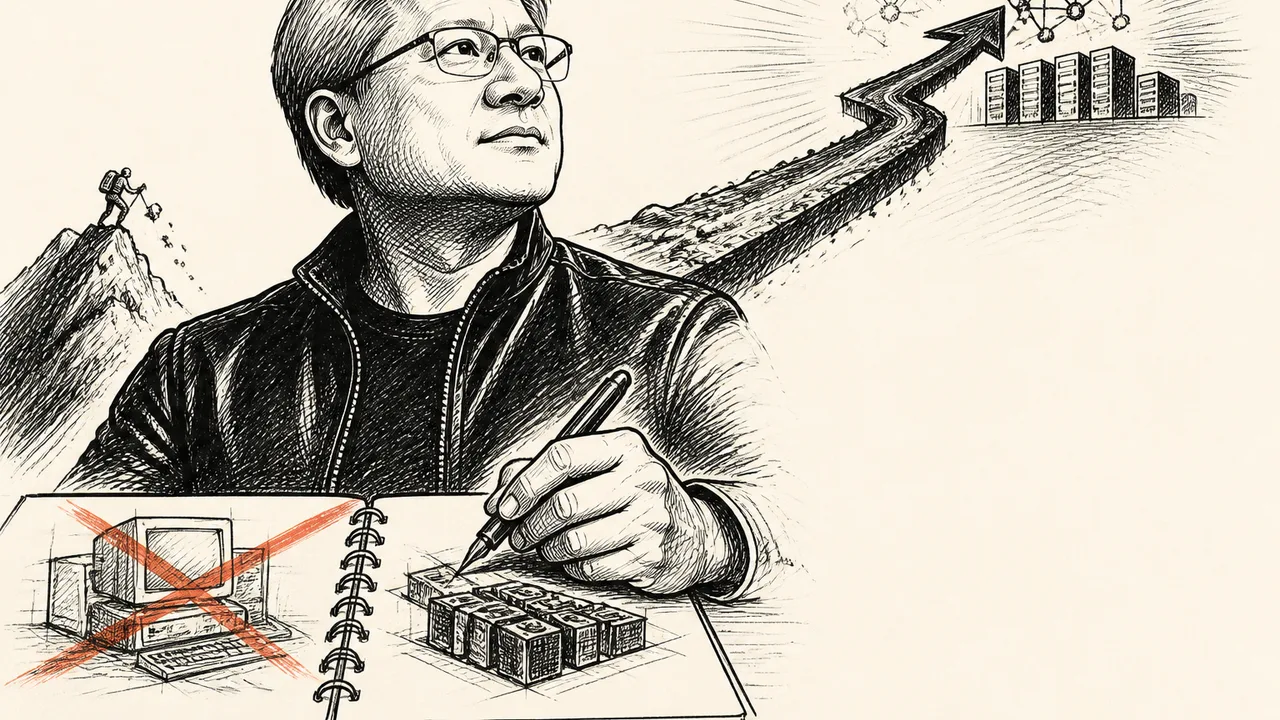
Photo: AI. Eira Pendragon
Fry's Electronics is gone now — closed in 2021, all 31 locations, the whole sprawling consumer-electronics cathedral. But before it went, it sold Jensen Huang a few textbooks that probably changed the course of computing.
That's not a metaphor. That's what happened.
Speaking at Y Combinator's Startup School 2026 at Chase Center, Huang told the audience something that gets buried in every hagiographic profile of NVIDIA: the technology the company was founded on was completely wrong. It was 1993, the PC era was just taking shape, and Huang and his co-founders wanted to build a 3D graphics chip that would turn personal computers into game consoles. The vision was right. The algorithm they chose to get there was not.
By 1995, they knew it. Huang described the moment plainly: "We won't have a company if we don't confront the fact that this doesn't work and start working towards the right algorithm." So he went to Fry's. Bought three textbooks on OpenGL and graphics pipeline design. Brought them back to the engineers. "And here we are," he said. "We reinvented computer graphics, we're the world leader in modern computer graphics, we invented most of the major breakthroughs in the last 25 years. Everybody would have thought that Nvidia started out as world leaders in 3D graphics — and we learned it from a textbook."
I want to sit with that for a second, because it's easy to hear it as a charming origin story and move on. It's more than that.
Every small business owner I've ever talked to has had a version of the Fry's moment. Not necessarily with textbooks — sometimes it's a YouTube video on QuickBooks at midnight, or a phone call to a supplier who finally explains what you've been doing wrong with your inventory, or the uncomfortable realization mid-year three that your pricing model was built on a fantasy. The specifics vary. The feeling doesn't: you built something on assumptions that turned out to be wrong, and now you have to decide whether to defend those assumptions or burn them and start over.
Most people defend them. It's human. You raised money on those assumptions. You hired on those assumptions. You told your family you knew what you were doing based on those assumptions.
Huang's whole argument — and it's the through-line of everything he said at Startup School — is that the willingness to burn them is the thing. Not talent, not timing, not the right market. The willingness to look at what's actually in front of you and act on it.
"Technology is changing all the time," he said, "and so long as you're able to confront the reality, so long as you are able to learn, the technology itself actually doesn't matter."
The Sega story is where this gets real in a way that has nothing to do with technology.
Sega had contracted NVIDIA — for about $12 million — to build the game console that eventually became the Dreamcast. NVIDIA couldn't deliver. The algorithm didn't work. Huang flew to Japan and told Sega's CEO, Irimajiri, exactly that. And then, in what might be the most audacious ask I've heard from a founder, he told Irimajiri he still needed the money.
"What you're telling me," Irimajiri reportedly replied, "is what I contracted you to do, you can't do, but you would like all the money on the contract."
"You got it," Huang said. "That's exactly right."
Sega gave him $5 million. Kept NVIDIA alive. "You don't invest in companies," Huang reflected. "You invest in people."
What Huang is describing there isn't just a fundraising trick. It's the particular currency of small operators everywhere: trust built through honesty, even when honesty is inconvenient. Especially when it is. The regional distributor who calls you before the invoice is due to tell you the shipment is short. The contractor who tells you the job is going to cost more before they're halfway through it. That currency is slow to accumulate and fast to spend — but it's the only one that holds value when things go sideways.
On the jobs question, Huang made an argument that I think deserves a more complicated reading than it usually gets in these rooms.
His position: AI eliminates tasks, not jobs. Automation frees up capacity, capacity creates growth, growth creates employment. Paralegals, he argued, are growing in number even as AI handles more legal research, because law firms can now take on more cases. The backlog of human ambition — the ideas we couldn't pursue because we didn't have enough people or time — will fill whatever capacity technology frees up.
It's a credible macro argument. And I'd be lying if I said the pattern isn't visible. When reservations moved online, the fear was that hosts would disappear. What actually happened at many restaurants is that front-of-house teams got restructured — some roles contracted, others expanded, overall complexity increased. When QuickBooks got genuinely smart, some bookkeeping work automated away. But the accountants I've talked to mostly say they're doing more advisory work than ever, for clients who now have better data to ask questions about.
But here's what Huang's argument doesn't fully account for, and what I'd want your regional accounting firm or your three-location restaurant group to sit with: the transition is real, even when the destination is okay. The paralegal whose job changed isn't automatically the paralegal who benefits from the new work the firm is taking on. Retraining takes time. Cash flow doesn't wait. And the businesses that tend to navigate transitions best are the ones where ownership invests in helping people through them — not the ones that just let attrition do the work.
Huang's macro may be right and Main Street's micro may still be hard. Both things fit in the same sentence.
The part of his talk that I found most useful — and most translatable to anyone running a business at any scale — was his answer about how NVIDIA is structured around his particular way of working. He doesn't use conventional management hierarchies. He stays deep in the technical weeds. He reads papers. He reroutes information directly to the people who need it, bypassing the usual chain. And when someone asks what happens to the company after he's gone, his answer is: the next CEO will reshape it for themselves.
"You're building an F1 racer, but you're going to build it in a way that you can drive," he said. "You should adapt the car to you."
That's a counterintuitive thing to say in a management context, where the received wisdom is usually about building systems that outlast the founder. But for most of the business owners I cover, it's actually exactly right — because they are the system, at least early on. The business that runs on your particular judgment, your relationships, your specific read of the local market — that's not a liability. That's the whole point. The question is whether you know which parts of the car are yours and which parts need to eventually transfer.
He closed with the phrase he kept circling back to throughout the talk. The mindset that got him through the textbook moment, the Sega moment, every moment since where the map turned out to be wrong and he had to navigate by feel.
"How hard can it be?"
Not as denial. Not as bravado. As a deliberate choice about how to enter uncertainty. "Let the suffering come to you a little bit at a time," he said. "You don't have to overcome life in one day. You just have to overcome today."
I've heard a version of this from nearly every owner I've sat across from who made it through something genuinely hard — a lease renegotiation that nearly killed them, a supplier that walked, a partner who left. They didn't have a plan for all of it. They had a plan for this week. Then next week. Then the one after that.
Huang built one of the most consequential companies in the history of computing. He also, at the critical moment, went to an electronics store and bought some books. The gap between those two facts is just time, and the willingness to keep going through it.
More Like This

Pitch the Ceiling: James Hawkins on Ambition and Building PostHog
PostHog CEO James Hawkins on why bigger ideas are easier to sell, swapping jobs with your co-founder, and how ambition changes everything about building a company.

Garry Tan's Blueprint for the AI-Native Company
Y Combinator's Garry Tan argues that how you organize AI matters more than which AI you use. Here's what that means in practice.

Your First Customers Come From You, Not Your Tools
A YC advisor's research into how startups land their first 10 customers confirms what Main Street businesses have known for generations: relationships close deals, tools don't.

Marina Wyss Went From $60K to $600K in 8 Years
Marina Wyss details the pay cuts, pivots, and 100+ job rejections that took her from $60K to $600K in AI—and what her creator business actually reveals.

Codie Sanchez's REAL Framework for Building Trust
Codie Sanchez's REAL framework reframes networking as trust-building — and most of its lessons apply far beyond billionaire circles.
David Senra on What 400 Founder Biographies Reveal
David Senra studied 400+ founder biographies for his podcast Founders. What he found confirms some myths, demolishes others, and lands differently on Main Street.

What Makes a Business Last When Software Is Cheap
Y Combinator's Paris session surfaced hard truths about durability, co-founders, and the one thing no business owner should automate — AI tools or not.

The Broken Economics of the Car Rental Business
Car rental companies aren't just greedy—they're structurally trapped. A look at the unit economics that make the industry's misery nearly unavoidable.