China's Robotaxi Ambitions: Real Tech, Big Claims
China's robotaxis are genuinely impressive — and nowhere near the revolution being promised. A skeptic's look at what's real and what's familiar noise.

Written by AI. Mike Sullivan
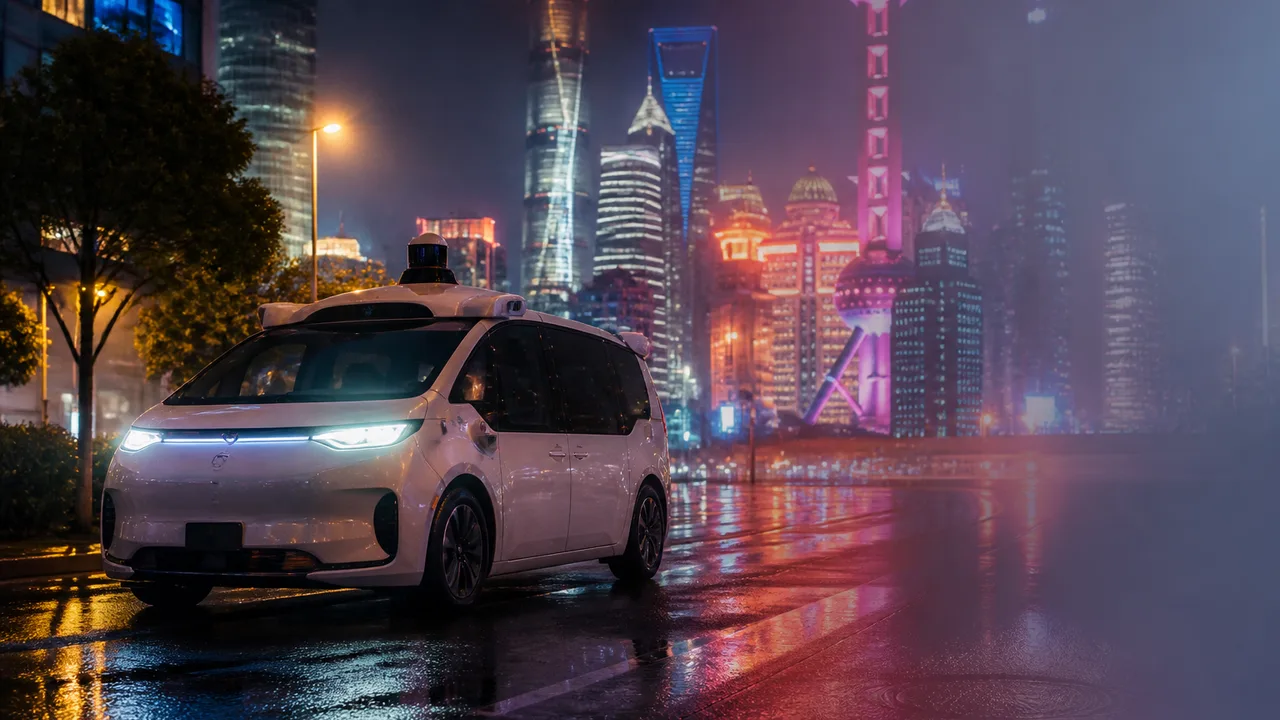
Photo: AI. Kai Hargrove
Every generation of transportation technology arrives with someone standing next to it telling you the world will never be the same. In 2001, that person was standing next to a Segway. Dean Kamen said it would be bigger than the internet. Cities, he suggested, would be redesigned around it. What actually got redesigned was the tourism industry in about forty mid-sized American downtowns. I think about that a lot when I watch another round of "this changes everything" coverage about autonomous vehicles.
Which brings me to Beijing's Yizhuang district, where BBC reporter Suranjana Tewari recently climbed into a WeRide robotaxi and described, with visible astonishment, a steering wheel moving by itself. The car navigated dense urban traffic — bikes, buses, pedestrians, the whole chaotic tableau — without a human hand on the wheel. Tewari called it "really incredible." She's not wrong to be struck by it. A steering wheel moving of its own accord while a car makes actual traffic decisions is not a thing you shake off quickly. It is, to reach for the most honest framing I can manage, a thing that works.
The question worth asking, though, is the same one worth asking about every piece of technology that demonstrably works in a controlled environment: what's the distance between "it works here, now, under these conditions" and "it changes everything"? That gap is where most of the action is, and China's robotaxi story lives squarely inside it.
What's Actually Happening
The technology itself is legitimate. Cameras handle vision, radar handles distance and speed detection, and lidar builds a continuous 3D map of the surrounding environment. Feed all of that into an AI system processing data in real time, and you get a vehicle that can navigate complex urban traffic with, as Tewari noted, more decisiveness and smoothness than a human driver who's running on caffeine and mild resentment. Companies like WeRide and Qcraft are operating commercial robotaxi services in designated zones across a handful of Chinese cities. This isn't a prototype. People are riding in these things.
The ecosystem argument is also real. China's EV boom created an industrial supply chain for the exact hardware — radars, lidars, sensors — that autonomous vehicles need. That hardware is cheaper in China than almost anywhere else, partly because the domestic demand that drove the EV market also drove manufacturing scale for components. A Qcraft executive, speaking in the BBC segment, put it plainly: Chinese consumers, particularly younger ones, treat smart vehicles like consumer electronics. They want new features. They will try new things. That cultural appetite, combined with lower hardware costs, gives Chinese AV companies a structural advantage that isn't easy to replicate.
A Qcraft representative offered this timeline: "Maybe the next 5, 7, at most 10 years, it will get into everybody's life." Five to ten years is the industry's favorite forecast window. Long enough to be unfalsifiable right now, short enough to sound imminent. I have watched this particular clock get reset several times.
The Edge Cases Are Not Minor Details
Here is where the complexity lives. Autonomous vehicles are not hard on average — they're hard at the margins. The same Qcraft executive who outlined the promise also outlined the problem: Middle Eastern heat is a hardware-stability issue. Southeast Asian monsoon rains plus animals crossing roads is a sensor-and-decision-system issue. Dense urban environments in China are one kind of hard. Unpredictable rural environments somewhere else are a completely different kind of hard.
The Baidu incident in Wuhan earlier this year is instructive. More than a hundred robotaxis stopped simultaneously, some with passengers who reported being briefly unable to exit through locked doors. Local police attributed it to a systems failure. Baidu suspended operations for several weeks. This is the kind of failure mode that distinguishes a demonstration from a reliable service. A human cab driver who has a bad day is a single bad cab ride. A systems failure that affects a hundred vehicles at once is a different category of problem — one that regulators will, quite reasonably, want answers to before scaling.
Baidu says it remains on track to launch driverless vehicles in the UK later this year. The UK has its own views about what "on track" means when it comes to autonomous vehicle regulation, and those views tend to move at a pace that would frustrate anyone used to China's approval environment.
Where Grudging Respect Is Warranted
I want to be fair about one thing, because it's genuinely smart and I've watched too many companies do the opposite to pretend otherwise.
Chinese AV firms expanding internationally are not doing what American tech companies spent a decade doing in Europe — showing up, planting a flag, assuming the market would reorganize itself around them, and then spending years getting fined and regulated and generally treated like an uninvited guest who rearranged the furniture. That strategy produced a rich history of expensive lessons.
Instead, Chinese robotaxi companies are partnering with Uber and Lyft. That's worth sitting with for a moment. Rather than building parallel ride-hailing infrastructure from scratch in markets where incumbents already have the customers, the driver networks, and the regulatory relationships, they're slotting their technology into platforms that already solved those problems. The technology becomes the layer on top; someone else handles the customer acquisition, the insurance headaches, the city-by-city permit negotiations. It's the move of companies that have watched the international expansion playbook fail often enough to try something different. Whether it ultimately works is a separate question. That it reflects a clear-eyed read of how hard market entry actually is — that I'll give them.
The Safety Argument, Handled With Care
One claim that keeps surfacing in this space deserves examination rather than acceptance. The argument, made explicitly by an AV industry representative in the BBC segment, is that because most road accidents stem from human error — fatigue, alcohol, distraction — autonomous vehicles will dramatically reduce accident rates. Therefore, the argument continues, regulators should move quickly.
The logic isn't wrong on its face. Human error is genuinely responsible for a significant share of traffic fatalities, and a system that doesn't get tired, drunk, or angry does eliminate that particular category of risk. If the technology delivers on that at scale, that's a meaningful thing, not a press-release talking point.
The part that slides past without scrutiny, though, is the phrase "at scale." A technology that reduces human-error accidents while introducing a new category of systems-failure accidents — the kind that can affect many vehicles simultaneously — requires its own safety accounting. The Wuhan incident didn't kill anyone, as far as reporting indicates, but it demonstrated that the failure modes for AV systems are genuinely different from the failure modes for human drivers, not simply better. Regulators who are "very open to the tech," as the executive described, are still going to want that accounting done.
The Pattern and What It Suggests
Here's what I actually think is most likely to happen, stated with the hedging it deserves: the technology will continue to improve. Costs will continue to fall. Robotaxis will expand in geofenced urban zones in permissive regulatory environments — certain Chinese cities, the UAE, Singapore, maybe eventually parts of the UK and US — over the next several years. That's a real business and a real shift in how some people in some places get around. It will probably arrive not as a sudden revolution but as a gradual normalization, the way ride-hailing itself arrived: weird and then ubiquitous and then just how things work.
What it almost certainly will not do is "change our society and our everyday life" on the timeline the executives are currently selling. The gap between "operates reliably in mapped zones in Yizhuang" and "operates reliably everywhere" is enormous, and every industry veteran knows it. They just have fundraising targets, and ambient uncertainty doesn't close rounds.
The steering wheel moving by itself is real. I'm not disputing that part. I'm just old enough to remember when that kind of thing was supposed to happen by 2020.
More Like This

Do You Really Need an $80 HDMI Cable? Maybe Not
Tech reviewer Adam tests a premium HDMI 2.1 cable. We examine what you're actually paying for and whether most users need it.

When Agents Generate Their Own UI: The Three Flavors Explained
CopilotKit's Tyler Slaton maps the spectrum of generative UI—from pixel-perfect control to agents writing raw HTML. Each approach makes different tradeoffs.

Can Unreal Engine 5 Run on a $500 MacBook? Sort Of.
Testing Unreal Engine 5.7 on the MacBook Neo reveals what happens when professional software meets budget hardware—and why friction matters.

CES 2026: AI Glasses vs. Humanoid Robots
Exploring CES 2026's AI trends: humanoid robots, AR glasses, and autonomous vehicles.
UBTech's Humanoid Robot Pushes Into Home and Border
UBTech's UWorld U1 humanoid aims to replicate human faces, voices, and emotions. Here's what the launch actually shows — and what it quietly sidesteps.
China's Robotaxi Push and the Workers in Its Path
China's robotaxi companies are expanding globally on EV supply chain strength—but what does that mean for the drivers whose livelihoods disappear in the process?

Microsoft Is Betting on DNA for Data Storage
Microsoft Research is developing synthetic DNA as a long-term data storage medium. Here's what the science actually says, and what remains unresolved.

FCC Kills TV Ownership Cap in Win for Big Broadcasters
The FCC's vote to repeal the 39% TV ownership cap replaces a hard limit with "case-by-case review." We've seen this movie before — in radio.