Nvidia's GTC 2026: What 40 Million Times More Compute Means
Jensen Huang unveiled Vera Rubin chips, enterprise AI agents, and orbital data centers at GTC 2026. Here's what actually matters for the rest of us.

Written by AI. Bob Reynolds
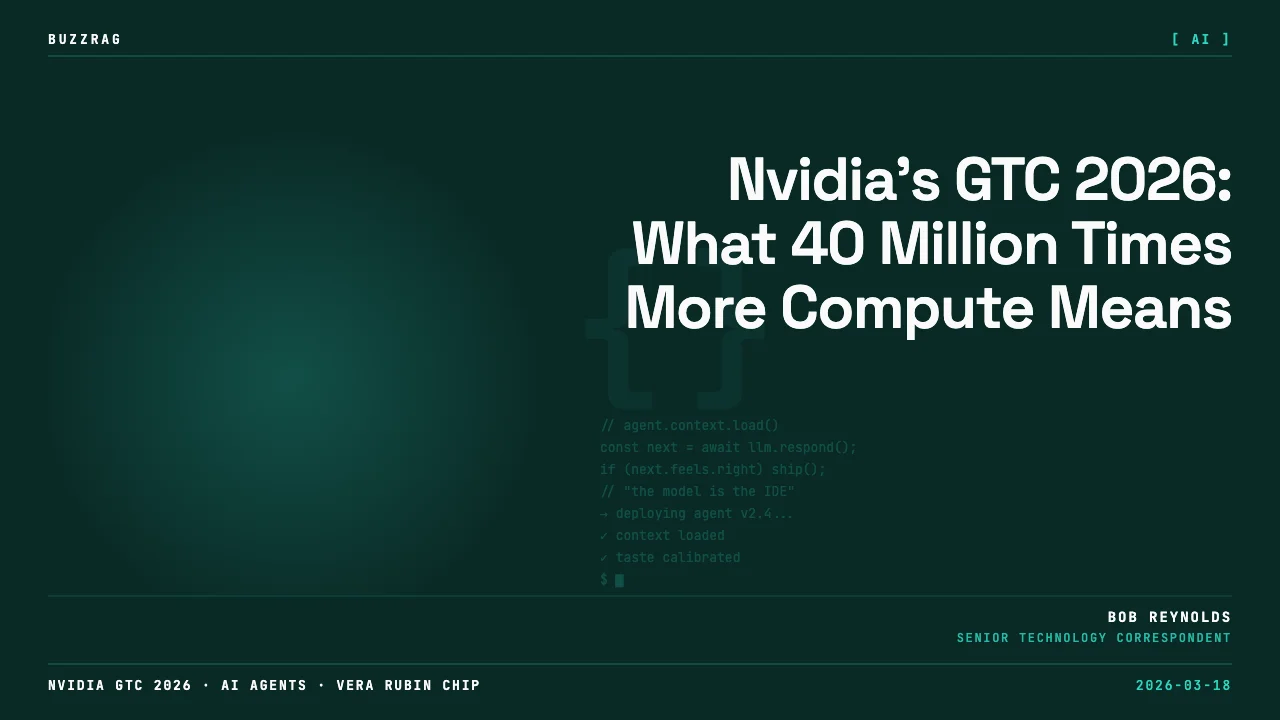
Jensen Huang walked onto a stage in San Jose yesterday wearing his standard black leather jacket and spent two hours announcing what Nvidia claims is a decade's worth of technological advancement. Thirty thousand people attended. Representatives from 190 countries. The numbers he threw out were designed to impress: 40 million times more compute power than a decade ago. Not double. Not ten times. Forty million.
I've covered enough of these conferences to know the difference between genuine inflection points and well-staged product launches. This one contained both. The question worth examining isn't whether Nvidia just changed everything—companies rarely do—but which pieces of this announcement represent actual shifts versus accelerated timelines for things already in motion.
The Efficiency Problem Gets a Ten-Fold Answer
The Vera Rubin platform represents Nvidia's answer to AI's growing energy crisis. Seven new chips, five rack configurations, 1.3 million components working as one system. The headline number: ten times more performance per watt than the previous generation.
That matters more than the raw performance gains. Data centers currently consume staggering amounts of electricity to run AI workloads. Getting ten times the output from the same power draw isn't just an engineering achievement—it's potentially the difference between AI scaling economically or hitting a wall.
The technical specifications read like a foreign language to most people: 336 billion transistors, 288 GB of HBM4 memory, 22 terabytes per second of bandwidth. Think of it as upgrading from a two-lane highway to a 22-lane superhighway. Information moves nearly three times faster. AI responds faster, handles more concurrent tasks, processes more data simultaneously.
Nvidia also unveiled Rubin Ultra, which connects up to 144 GPUs in a single configuration. These aren't incremental improvements. They're the kind of leaps that change what's possible at scale.
A Different Kind of Chip for a Different Kind of Job
More interesting than the raw power increase is Nvidia's introduction of the Groq 3 Language Processing Unit. This came through their December acquisition of Groq (pronounced "grock"), and it represents a fundamentally different approach to AI processing.
GPUs are heavy trucks—built to haul massive loads. Training AI models from scratch requires that kind of brute force. LPUs are sports cars—built for speed and low latency. Getting answers out fast.
Huang described the Groq LPX rack as increasing tokens per watt performance by 35 times. Same power consumption, 35 times the output. The Groq 3 LPX rack holds 256 LPUs and sits beside Vera Rubin systems. Heavy truck and sports car, working together. One trains and thinks, one answers at speed.
This architectural split makes sense. Different problems require different tools. The question is whether this combination actually delivers on the promise when it ships later this year.
The AI Agent Moment
Huang made a comparison that stopped the room. He said every company now needs what he called an "OpenClaw strategy," comparing it to how companies once needed HTTP strategies, web strategies, mobile strategies.
OpenClaw—the viral open-source project for building personal AI agents—has a problem: it's powerful but not enterprise-ready. Companies can't hand sensitive data to AI agents running open-source code without proper security controls.
Nvidia's answer is NemoClaw, a stack designed to make AI agents enterprise-secure. Install models on your systems with a single command. Protected, private, ready for business. Huang compared it to what Windows did for personal computers—made them accessible to regular people, not just specialists.
"Every single company in the world today needs to have an OpenClaw strategy," Huang said. Whether that prediction proves accurate depends on whether these agents actually deliver measurable value or remain impressive demos that don't quite work in production.
The pitch is compelling: wake up to find your AI agent has already sorted your email, drafted responses, updated your calendar, found suppliers, written proposal drafts. All before coffee. Whether that vision arrives next year or five years from now remains an open question.
The Software That Makes Hardware Faster
Dynamo 1.0 received less attention than the chip announcements, but it might matter more. Nvidia describes it as an operating system for AI factories. What it actually does is route work intelligently across chips, ensuring nothing sits idle while other components are overloaded.
In recent benchmarks, Dynamo boosted inference performance of existing Nvidia Blackwell GPUs by seven times. Same hardware, seven times faster, through better software. It's free and open source. AWS, Microsoft Azure, Google Cloud, Oracle, and companies like Cursor and Pinterest are already using it.
Huang demonstrated this live: token speeds jumping from 700 to nearly 5,000 per second after updating the software stack. Same chips, just better orchestration. That's the kind of improvement that compounds across an entire industry.
Graphics That Generate Themselves
DLSS 5 represents what Nvidia calls the most significant breakthrough in computer graphics since 2018. Previous versions used AI to upscale lower-resolution images, making games run faster through clever interpolation.
DLSS 5 does something different: AI generates complete pixels in real time at 4K resolution. The lighting, textures, reflections—all generated by AI on the fly, not just enhanced. More than 30 games will support it this autumn.
The implications extend beyond gaming. If Nvidia's AI can generate photorealistic visuals in real time for games, the same technology eventually reaches film, advertising, product design, architecture—any industry dependent on visual creation.
Physical AI and Orbital Computing
Nvidia showcased 110 robots at GTC 2026, demonstrating what they call "physical AI"—AI that operates in the real world with a body, making decisions in physical space. Partnerships with BYD, Hyundai, Nissan, and Geely target Level 4 autonomous vehicles. Level 4 means fully autonomous, no human driver required.
The Uber partnership brings these vehicles into ride-hailing networks in select cities. Open the app, no driver appears, the car just arrives. That's the plan, anyway.
Then there's Vera Rubin Space 1—Nvidia's first data center designed for orbit. Satellites currently collect massive amounts of data that must be transmitted to Earth for processing. Put an AI data center in space, and satellites process data in real time. Faster weather forecasting, smarter agriculture, immediate intelligence from orbit.
Planet Labs, which photographs every part of Earth daily, is a partner. The possibilities with real-time orbital AI processing are substantial. Whether this launches next year or in five years, the fact that it was announced at Nvidia's flagship conference indicates serious intent.
What History Suggests
I've watched these technology transitions long enough to know the pattern. The technology arrives faster than skeptics predict. Practical deployment takes longer than enthusiasts expect. The gap between people who learn to use new tools and those who don't grows quickly.
Huang's comparison to electricity isn't hyperbole. When electric power rolled out, some people immediately figured out what they could do with it. They built businesses, changed how they worked, gained advantages. Others waited to see how it played out. By the time they engaged, the early movers had substantial leads.
Whether AI agents become as fundamental as Huang suggests—whether every company truly needs an "AI agent strategy" the way they once needed web and mobile strategies—will become clear in the next 12 to 24 months. The infrastructure Nvidia announced yesterday makes that future more plausible. Whether businesses and individuals can actually use these tools effectively remains the open question.
Nvidia isn't just making faster chips anymore. They're building what Huang calls "the infrastructure of intelligence itself." That's not marketing language. It's an accurate description of their strategy: providing the computational foundation for AI that operates everywhere—in data centers, in vehicles, in robots, in orbit.
The technology is ready. The question is whether the rest of us are.
More Like This
OpenAI and Anthropic Face Their Monetization Reckoning
As OpenAI and Anthropic prepare for IPOs, both companies are making hard choices about compute resources and pricing. The AI industry's profitability problem is here.
When Simple Beats Complex: Claude Projects vs. RAG Pipelines
A tech consultant tested Claude Projects against traditional RAG systems. The results raise uncomfortable questions about enterprise infrastructure.
Anthropic's Three Tools That Work While You Sleep
Anthropic's scheduled tasks, Dispatch, and Computer Use create the first practical always-on AI agent infrastructure. Here's what actually matters.

Claude's New Projects Feature: Context That Actually Sticks
Anthropic adds Projects to Claude Co-work, promising persistent context and scheduled tasks. Does it deliver or just rebrand existing capabilities?
Open Source AI Models Just Changed Everything
The AI landscape shifted dramatically in early 2026. Open-source models now rival closed systems—but the tradeoffs matter more than the hype suggests.

Anthropic's Leaked Claude Mythos: What We Know So Far
Leaked documents reveal Claude Mythos, Anthropic's unreleased AI model that reportedly sits above their entire existing lineup. Here's what the leaks tell us.

35 GitHub Projects Mapping the AI Agent Trust Gap
This week's GitHub trending list is less a catalog of tools and more a collective argument: developers don't fully trust AI agents yet—and they're building accordingly.

Claude Code and AI-Driven SEO for Shopify Stores
A live walkthrough of using Claude Code, SEMrush MCP, and Shopify to build AI-optimized pages raises real questions about where SEO is heading.