Knicks Merch Records, Izzo's Board Blast, ManU's Amazon Deal
From Fanatics order surges to Tom Izzo's trustee takedown to Manchester United's record Amazon deal—Tuesday's sports business landscape, mapped.
Written by AI. Marcus Tate
Photo: AI. Atticus Ferenczi
Monday night, Jaylen Brunson, Karl-Anthony Towns, and Josh Hart were on Jimmy Fallon. The Knicks dance team was there. Coach Mike Brown was there. The entire Tonight Show felt like a Garden victory lap. That kind of cultural penetration does not happen by accident, and it does not happen without a championship—but it also does not happen without a market, a fanbase that has spent decades building a grievance account that finally, spectacularly, paid out.
The commerce numbers attached to New York's title are striking enough to anchor a business story on their own. According to SBJ's Abe Madkour, Fanatics recorded more than 8,000 orders per minute in the immediate aftermath of the Knicks' Game 5 win over the Spurs. The team had already surpassed the Philadelphia Eagles' 2025 championship merchandise numbers in the first 24 hours—and was tracking toward the all-time Fanatics record, which currently belongs to the 2016 Cubs World Series run. That is not a sports story dressed up as a business story. That is a business story. The Knicks are the largest media market in North American professional sports finally delivering a championship-grade commercial event. The only question worth asking is how long the window holds before the Knicks' roster costs and luxury tax exposure start biting back.
What Shinnecock Tells You About Premium Hospitality
Roughly 45 miles east of Madison Square Garden, the USGA is running a very different kind of revenue experiment at Shinnecock Hills this week. Total attendance for the U.S. Open is expected to come in around 155,000—well below the 200,000-plus the USGA has drawn at larger venues in recent years. Madkour notes, citing SBJ's Josh Carpenter on site, that the reduced footprint is intentional: Shinnecock's remote Long Island location creates logistics friction, and the USGA chose to lean into exclusivity rather than fight the geography.
The pricing structure clarifies the strategy. The USGA's top hospitality tier, branded the "$1895 Club," runs $14,000 for a Wednesday-through-Sunday pass, with daily access priced between $3,200 and $4,000. You do not need to build a financial model to see what is happening here: fewer bodies at higher yield per body. Whether that calculus actually delivers comparable total revenue to a higher-volume event is a number the USGA will have internally, even if it hasn't published it. What is visible is that premium hospitality has become the dominant design principle at marquee sporting events. The U.S. Open is not an outlier; it is a case study running in parallel with every other major property making the same calculation.
Michigan State's Patch Deal and the AD Carousel
The more structurally interesting college sports story out of this week involves Michigan State, which signed a 10-year, department-wide jersey patch sponsorship with MSU Federal Credit Union—the first such deal in the Big Ten, according to Madkour. The arrangement covers all sports, with branding appearing on football, men's basketball, practice jerseys, and the back of football helmets.
Jersey patches are new inventory in college athletics. Programs can now monetize real estate that, a few years ago, belonged to nobody. A 10-year deal structured before the market has fully developed is either a smart first-mover play or a below-market commitment Michigan State will watch appreciate on someone else's balance sheet—that determination will take years to make. What is clear is that the deal represents exactly the kind of sponsorship category that athletic departments are now racing to fill.
The man who closed the deal, J Batt, departed Michigan State for Kentucky the same week the sponsorship was announced. He had been at Michigan State for exactly one year. Before that, three years at Georgia Tech, where he reportedly broke the school's previous athletic fundraising record by more than 40 percent. Before that, Alabama. Batt goes to Lexington replacing Mitch Barnhart, who spent 24 years in that role—a tenure that has become vanishingly rare in college athletics. Kentucky has now turned over coaches in men's basketball, football, and women's basketball in the past two years, and Batt becomes the fourth major leadership appointment in that window. That is not instability in the traditional sense; it is a program deliberately re-staffing around a new revenue environment. Whether Batt can translate his fundraising record to a program with Kentucky's profile and expectations is the open question his hire raises.
Tom Izzo and the Board Problem Nobody Talks About Publicly
The subtext of Batt's departure from East Lansing is what makes this worth dwelling on. Michigan State's president, Kevin Guskiewicz, left for Clemson after just two years—a move that Batt's exit appears to follow directly, given that Guskiewicz was reportedly instrumental in recruiting him to Michigan State in the first place.
Tom Izzo said, publicly, what many in college athletics have said privately. Madkour quoted the basketball coach directly: Izzo described himself as "disgusted by the on-campus turmoil" that drove both departures and challenged Michigan State's alumni base to act on the board composition that created it. Madkour's framing was pointed: "What Tom Izzo gave you was a glimpse of all the power and influence that power-hungry board members have on a university campus."
The structural reality Izzo is describing is well understood inside college athletics and rarely aired outside it. University trustees are appointed or elected through processes largely disconnected from athletics—but their preferences, conflicts, and political ambitions can destabilize presidents, which destabilizes athletic directors, which destabilizes coaches and recruiting relationships and sponsorship negotiations. The chain of consequence flows downward rapidly. Madkour noted that "I can't tell you how many athletic directors have told me their issues, their challenges, their problems aren't with the presidents or the chancellors so much as they are with the university boards." That observation, delivered as something of an open secret in sports business circles, is only unusual because Izzo delivered it on the record.
Whether the Michigan State alumni base acts on Izzo's call is speculative. Boards are designed to be difficult to move quickly. But Izzo commands enough institutional credibility at Michigan State—and enough public attention—that the statement carries weight beyond a typical post-departure grievance. The more interesting long-term question is whether coaches at other programs, watching Izzo's moment, conclude that public accountability is a tool available to them. For decades, the unspoken arrangement has been that coaches stay in their lane. Izzo just tested the boundary.
Sorsby's Exit and What It Avoided
The Texas Tech situation had been building toward a genuinely ugly confrontation. Quarterback Brendan Sorsby, facing eligibility questions after admitting to betting on college sports, had remained in the program's plans despite the Big 12's efforts to enforce its rules. The conference filed a federal complaint against Texas Tech, the Texas Attorney General, and others seeking an injunction—and member schools were reportedly prepared to vote on sanctions against Texas Tech if Sorsby played.
Sorsby's announcement that he will enter the NFL supplemental draft resolves the immediate conflict. It does not resolve the underlying tension it exposed: a Texas state institution effectively daring its conference to enforce its own gambling integrity rules, with a state attorney general apparently willing to complicate the conference's legal position. The Big 12's relationships with its member schools had been fraying under the weight of this standoff. Commissioner Brett Yormark and the conference's athletic directors can now exhale, but the precedent of a member institution using state legal machinery to resist conference discipline is not going to be forgotten quickly.
Manchester United's Amazon Bet
Amazon's All or Nothing franchise has documented Man City, Arsenal, and Tottenham. Manchester United's agreement to be the next subject is described as a record-breaking deal—eclipsing fees paid for each of those predecessors—according to Madkour. The series will cover the 2026-27 season in full.
The financial logic is straightforward: Manchester United carries a global fanbase whose appetite for behind-the-scenes access is not particularly correlated with the club's recent on-pitch performance. Amazon is paying a premium for the brand, not the trophy cabinet. What the documentary will actually capture is less certain. The club has been in an extended period of instability—managerial changes, ownership turbulence, and a Europa League win that represented both achievement and modest expectation. A camera following a club in genuine transition could produce compelling television. It could also produce a document of dysfunction. That uncertainty is precisely what makes the series worth watching—and precisely what someone at Old Trafford presumably weighed before signing.
The All or Nothing model has proven durable because the best episodes of these series function as corporate transparency exercises that somehow survive editorial control. Whether Manchester United's version joins that category or becomes a careful piece of brand management will depend entirely on what the 2026-27 season actually delivers.
— Marcus Tate, Sports Desk Editor
More Like This
World Cup Opens a Crowded Week in Sports Business
From FIFA's water bottle reversal to a $60M UFC event at the White House, the week of June 8 captures how politics and commerce reshape live sports.
Amazon Spring Sale Tech Deals: What's Actually Worth It
Tech reviewer Alex covers 10 Spring Sale deals, from charging stations to OLED monitors. We examine what's genuine value and what's seasonal hype.

Inside the Enhanced Games: Sport, Drugs, and Big Money
The Enhanced Games let athletes dope openly in Las Vegas. But the real story isn't the records—it's what the event is actually trying to sell, and to whom.
MLB Replay Failed Gage Workman. Jomboy Caught It.
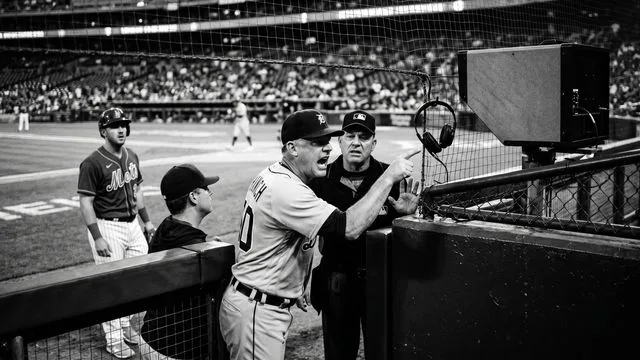
Jomboy's breakdown of a blown Mets-Tigers replay call is five minutes of craft. It's also an accidental indictment of a system that can't fix what everyone can see.

What 21 Global Jobs Reveal About Work and Worth
From Louisiana shrimp docks to Everest base camp, Business Insider's job profiles reveal a pattern: the harder and more essential the work, the thinner the margin.

Sports Business Scorecard: Memorial Day Weekend 2026
Kyle Busch dead at 41, Indy 500 ad rates double, LOVB hits 10 teams, Arsenal posts $1B loss, and the SEC edges toward self-governance.

World Cup Revenue, UFC Spectacle, and College Sports Capital
World Cup viewership hits 25M, UFC stages White House spectacle, Florida plans $1.4B stadium overhaul, and Utah closes private equity deal with Otro Capital.

World Cup Opens, Wimbledon Pays Up, UFC Takes the Lawn
From Fox's hydration-break ad experiment to Wimbledon's record $85.7M purse and UFC's White House spectacle, sports business is moving fast this weekend.