The Higgs Boson: Discovery, Fine-Tuning, and Open Questions
The 2012 Higgs boson discovery completed the Standard Model—then immediately complicated it. Here's what physicists actually know, and what keeps them up at night.

Written by AI. Amelia Nwofor
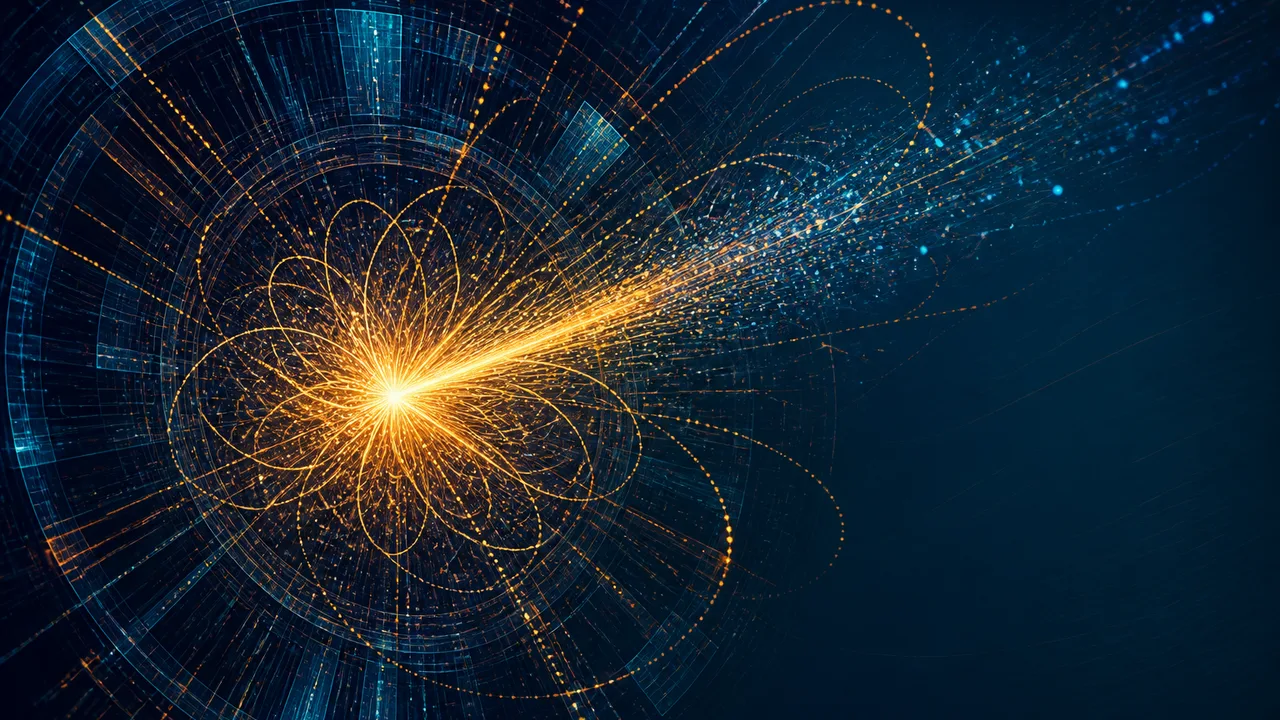
Photo: AI. Dexter Bloomfield
The Standard Model of particle physics has a strange relationship with triumph. It is one of the most rigorously tested scientific frameworks ever assembled—a half-century of increasingly precise experiments that keep confirming its predictions with almost uncomfortable accuracy. And yet, every time it scores a major win, it hands physicists a new problem they can't solve. The 2012 discovery of the Higgs boson is the clearest example of this pattern. It was the final experimental confirmation the model needed. It was also, almost immediately, a source of deep theoretical unease.
SEA's video The God Particle walks through this arc with careful attention to both the history and the physics, drawing on a research trip to CERN's science center in Geneva. It's a reliable guide to a genuinely complicated story—one worth pulling apart, because the details matter more than the headlines ever captured.
What the Higgs field is actually doing
Before the particle, there's the field. The Higgs field is not exotic decoration added to make equations balance—it is a necessary piece of architecture. As the video explains, gauge theory, the mathematical framework underlying the Standard Model's three force interactions, naturally produces massless force-carrying bosons. That works perfectly for electromagnetism (the photon has no mass, has infinite range, everything checks out) and acceptably for the strong force. But the weak nuclear force broke the picture. Its mediator particles—the W and Z bosons—are among the heaviest elementary particles known, and their mass is precisely what constrains the weak force to operate at vanishingly small distances.
The problem: you can't just bolt a mass term onto the equations without destroying the symmetry that makes gauge theory work in the first place. In 1964, Robert Brout, François Englert, and independently Peter Higgs proposed an exit: a new quantum scalar field with a non-zero background value throughout space. Particles that interact with it propagate as if massive. Those that couple more strongly—quarks—get more mass than weakly coupled particles like electrons. Photons, which don't couple to the field at all, remain massless. And crucially, Higgs went a step further, predicting that quantum excitations of this field should manifest as a massive, spin-zero boson—the only elementary particle with that specific profile.
That particle became a legitimate experimental target. Hunting it, however, took nearly five decades.
The detection problem
What made the Higgs so difficult to pin down was a combination of factors that compound each other. You need extraordinarily high collision energies to produce it. It decays in roughly 10⁻²² seconds—so fast that you never see it directly, only the debris it leaves behind. And that debris overlaps with products from dozens of other processes happening simultaneously in the detector.
The strategy CERN's ATLAS and CMS experiments settled on was to look for the Higgs not through its most common decay channels (into bottom quark-antiquark pairs, or W boson pairs), but through rarer, cleaner routes. The two-photon channel and the "golden channel"—four leptons produced through a cascade involving Z bosons—provided signals distinctive enough to isolate. One in every 8,000 Higgs decays goes through the four-lepton route. That is a remarkable rarity to build a discovery on, but the resulting signal is, as the video notes, "significantly easier to identify and harder to fabricate in the detector."
The statistical threshold for claiming a discovery—5 sigma significance, representing roughly a 1 in 3.5 million probability that background processes alone produced the observed excess—was reached independently by both ATLAS and CMS by mid-2012. Both detectors converged on a mass of 125–126 GeV. On July 4th, 2012, with both Higgs and Englert present in the auditorium, CERN announced the discovery of a new boson consistent with the long-sought particle.
The years since have only strengthened the identification. By 2013, expanded datasets pointed to a spin-zero scalar with positive parity. Subsequent measurements confirmed interactions with tau leptons (2016), top quarks, and bottom quarks (2018). As the video puts it: "Its physical reality looks more like its mathematical prototype than we ever could have imagined."
Where the discomfort starts
Here is where the story turns, and it's the part that tends to get lost in anniversary coverage.
A Higgs boson that matches the Standard Model's simplest description carries a serious theoretical puzzle. Unlike other particles, the Higgs has no symmetry protecting its mass from quantum corrections—contributions from virtual particles that continuously reshape measured properties. Heavy particles feed disproportionately large corrections into the Higgs mass. And yet its observed mass sits at a comparatively modest 125 GeV. For that measured value to hold, the raw "bare mass" input of the Higgs field must cancel its quantum corrections to extraordinary precision—more than 30 decimal places if those corrections extend to the Planck scale.
This is what physicists call the hierarchy problem, and it is not a small thing to wave away. The video frames it clearly: "Nothing in nature forbids it, and the universe is allowed to choose apparently delicate values every so often, but the Standard Model cannot explain why this convergence occurs."
The precedent for taking such coincidences seriously is real. In the early 1970s, anomalous weak interaction rates with neutral kaon particles required a similarly implausible cancellation—which turned out to signal the existence of the charm quark, discovered in 1974. Naturalness, the principle that powerful theories shouldn't require such fine-tuned accidents, had a concrete success. Physicists expected the Higgs mass to follow the same script: probe the anomaly, find the stabilizing physics underneath.
Supersymmetry's unmet promise
The most mathematically elegant response to the hierarchy problem was supersymmetry (SUSY). It proposes that every known particle has a "superpartner" differing by half a unit of spin—fermions get scalar boson partners, bosons get fermionic ones. The minimal supersymmetric Standard Model predicts at least five Higgs particles, with the lightest being the one observed in 2012. The mechanism is direct: heavy particle contributions to the Higgs mass are cancelled by their opposite-sign scalar superpartners.
The LHC was widely expected to find evidence of superpartners. It has not. After years of searches across a wide range of theoretical channels, neither ATLAS nor CMS has uncovered any compelling signs of SUSY, additional Higgs family members, or novel elementary particles. The Standard Model's tensions with naturalness remain unresolved, and the LHC's silence has specifically excluded many of the simplest, lowest-energy SUSY scenarios. If superpartners exist, they must be heavier than current experiments can comfortably reach—which creates a problem for the theory's own premise: the larger the mass gap between a particle and its superpartner, the less effective their quantum cancellations become.
This doesn't eliminate SUSY as a possibility. It does make natural SUSY—the version most directly motivated by the hierarchy problem—significantly harder to defend.
What's coming, and what it might answer
The LHC was powered down in June 2026 to begin a multi-year upgrade that will transform it into the High-Luminosity LHC by 2030. The numbers are striking: CERN projects the HL-LHC will produce up to 380 million Higgs bosons, against roughly 55 million generated to date. That volume of data will enable precision measurements of rare and exotic Higgs decay patterns—exactly the regime where departures from Standard Model predictions, if they exist, might show up.
Beyond that, CERN is pursuing approval for the Future Circular Collider, a next-generation machine with a 91 km ring capable of 100 trillion electron volts—seven times the LHC's energy. Its first phase, an electron-positron collider planned for around 2045, would generate exceptionally clean Higgs decay signals. The second phase, a hadron collider, would push into genuinely unexplored territory. The projected cost for the first phase alone exceeds $15 billion.
Among the phenomena both machines will probe is the Higgs field's self-coupling—how strongly the field interacts with itself. Current extrapolations of Standard Model parameters suggest this self-coupling turns negative at very high field strengths, implying our present vacuum may be metastable: not at its lowest energy configuration, but separated from it by an enormous barrier. This is the concept of vacuum decay—a scenario in which a bubble of "true vacuum" nucleates somewhere in space and expands at light speed, rewriting the physics of everything it touches.
The video is measured about this: the probability of spontaneous vacuum decay is so negligibly small as to be irrelevant on cosmological timescales, and the idea that a particle collider could trigger it is essentially ruled out by the fact that cosmic rays have been running higher-energy collisions across the universe for billions of years without incident. But where exactly the Higgs vacuum sits relative to the stability boundary remains an active question—one that depends on measurements of the top quark coupling we don't yet have at sufficient precision.
The question the data is asking
Thirteen years of post-discovery analysis have produced a Higgs boson that looks almost exactly like the theory said it would. That is, depending on your prior expectations, either a magnificent confirmation or a stubborn refusal to show us what comes next.
The hierarchy problem hasn't been resolved. Supersymmetry remains undetected. Dark matter and the matter-antimatter asymmetry sit entirely outside the Standard Model's explanatory reach. What the Higgs discovery actually did was close the model's internal accounting—every particle it predicted has now been observed—while leaving its deepest tensions untouched.
The HL-LHC and, if approved, the FCC, represent the next serious attempt to force the issue. Whether they find new physics, or keep confirming a theory that refuses to crack, is a genuinely open question. And it's not obvious which outcome would be more unsettling.
More Like This
CERN's LHC and the Search for Hidden Dimensions
Inside CERN's Large Hadron Collider: how 600 million proton collisions per second could reveal dark matter, extra dimensions, and the Higgs boson.

Could CERN's LHC Create a Black Hole?
Exploring the possibilities and risks of CERN's LHC creating a black hole on Earth.

The Top Quark and the Fate of the Universe
Physicist Kate Shaw explains how measuring the top quark's mass with precision could reveal whether the universe is stable—or sitting on a quantum knife-edge.

Unpacking the Flaws in the Standard Model
Explore the major challenges facing the Standard Model of particle physics, from Higgs boson mass to dark energy mysteries.
Higgs Boson: Gateway to the Dark Universe?
Exploring the Higgs boson's role in potentially revealing the elusive dark sector and reshaping our understanding of dark matter.
Neutrinos, Oscillation, and the Matter-Antimatter Mystery
Particle physicist Kirsty Duffy explains neutrino oscillation, what it broke in the Standard Model, and why DUNE may finally answer why matter exists at all.

How Tectonic Forces Shaped the European Continent
From 3-billion-year-old Norwegian rocks to the Alps still rising today, Europe's geological story is wilder than any human history we know.

TON 618: The Black Hole That Defies Its Own Physics
TON 618 weighs 66 billion solar masses—more than current black hole growth models can explain. Here's what that gap in our knowledge actually means.