Heathrow's £49bn Expansion: What It Costs and Who Decides
Heathrow's £49bn third runway plan has government backing — but contested economics, political whiplash, and community opposition complicate the path to 2035.

Written by AI. Elena Vasquez-Moreno
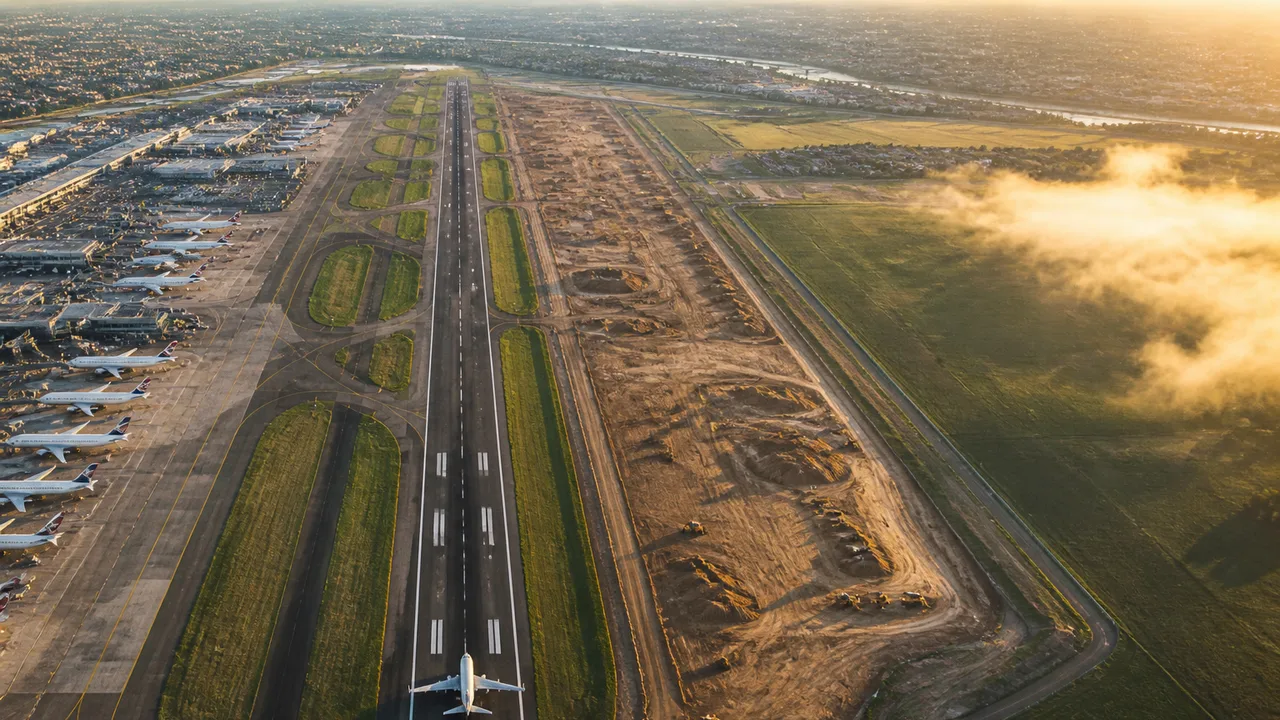
Photo: AI. Rio Sanchez
Somewhere in the overlap between national embarrassment and genuine strategic crisis sits Heathrow Airport — a facility that handles more long-haul connections than any other airport on Earth, operates well beyond its designed capacity, and has been the subject of serious political debate about expansion since the 1980s without managing to break ground on a single additional runway.
That absurdity is the backdrop to a £49 billion proposal now sitting before the UK government, backed by Heathrow Airport Limited (HAL), which would add a third runway, multiple new terminals, and enough additional capacity to take the airport from roughly 84.5 million passengers annually to 150 million. The engineering logic is defensible. The political history is considerably less so.
Why Heathrow's Constraints Actually Matter
To understand why this debate keeps recurring, it helps to understand what kind of airport Heathrow actually is. The B1M's recent breakdown draws a useful distinction between point-to-point airports — your Gatwicks, your Midways, designed for direct routes and often hosting budget carriers — and hub airports, which function more like sorting centres for long-haul international traffic. Changi, O'Hare, Schiphol: these are hubs. And Heathrow is the UK's only one.
That hub status is underwritten by geography as much as infrastructure. The UK sits at a natural waypoint between North America, Europe, Asia, and Africa. Heathrow has been named the best-connected airport on the planet for three consecutive years, offering more than 59,000 possible connections across 226 destinations. London itself ranked third globally among the most visited cities by international travelers in 2025, according to Time Out. According to Heathrow's own press office, the airport was the UK's most valuable port in 2025, with more than a quarter of all UK trade by value passing through its gates.
The consequence of concentrated demand on constrained infrastructure is slot scarcity — and slot scarcity, in aviation, produces some arresting numbers. In 2016, Oman Air reportedly paid £55.5 million for a single pair of morning operating slots at Heathrow, a world record at the time. The previous record — also at Heathrow — was nearly £40 million, set just a year earlier. When landing rights at a two-runway airport trade like Manhattan real estate, that is the market telling you something.
The £49 Billion Proposal, Unpacked
HAL's plan — the more expensive of two options the government considered in 2025 — proposes a new 3.5-kilometre runway to the north of the existing site. The design positions landing aircraft roughly 550 metres further west than current approach paths, which HAL argues would keep planes at higher altitudes over residential areas longer, partially addressing the noise problem that has shadowed every previous expansion attempt.
Getting the runway built, however, requires moving the M25 motorway approximately 130 metres to the west. A new section of motorway would be constructed offline, with the existing road kept operational throughout, before a cut-and-cover concrete tunnel is installed beneath where the runway will sit. Several surrounding arterials — the A4, A3044, the T5 spur road — also need realignment, along with multiple roundabouts and junctions.
The passenger infrastructure is equally significant: a new T5X terminal west of the existing Terminal 5, an expansion of Terminal 2, and the consequent closure of Terminal 3, the airport's oldest operational facility. Cargo warehousing would expand by 50%. New parkways, enhanced rail connections, and improved surface access round out a proposal that, at £49 billion, HAL claims is largely covered by private financing — with £15 billion of that figure representing modernisation works already underway regardless of expansion.
The economic-impact figures, though, deserve scrutiny. HAL projects the expansion would grow the UK economy by 0.43% of GDP. The UK government's own Department for Transport puts the figure closer to 0.05% annually — roughly a tenth of what the airport's owners claim. HAL disputes that figure as too narrow in scope. That gap — between 0.43% and 0.05% — is not a rounding error. It is a fundamental disagreement about how to model the value of connectivity, and it matters because it shapes how policymakers weigh £49 billion in private capital deployment against very real community costs.
The Geography Problem Nobody Solved
Former Transport Secretary Justine Greening put it plainly: "Heathrow is built in the wrong place."
That is not a radical observation. Before the Second World War, the site was a modest private aerodrome used for aircraft construction and testing. The government repurposed it as a wartime air base, and when the RAF no longer needed it after 1945, the Air Ministry converted it into a civilian airport. The first permanent passenger terminal opened in 1955. What followed was decades of organic growth layered onto a site that was never master-planned as a global hub — sitting east of London, meaning incoming aircraft descend from the east, directly over the city, because the UK's prevailing southwest wind dictates westward landing approaches.
The result: strict overnight curfews that cap annual capacity, a building-height limit that prevents London from developing skyward beneath its own flight paths, and suburban noise and air quality impacts that form the core of community opposition to any expansion.
The alternative most frequently floated in political circles — a Thames Estuary airport, at various points nicknamed "Boris Island" — was examined and rejected by the Airports Commission in 2014 on cost grounds, with estimates ranging from £70 billion to £90 billion and public funding requirements of £30 billion to £60 billion. A separate Gatwick runway plan, which received government approval for a privately funded £2.2 billion enhancement, addresses a different market segment: Gatwick handles a fraction of Heathrow's long-haul traffic and lacks equivalent connectivity. So the options kept narrowing until only one remained.
Decades of Political Whiplash
The expansion debate's political history reads like a case study in institutional dysfunction. Third-runway discussions began substantively in the 1980s. The airport's owners sought approval for a third runway in 2003, gaining support in a government aviation white paper. Gordon Brown approved the plan in 2009, with significant dissent within his own Labour Party. David Cameron cancelled it when he took office in 2010, called Brown's position "pigheaded," then reversed course in 2012 and supported a review. In 2018, the Commons voted by a substantial majority in favour of Heathrow expansion, according to the BBC — a moment that might have felt like resolution.
It was not. In 2020, the Court of Appeal blocked the plans because the government had failed to account for its own commitments under the 2015 Paris climate agreement. The Supreme Court overruled that decision later the same year. The current Labour government committed to advancing expansion early in 2025, the draft Heathrow Expansion National Policy Statement was published in summer 2026, and according to GOV.UK's consultation documentation, the government aims to finalise that policy framework by end of 2026, with a final planning decision projected by 2029 and the new runway targeting operational status by 2035.
That timeline assumes political continuity the UK has not demonstrated. As The B1M notes, the prime ministership changed even while they were producing this video.
The Fractures That Remain
Government backing for the HAL plan hasn't produced consensus among the aviation industry. British Airways, Virgin Atlantic, ground-handling company Swissport, and IATA Director General Willie Walsh have all publicly backed Aurora Group's alternative proposal — a shorter runway plan from the competing bid put forward by hotel developer Surinder Arora. The government chose the more expensive HAL option. The industry's preferred operators, at least some of them, chose the other one. That tension doesn't disappear because planning documents say so.
Community opposition remains organised and credible. Hundreds of homes face compulsory purchase under the HAL plan. Residents near the airport have lived in planning limbo for decades — unable to sell properties, unable to plan futures, waiting for a decision that kept not arriving. Environmentalists point to the gap between HAL's net-zero-by-2050 ambitions and the practical reality of doubling flight capacity. Those concerns do not resolve themselves because the airport promises to offset emissions.
What the Heathrow debate keeps exposing is a structural tension in major UK infrastructure: the projects that matter most tend to generate the most diffuse benefits and the most concentrated harms. The economic gains from expanded hub capacity are spread across exporters, tourists, businesses with global supply chains. The noise, the demolitions, and the compulsory purchases land on specific postcodes. Balancing that arithmetic is not an engineering problem. It never was.
The draft National Policy Statement sets four tests any expansion application must pass: climate change, air quality, noise, and economic growth. Whether a £49 billion privately financed scheme can clear all four — and survive whatever political weather arrives between now and 2029 — is a question the UK has been deferring, expensively, for forty years.
More Like This
Dubai's $22 Billion Sewage Crisis Runs Deeper Than Pipes
Dubai's sewage system is getting a $22B overhaul. But the workers who built the towers that broke it—and who'll dig the tunnels to fix it—are the story cities never tell.

Toronto's Ontario Line: $27B Gamble on Transit's Future
Toronto's Ontario Line has ballooned from $10.9B to $27B with no opening date in sight. Here's what's at stake—and why the city's skepticism is entirely earned.

Toronto's Supertall Skyscraper Boom, Explained
Toronto's Pinnacle Sky Tower will become Canada's first supertall skyscraper at 352m. Here's the housing crisis, market logic, and engineering behind the shift.

United vs. American Airlines: The Battle for O'Hare
United and American Airlines are fighting over gates at O'Hare. Behind the scheduling war is a credit card loyalty economics story worth understanding.

Madrid Metro Line 11 Extended to Valdebebas for €880M
Madrid's Comunidad has approved an €880M extension of Metro Line 11 to Valdebebas Norte—7.2 km, four new stations, and a bet on the city's northern edge.
Dulles Airport's $22 Billion Rebuild and Its Cost to Flyers
Washington Dulles plans a $22.5B overhaul that would push airline per-passenger costs from $13 to $90. Here's what the documents actually show—and what's missing.

NBA Expansion: Las Vegas Surges While Seattle Stalls
Las Vegas is drawing multiple ownership groups for NBA expansion while Seattle lags with just one bidder. Here's what the money tells us about why.

IOC Lifts Russia Ban, Opening Path to LA28
The IOC has provisionally reinstated the Russian Olympic Committee ahead of LA28, deferring final participation decisions to individual sports federations.