Toronto's Ontario Line: $27B Gamble on Transit's Future
Toronto's Ontario Line has ballooned from $10.9B to $27B with no opening date in sight. Here's what's at stake—and why the city's skepticism is entirely earned.

Written by AI. Margaret "Maggie" Holloway
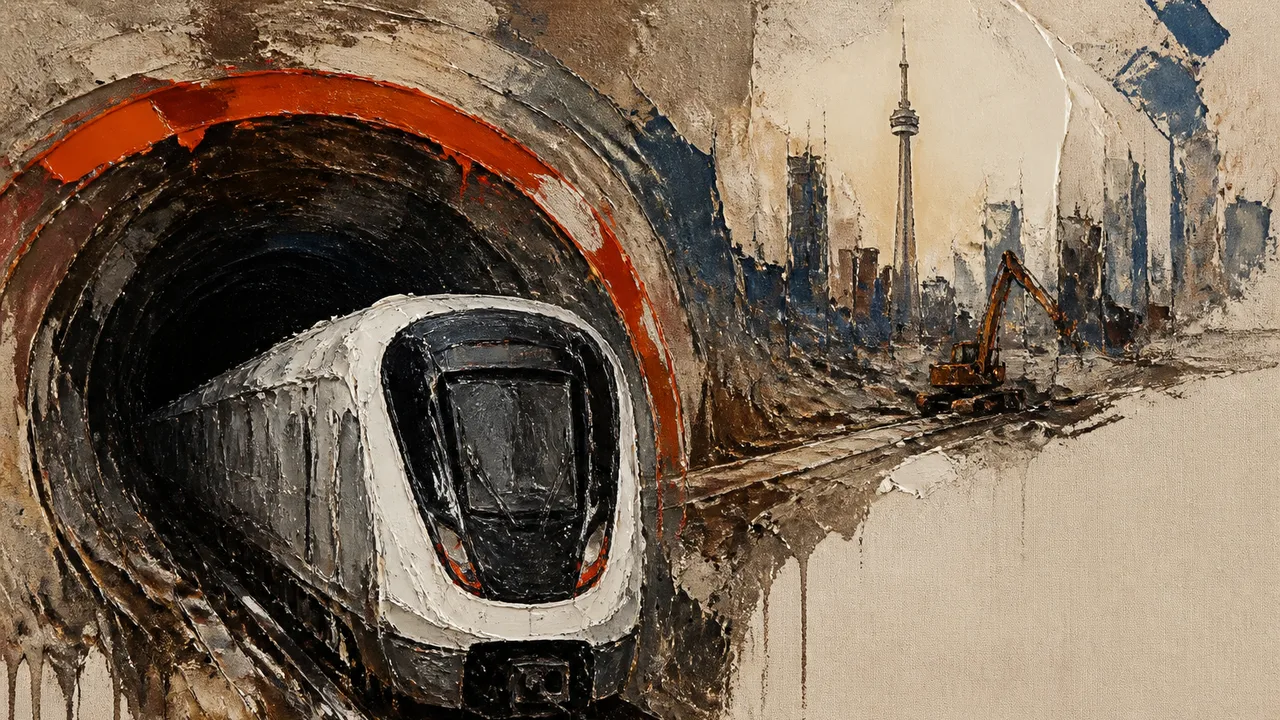
Photo: AI. Saskia Aaltonen
There is a particular kind of civic exhaustion that sets in when a city has been promised the same thing enough times. Toronto has earned that exhaustion. The Eglinton Crosstown LRT took fifteen years to build and opened six years late. The Finch West LRT, which debuted in late 2025, was beaten in a race from end to end by a jogger—who arrived eighteen minutes ahead of the train. Against this backdrop, the Ontario Line, a 15.6-kilometre subway cutting through the heart of downtown, is asking Torontonians to believe once more.
The numbers alone are enough to give pause. When the province broke ground in 2022, the Ontario Line carried a price tag of roughly $10.9 billion and a completion target of 2027. Four years later, that budget has grown to $27 billion, the civil infrastructure completion has slipped to the early 2030s, and—notably—no specific opening date has been announced for the actual service. That last detail is not an oversight. It is a choice.
The Problem Predates the Project
To understand what's happening with the Ontario Line, you have to understand what happened to Toronto long before anyone drove a tunnel-boring machine under Queen Street. The city's growth has outrun its infrastructure for decades. Toronto's population sits at roughly six million today and is projected to reach ten million by 2050, making it one of the fastest-growing urban regions in North America. Hundreds of thousands of people commute in from sprawling suburbs each day—suburbs that exist partly because old housing laws discouraged density on the urban fringe, pushing development outward rather than upward. The jobs stayed downtown. The houses kept moving further away. The roads filled up.
That's the physical problem. The structural problem is arguably harder to solve. Canadian cities own approximately 60 percent of the country's core infrastructure but receive somewhere between eight and ten cents of every tax dollar collected. The resulting national infrastructure deficit sits anywhere between $110 billion and $270 billion, depending on whose estimate you trust. Transport Canada has projected that $284 billion needs to be spent upgrading rail services by 2070 alone. As one observer put it in the B1M's recent video on the project, "The cities in Canada are basically handcuffed. Local governments own about 60% of the country's core infrastructure, but receive just 8 to 10 cents of every tax dollar." That's not a construction problem. That's a constitutional one.
The Project That Was Cancelled to Make Way for This One
What makes the Ontario Line's cost trajectory particularly awkward is that there was a cheaper predecessor. The Toronto Transit Commission, with provincial backing, had spent years and millions developing a Downtown Relief Line that followed a similar corridor with eight stations. Cost estimates had risen to roughly $8.3 billion—a figure that government officials acknowledged would likely climb—before then-Toronto city councillor Doug Ford became Premier of Ontario in 2018 and his government scrapped it in 2019.
The replacement was bigger: 15 stations instead of eight, seven kilometres longer, and guided by Metrolinx, the provincial agency that now controls major transit construction in the region. The logic was consolidation and speed. Centralize the decision-making, eliminate the back-and-forth between city and province, build faster and more efficiently. The result, so far, has been a project that cost two and a half times its original estimate and has no confirmed opening date.
The governance question this raises is live and contested. Critics argue that provincial takeover removed the people who actually know the city from the people who control the money. "In comes the province which has its own agenda and its own lack of expertise and says, 'Well, we know what's best for you, city of Toronto,'" one observer noted in the B1M video. "There's a lot of animosity in the city of Toronto against Metrolinx. So people's backs have been up right from the very beginning."
Metrolinx CEO Michael Lindsay's counter-argument, offered in February, is that cost overruns on major infrastructure are not a uniquely Canadian phenomenon—they are a feature of the English-speaking world's construction environment right now. That is factually defensible. Major rail projects in the United Kingdom, the United States, and Australia have all experienced similar trajectories in recent years. Whether that constitutes an explanation or an excuse depends on what you think governments owe their citizens when they take on projects of this scale.
What's Actually Being Built
The engineering story is genuinely interesting, whatever you think of the politics. More than half the route runs underground through downtown's dense urban core, where specialized earth pressure balance tunnel boring machines are being used—these are more sensitive instruments than standard hard-rock TBMs, designed to control ground pressure and prevent surface settlement in Toronto's mixed soil conditions.
Above ground, roughly three kilometres of elevated guideway will carry trains up to fourteen metres in the air. This is partly an aesthetic choice and partly a pragmatic one: in the Don Valley section, tunnelling would require stations to sit seventy metres below the surface. The elevated alternative is cheaper, faster to construct, and avoids the geological complexity of drilling that deep. The tradeoff is that elevated rail through residential neighbourhoods is loud, and it's permanent.
Six of the fifteen stations will be interchange points, connecting to GO Transit, existing TTC subway lines, and the Eglinton Crosstown. Five existing stations are being expanded. Five brand-new underground stations will be built thirty to forty metres below street level. When it's finished—whenever that is—it is projected to bring 230,000 people within walking distance of transit, accommodate nearly 400,000 daily boardings, and remove 28,000 car trips from city streets every day.
That's not a modest claim. If those projections hold, the Ontario Line would be genuinely transformative for how Toronto moves.
The Trust Deficit
The problem isn't engineering. The problem is credibility. NDP leader Marit Stiles has described the project as a potential "boondoggle" with costs that appear to have no ceiling. Residents along the construction corridor are living with noise, road closures, and the particular disorientation of watching a neighbourhood get taken apart for a benefit that keeps getting pushed further into the future.
There is something uncomfortable about the fact that the Eglinton Crosstown—the project that took fifteen years and opened six years late—is now being cited as a relative success story because it runs reasonably well. That's the bar. Not "did it come in on time and on budget" but "does it actually work."
The Ontario Line will have to clear a higher bar than that. Not because Torontonians are unreasonable, but because the institutional trust required to absorb this level of disruption has been spent. The first line down Yonge Street was disruptive too—businesses went under, residents were furious—and now the city couldn't function without it. That historical parallel is true and worth holding. It's also a long way from where Toronto is standing right now, watching a $27 billion project with no opening date and an agency that, as one commentator noted, has "a lot of credit in the bank" to spend—except the bank account is empty.
The question Toronto is actually living with isn't whether the Ontario Line will eventually be worth it. It probably will. The question is whether the institutions responsible for building it have the competence, the accountability, and the remaining public goodwill to get there.
More Like This

GoFundMe's CPTO on Marketplace Failure & AI Growth
GoFundMe's CPTO Arnie Katz breaks down 3 marketplace failure modes and how AI agents are driving real revenue—not just dev productivity.
Dubai's $22 Billion Sewage Crisis Runs Deeper Than Pipes
Dubai's sewage system is getting a $22B overhaul. But the workers who built the towers that broke it—and who'll dig the tunnels to fix it—are the story cities never tell.
Wall Street Knew the Crash Was Coming. Saying So Got You Fired.
Jeremy Grantham's famous poll revealed 398 analysts knew the dot-com crash was guaranteed. A 2003 study shows why none of them said so publicly: accuracy cost careers.
Berlin's Tegel Airport: Built in 90 Days, Abandoned at Last
Berlin's Tegel Airport was built in 90 days during the Cold War. Now abandoned, its layered history—from airlift to hexagonal icon—raises urgent questions about memory and renewal.

Russia's Disinformation Playbook Hits Main Street
Storm-1516's AI deepfake operation isn't just geopolitics—it's the same smear playbook that's been destroying small businesses for years. Here's what you need to know.

Canada Strong Fund: What Retail Investors Need to Know
Canada's new sovereign wealth fund sounds appealing — but before you invest your savings, here's what the government hasn't told you yet.

The Invisible Inventions That Built Modern Life
From flush toilets to undersea fiber cables, the inventions that most shaped modern civilization are the ones we've stopped noticing entirely.
How William Penn's 1682 Grid Still Shapes Philadelphia
From Penn's Quaker grid to Ed Bacon's urban renewal, Daniel Steiner's video traces how Philadelphia's original plan survived — and who it cost along the way.