Dulles Airport's $22 Billion Rebuild and Its Cost to Flyers
Washington Dulles plans a $22.5B overhaul that would push airline per-passenger costs from $13 to $90. Here's what the documents actually show—and what's missing.

Written by AI. Priya Chandrasekaran
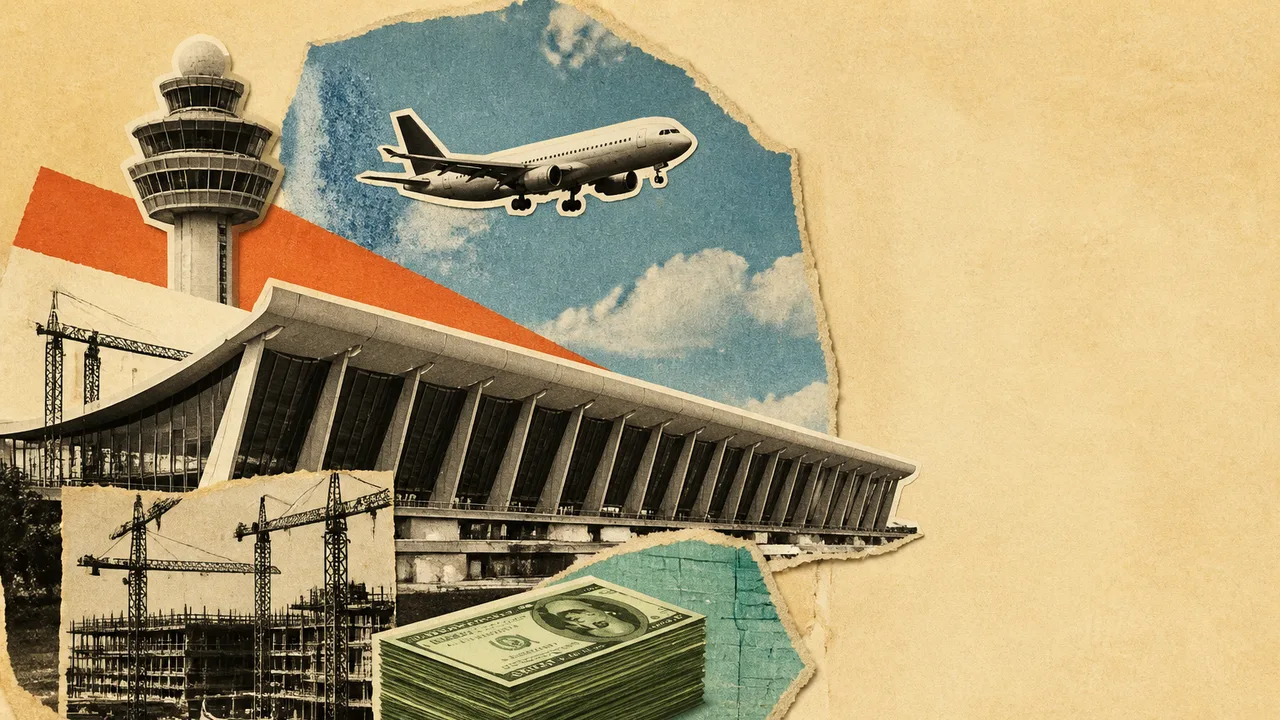
Eero Saarinen designed Washington Dulles as a machine for optimism. When it opened in 1962, the main terminal — that swooping concrete wave, those sixteen soaring columns — was a statement about what America thought the future of travel would look like. Flying was still an event. A transatlantic ticket, as Fast Company has documented in its history of commercial aviation's golden age, cost what few middle-class families could spare. The airport itself was the destination before the destination.
Now the Metropolitan Washington Airports Authority wants to tear most of it down — or at least the additions layered over and around Saarinen's bones — and rebuild Dulles from the ground up for roughly $22.5 billion. The price tag on your ticket, if you fly through that rebuilt airport, would reflect that ambition directly.
According to Simple Flying, the MWAA recently voted on a $15.5 billion rebuild project that could push per-passenger airline costs from the current $13 to as high as $90 — a 600 percent increase. View from the Wing puts the starting figure at $12.77 and confirms the same $90 ceiling, with the headline observation that the plan "delivers less" while costs sextuple. The full program price, as InsideFlyer reports, reaches $19.91 billion — nearly $20 billion, nearly all of it debt-financed, with construction extending into the 2040s.
That debt structure is worth sitting with. View from the Wing reports the project is 99% financed with debt, pushing major construction into at least 2039. This is not unusual for large airport projects — airports rarely have the cash reserves to self-fund infrastructure at this scale — but it does mean that the $90 per-passenger figure isn't an abstract projection. It's the math of debt service, and it lands on airlines, who then decide whether to absorb it, pass it to passengers, or quietly redirect routes to airports where the operating economics make more sense.
What the plans actually include — and exclude
D.C. travel writer Edward Russell obtained the MWAA's internal revitalization plan and reported on it exclusively through his Airport Architecture Substack. The vision, as he describes it, includes a terminal expansion, four new linear concourses, and new subterranean circulation infrastructure. What it does not include: the Direct Jet system — the people mover technology that has been part of the Dulles transit conversation for years.
Travelers Today confirms that the renovation ditches the people movers entirely, and quotes an aviation analyst who notes that the arrangement could raise per-passenger costs for airlines operating at Dulles from $9.56 today to more than $90 — a level, the analyst says, that would effectively reshape the airport's competitive position. InsideFlyer adds that the construction timeline omits key promised elements including a parking garage.
This is the detail that sharpens the story. A $22.5 billion project that drops the people movers, delays the garage, and pushes completion into the 2040s is a different kind of project than the one that might have been sold to the public. Axios Washington D.C. reports that per-passenger costs are projected to reach $90.64 — the precision of that figure, six cents past ninety dollars, has the quality of a financial model rather than a political promise. What that number represents in terms of project milestones versus final completion remains unclear in the available documents; the timelines reported across multiple sources range from the mid-2030s to the 2040s, and the relationship between specific cost projections and specific completion phases has not been publicly resolved.
The naming question deserves more than a footnote. The project has been informally branded the "Trump Terminal" — a label that, like most political christenings of infrastructure, says more about the moment than the building. You can see it in the physical: an airport named for one president (Dulles served as Eisenhower's Secretary of State), now getting a terminal gesture toward another. Dulles International sits beneath the flight path of official Washington, where every runway is also, in some register, a stage. What the name actually commits anyone to, in terms of design, funding guarantees, or federal involvement, is not established in the available reporting. What it does, unmistakably, is tie the project's political fortunes to a particular name at a particular moment — which is either an asset or a liability depending on which way the wind blows in any given budget cycle.
The competitive geography problem
Here is the tension that the cost projections don't fully capture: Dulles already operates in a complicated competitive relationship with Reagan National, which sits significantly closer to downtown Washington and consistently attracts the business travelers and frequent flyers who keep routes profitable. The logic of Dulles has always been that it offers capacity — room for the long-haul international routes, the wide-body aircraft, the volume that Reagan's footprint cannot absorb. That logic holds as long as operating at Dulles is economically reasonable for airlines.
When per-passenger costs sextuple, airlines face a choice that has nothing to do with architecture. View from the Wing frames this directly: higher costs push carriers toward airports where the math works better. An airport can build gleaming new concourses and still find itself with fewer routes if the cost structure drives away the carriers who were filling those gates. Saarinen's terminal was a statement about optimism; a half-empty terminal with a debt-financed price tag is a different kind of statement.
This is what makes the financing structure — 99% debt — the actual center of the story, more than the architecture or the naming. Debt-financed infrastructure is standard practice. But when the debt service is this large relative to current passenger volumes and current revenue, the model depends on a bet: that traffic will grow enough, and quickly enough, to spread those costs across enough passengers to keep airlines from making the calculation that Dulles simply isn't worth it.
That bet might be correct. Washington Dulles handles substantial international traffic, and the D.C. metro area continues to grow. A genuinely modernized airport — better connectivity, more gates, improved passenger flow — could attract more carriers and more routes, which would naturally soften the per-passenger cost as volume increases. The case for the investment is real.
The case for scrutiny is also real, and it lives in the same documents: a project that is already dropping promised elements, already pushing timelines into the 2040s, already projecting costs that would make Dulles one of the most expensive airports in North America to operate from. When a financial model rounds to $90.64 per passenger, someone has done very careful arithmetic. The question is whether the assumptions underneath that arithmetic will survive contact with a decade or more of construction, interest rate movement, and airline decision-making.
Saarinen built Dulles to feel like flight itself — all forward momentum, all lift. The plan to rebuild it will be tested not by its ambition, but by how honestly it accounts for what it's leaving behind.
More Like This

Small Group Italy Tours Are Reshaping Travel
Small group Italy tours promise authenticity over crowds. But do they deliver — and at what cost to the communities they claim to honor?
Qantas A350 Flies 24 Hours Nonstop: What It Means for You
A Qantas Airbus A350-1000ULR just flew Melbourne to Toulouse in 24 hours 24 minutes. Here's what that test flight record actually means for real passengers.
United vs. American Airlines: The Battle for O'Hare
United and American Airlines are fighting over gates at O'Hare. Behind the scheduling war is a credit card loyalty economics story worth understanding.
A New Object in the Sky: The JetBlue Drone Strike
A JetBlue pilot reported hitting a drone on approach to JFK. What the incident reveals about airspace rules built before drones existed.
France Tests Low-Cost Rail Signalling for Rural Lines
France's NS2F consortium is trialling digital signalling tech to cut rural rail costs by 30%. Here's what's at stake for the towns trains forgot.
Delta's 2026 Profit Bet Rides on High Airfares Holding
Delta reaffirmed its 2026 earnings forecast despite fuel volatility—but the plan depends on keeping fares high for customers it says can afford it.
Tauck's Seine River Cruise: What $10,000 Actually Buys
Travel + Leisure boards Tauck's MS Serene for a nine-night Seine cruise. Here's an honest look at what luxury river cruising delivers — and what it costs.
The Best US Airport Lounges Worth Visiting in 2026
Jeb Brooks visited 50+ US airport lounges to rank the top 10. Here's what his scoring reveals about access, value, and the lounge arms race.