The Best US Airport Lounges Worth Visiting in 2026
Jeb Brooks visited 50+ US airport lounges to rank the top 10. Here's what his scoring reveals about access, value, and the lounge arms race.

Written by AI. Mariel Fontaine
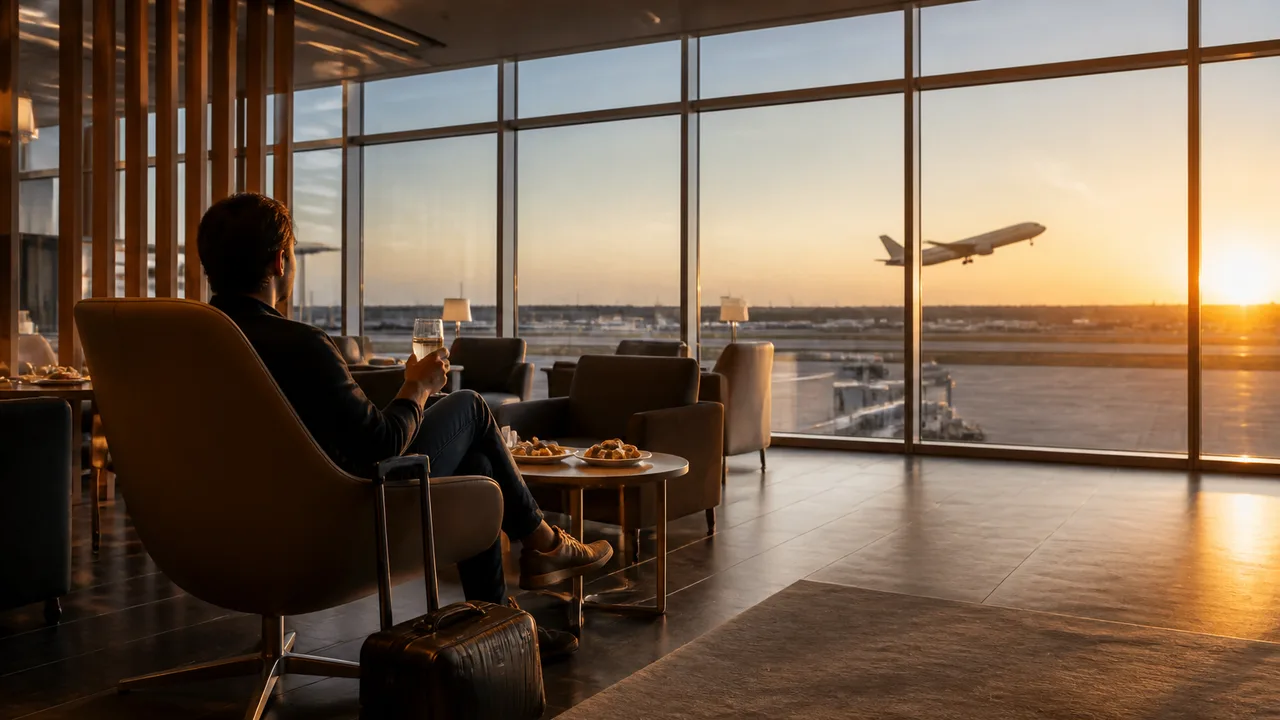
Photo: AI. Asha Kingsley
The airport lounge used to be a fairly simple proposition: fly in a premium cabin or hold the right card, and you get a quiet room, a glass of something passable, and relief from the gate. That compact bargain has quietly collapsed. The lounge landscape in the United States is now a layered, expensive, and frankly bewildering ecosystem of airline clubs, credit card–sponsored showrooms, and ultra-exclusive cabin-specific sanctuaries — each with its own access logic, its own crowding problem, and its own version of what "premium" means.
Travel content creator Jeb Brooks of greenergrass.com spent the better part of a year visiting more than 50 US airport lounges to produce a ranked list of the top 10 worth your time in 2026. His methodology is transparent: seven criteria scored on a three-point scale each, for a maximum of 21 points. Exclusivity, crowdedness, seating, views, food and drink quality, amenities, and vibe/decor. It's a reasonable framework and it produces some instructive results — including a winner that surprised even him.
The scoreboard, briefly
The list runs from the American Express Centurion Lounge in Atlanta at number 10 (12 out of 21) through the American Airlines Admirals Club at Washington National (13 points), the new Delta Sky Club in Atlanta's Terminal D (14 points), and Alaska Airlines' flagship lounge in Seattle (14.5 points). The United Club near Denver's B32 gate earns number six with 15 points. The Capital One Lounge at JFK lands at number five with 15.5.
The top four are where things get genuinely interesting: JFK's Soho Lounge, operated jointly by American Airlines and British Airways, earns 17 points and the "most exclusive" designation on the list. The Chase Sapphire Lounge in Philadelphia ties it at 17.5. The United Polaris Lounge at Newark scores 19. And the Delta One Lounge at JFK scores a perfect 21.
That last result is the one that caught Brooks off guard. "Our top lounge actually surprised us," he notes. "We really thought one of the credit card lounges would pull out on top, but that's just not what happened."
What the credit card lounges get right — and where they fall short
The credit card lounge arms race has been one of the more visible stories in travel over the past few years. Capital One, Chase, and American Express have all invested heavily in proprietary spaces that aren't attached to any single airline, theoretically making them accessible to a broader swath of travelers. The results are genuinely impressive in some respects.
The Capital One Lounge at JFK demonstrates what happens when a financial brand decides it wants to compete on hospitality rather than just access. Individually plated buffet portions, table-service ordering via QR code, a resident cheesemonger offering wine-paired tastings, made-to-order bagel sandwiches out of a bodega setup — it reads more like a food hall concept than a traditional lounge. Access requires either the Capital One Venture X card ($395 annual fee) or a walk-in fee of $90 per person.
The Chase Sapphire Lounge in Philadelphia pushes even further into experience territory. Brooks describes a beer garden with local Pennsylvania drafts, an arcade, a spa with complimentary facial treatments, reservation-only relaxation pods, and a beer garden–exclusive menu that includes a Philly cheesesteak. "This lounge has almost everything you could ever want to pass time in an airport," he observes. Unlimited access comes via the Chase Sapphire Reserve at $795 per year; Priority Pass holders get one complimentary visit annually.
These spaces are genuinely inventive. The tension, though, is that credit card lounges have an access problem baked into their business model. They need to justify the card's annual fee, which means keeping access relatively democratic — and democratic access tends to produce queues. The Centurion Lounge in Atlanta, sitting at number 10, illustrates this vividly: "We've never been to this lounge and not had to get on a wait list," Brooks reports. "I had to work really hard and wait for people to leave in order to briefly find empty seats to film." A card costing $895 per year, a wait list to enter, and crowded seating once inside — that's a difficult value proposition to defend with a straight face.
The airline lounges make a quiet argument for exclusivity
The upper tier of Brooks's list is dominated by airline-operated spaces with genuinely restrictive access, and the correlation between exclusivity and quality is hard to argue with.
The United Polaris Lounge at Newark — the original location, since expanded — earns its 19-point score with a combination of elements: sweeping airfield views, a full sit-down restaurant with a robust menu, shower suites, nap rooms, and a bar with an extensive wine list. It's designed specifically for international business class passengers who want to skip the inflight meal in favor of eating properly before they board. Access requires a full Polaris ticket or business/first class on a qualifying Star Alliance carrier. One important caveat from Brooks: United has begun selling stripped-down "base" Polaris fares that do not include lounge access. Verify what's included before you book.
The Soho Lounge at JFK Terminal 8 — operated jointly by American Airlines and British Airways — sits at number four precisely because it's hard to get into. Entry requires American Airlines Platinum Pro status or higher on an international flight, or Oneworld Emerald status on any flight. The payoff is a space that Brooks describes as genuinely sophisticated: warm wood tones, statement lighting, made-to-order dining, shower facilities, and an atmosphere suited to the long-haul flights it serves.
The Delta One Lounge and the art of the affordable workaround
The Delta One Lounge at JFK's Terminal 4 is not a Sky Club. That distinction matters enormously. It's a cabin-specific lounge accessible only to passengers booked into Delta's transcontinental and international business class product — flights marketed as "Delta 1." The scoring here is unambiguous: a perfect 21 out of 21 across Brooks's seven criteria. Food hall rather than buffet. Full sit-down restaurant with a menu that spans tuna tartare to miso black cod to what Brooks calls "the best burger in aviation right now." A complete art gallery. A wellness area with bookable massage chairs and express treatments. An outdoor patio with close airfield views. Showers.
The access problem is obvious: Delta 1 tickets on long-haul international routes run to thousands of dollars. But Brooks identifies a legitimate workaround. Delta operates Delta 1 on certain transcontinental domestic routes, and fares from Los Angeles to Atlanta in Delta 1 have been found as low as $829 one way. That's still a meaningful sum to pay to visit a lounge, but for someone cross-country anyway, it makes the calculus more defensible.
One caveat worth noting: Delta has reportedly been considering unbundling its business class fares along the lines of what United has done with Polaris, which would potentially strip lounge access from lower-tier Delta 1 tickets. If that happens, the workaround closes.
The question the rankings don't answer
Brooks's framework is useful and his fieldwork is thorough. What the scoring doesn't capture — and what any lounge guide struggles to quantify — is the relationship between access cost and actual use. A Centurion Lounge membership via the Amex Platinum requires $895 per year and still puts you in a queue. The Chase Sapphire Reserve costs $795 annually for unlimited access to a lounge that, in practice, often has a wait. The Delta One Lounge scores perfectly on every dimension but requires either significant flight spend or creative routing to enter.
The honest answer is that the "worth your money" question is personal arithmetic. How often do you fly? Through which airports? In which cabins? Are you paying for the card anyway, for other benefits? The lounge becomes a value-add to an existing travel pattern, not a destination unto itself — with one possible exception.
"These next ones are so good, you might want to book a flight just to see them," Brooks says of the top-tier entries on his list. He means it partly as enthusiasm and partly as practical suggestion. But it also captures something real about where the airport lounge has arrived in 2026: a hospitality product that has, in some cases, become the point of the journey rather than a way station inside it.
Whether that's a natural evolution of the travel industry or a slightly surreal inversion of what airports are actually for is a question probably worth sitting with — ideally in a comfortable chair, with a decent pour, while watching planes push back from the gate.
Mariel Fontaine is the Travel Desk Editor at BuzzRAG.
More Like This
What to Expect When Staying in European Hotels
European hotels operate by different rules than North American ones. Here's what actually differs—room size, beds, breakfast pricing, accessibility, and more.

Blackstone's Career Ladder, From Analyst to Partner
From a $90K analyst seat to Schwarzman's billion-dollar paycheck: how Blackstone's career ladder works—and why private credit is quietly rewriting it.

Dulles Airport's Mobile Lounges Were Never Built for You
Dulles Airport's 1960s mobile lounges were designed for jet-age elites. When flying democratized, regular people inherited a system built for someone else.

The World's Longest Domestic Flights, Explained
From Boston to Honolulu to Paris to Réunion, the world's longest domestic flights reveal how borders, customs zones, and sovereignty really work.
Southwest Airlines in 2026: What Actually Changed?
Southwest Airlines overhauled everything in 2026—assigned seats, bag fees, new fare tiers. A 12-flight stress test reveals what the changes actually mean for travelers.
Luxury Train Journey Across Australia: Worth the Cost?
Explore a luxurious 80-hour train journey across Australia and its opulent offerings.
Fallow Restaurant London: Waste-First Cooking Reviewed
Fallow in London's St. James's serves over 1,000 covers a day by making discarded ingredients — cod heads, pig heads, parsnip trimmings — the stars of the menu.
How Airport Luggage Theft Works and How to Reduce Your Risk
Airport luggage theft is more systematic than random bad luck. Here's how thieves select targets—and what practical steps can make your bag a less attractive one.