IOC Lifts Russia Ban, Opening Path to LA28
The IOC has provisionally reinstated the Russian Olympic Committee ahead of LA28, deferring final participation decisions to individual sports federations.

Written by AI. Elena Vasquez-Moreno
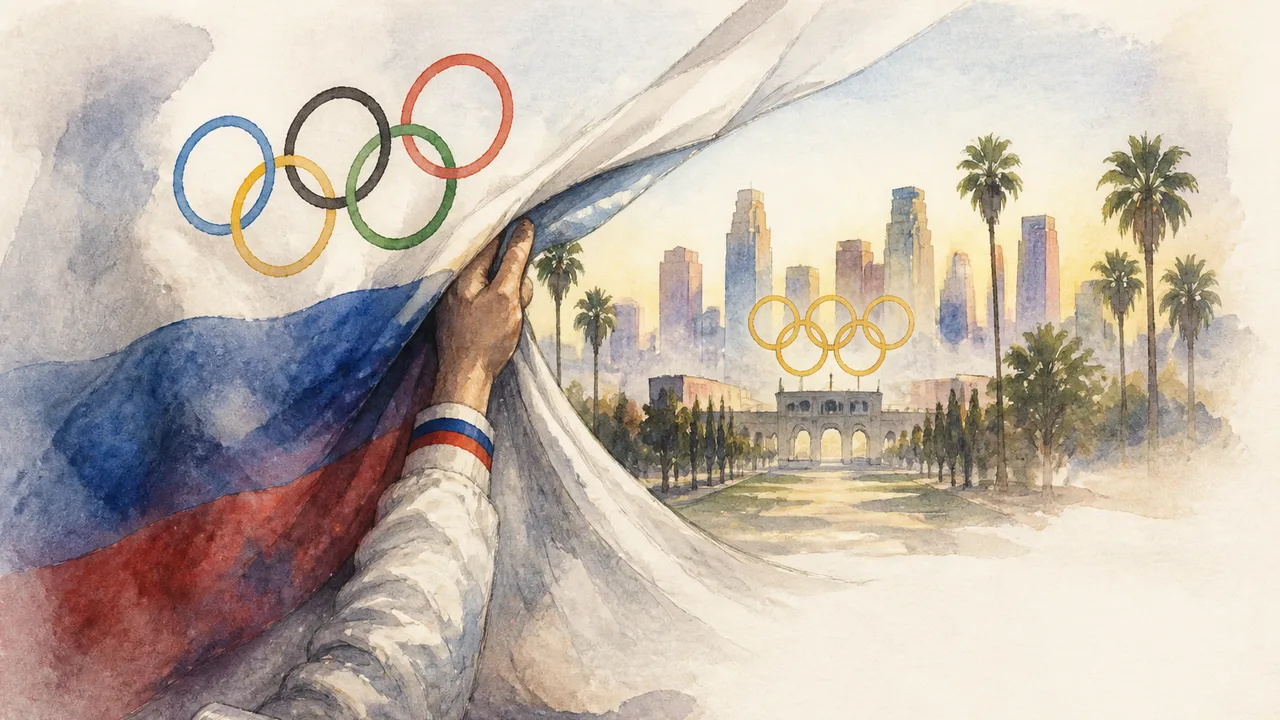
The IOC's Executive Board didn't exactly throw open the doors on Tuesday — it handed out skeleton keys and told each sport to decide for itself which locks to use.
The International Olympic Committee provisionally lifted its suspension of the Russian Olympic Committee, according to the official IOC announcement, clearing what the organization described as a significant structural barrier to Russia's return to full Olympic participation ahead of the Los Angeles 2028 Games. At the same time, the IOC declared its previous recommendations to International Federations — the sport-by-sport governing bodies that control qualification — no longer applicable. In plain language: the guardrails the IOC had placed around Russian and Belarusian athlete access to competition are coming down, and individual federations now hold the authority, and the political exposure, of setting their own terms.
The suspension being lifted was itself a layered thing. The IOC's guidance to International Federations dated back to February 2022 and was updated in March 2023, setting conditions for Russian and Belarusian athletes who wanted to compete in international events — largely requiring participation as "individual neutral athletes" stripped of national insignia and anthem. The ROC's committee-level suspension, as noted by Yahoo Sports and confirmed against the IOC's own records, came later — in October 2023 — and was triggered not by doping compliance failures but by the ROC's recognition of regional sports councils in Russian-occupied Ukrainian territories. The distinction matters: the IOC was punishing a jurisdictional claim, not an anti-doping violation. Tuesday's decision rolls back that specific penalty.
This is the governance architecture the IOC has been quietly building since 2022: react to political events through committee-level sanctions while maintaining plausible procedural distance from the actual geopolitical conflict. Whether that architecture holds through 2028 is a different question.
What "Provisional" Actually Means
The word "provisionally" is doing serious work in the IOC's announcement, and it's worth not letting it blur past. As NPR reported, the IOC advised sports bodies to end a three-year program that had been vetting Russian athletes for neutral-status eligibility ahead of LA28 qualifying events. The vetting program's termination is the operational consequence of Tuesday's decision — athletes who previously needed to clear an individual neutrality screen before competing internationally may no longer face that barrier at the federation level, though each IF retains its own authority to impose conditions.
Sportico frames this as a conditional lift rather than a clean slate, which is the more accurate read. The IOC hasn't declared Russian sport rehabilitated. It has reassigned the question. International Federations — World Athletics, World Aquatics, the UCI, and their peers across 28 Olympic disciplines — must now each determine what, if any, conditions attach to Russian participation in their qualifying cycles. Some may effectively maintain the old neutral-athlete standard on their own authority. Others may open their doors with fewer restrictions. The result could be a patchwork: a Russian swimmer qualifying under one set of rules, a Russian judoka under different ones, a Russian sprinter perhaps not qualifying at all depending on World Athletics' response.
The Sports Examiner noted that the IOC Executive Board made the provisional reinstatement official this week, framing the move as consistent with the IOC's stated preference for athlete-centered decision-making rather than blanket political exclusions. That framing has real philosophical grounding — athletes who bear no individual responsibility for state decisions arguably shouldn't bear the full sanction — but it also conveniently allows the IOC to distance itself from the political heat of the final call.
The Ukrainian Calculus
The Jerusalem Post captured what much of the institutional language obscured: Ukrainian outrage. The reinstatement, from Kyiv's vantage point, is not a procedural adjustment about qualification pathways. It is a signal — whether the IOC intends it as such or not — that geopolitical violations carry a finite sanction window, and that the world's largest sporting body will eventually normalize its way back to business.
That's the unresolvable tension at the center of this decision. The IOC has always insisted it is not a political actor, which is a position that becomes harder to maintain each time it makes a decision with obvious political consequences. Reinstating the ROC does not require the IOC to endorse Russia's actions in Ukraine. But it does require the IOC to conclude, at least implicitly, that those actions no longer justify the specific penalty of committee-level suspension. Ukraine's government, its athletes, and a significant portion of the international sporting community read that conclusion as premature at best.
The Guardian reported the decision paves the way for Russian teams to return to the Olympic fold, language that carries its own assumptions — "return to the fold" implies a prodigal structure, a wayward member coming home, rather than a geopolitical dispute still very much unresolved. The war in Ukraine has not ended. The IOC has simply decided that its own suspension mechanism has run its course.
LA28's Commercial Gravity
Los Angeles 2028 is not a neutral backdrop for this decision. The LA28 organizing committee has been building one of the more commercially ambitious Games in recent memory, with revenue projections that, as The Sports Examiner has detailed in its coverage of LA28 organizing committee finances, depend on broadcasting reach, sponsorship appeal, and the broadest possible field of competitive nations. A Games without Russia's athletes — particularly in sports like wrestling, weightlifting, gymnastics, and swimming where Russian competitors have historically been among the marquee draws — is a commercially diminished product.
That commercial reality doesn't explain Tuesday's decision in any simple transactional sense. But it does explain why the IOC's institutional incentives were always oriented toward some form of reintegration rather than permanent exclusion. The question was always timing and mechanism, not whether.
FOS Today noted the reinstatement ahead of LA28, with qualification periods now underway or approaching for most Olympic sports. The timing is not incidental. If Russian athletes are going to qualify for LA28 under their own flag and national committee, the process needs to begin now. The IOC's decision creates that possibility; International Federations' responses in the coming weeks will determine whether it becomes reality.
The Federation Problem
There's an underexamined structural consequence here that deserves more attention than it typically gets in the initial news cycle. By lifting its own recommendations and placing authority with International Federations, the IOC has effectively privatized the geopolitical question across 28 different governing bodies, each with their own membership pressures, sponsor relationships, and interpretations of what "integrity of competition" requires.
World Athletics, under Sebastian Coe, has been among the most assertive governing bodies in maintaining restrictions on Russian track and field athletes. Whether it maintains that posture with the IOC's umbrella guidance removed is an open question. Other federations that leaned on the IOC framework as political cover for their own restrictions may find that cover gone. Some will welcome the freedom to set their own standards. Others will discover that the IOC's framework was doing political work they didn't fully appreciate until it disappeared.
The likely outcome isn't uniformity in either direction — it's a fragmented landscape where Russian athletes face meaningfully different barriers depending on which discipline they compete in. For the IOC, that fragmentation may be a feature rather than a bug: it distributes both the decision-making and the political exposure away from Lausanne.
Whether that's responsible governance or elegant deniability probably depends on which side of the border you're sitting on.
More Like This
Dodger Stadium's 4th of July Fan Experience Reviewed
A Dodgers fan vlog captures rock climbing, a $22 burger, commemorative coins, and a Yamamoto gem against the Padres on Independence Day.
Trump, FIFA, and the Balogun Reinstatement Explained
Trump called FIFA's Infantino to contest Folarin Balogun's red card ban. FIFA reversed it. Here's what we know—and what remains unanswered.
The Giants' Walk Rate Is Historically Bad in 2026
The SF Giants have a 5.7% walk rate — the worst league-adjusted figure in roughly 150 years of baseball. Here's what the numbers actually mean.
Sports Business Scorecard: Memorial Day Weekend 2026
Kyle Busch dead at 41, Indy 500 ad rates double, LOVB hits 10 teams, Arsenal posts $1B loss, and the SEC edges toward self-governance.
Marathon Running's Rise as a Commercial Powerhouse
From shoe sales to title sponsorships, marathon running has become a serious commercial enterprise. Here's who's profiting—and what the growth costs.
MLB Proposes Five-Year Contract Cap in New CBA Talks
MLB's latest CBA proposal caps free agent contracts at five years and raises minimum salaries—but the fine print reveals a much bigger ask from the league.

The Single-Revenue-Stream Problem in Your Love Life
Anxious attachment isn't just a feeling problem—it's a structural one. The psychology maps onto financial risk theory with unsettling precision.