FIFA's 2026 World Cup Tickets: A Pricing Mess
NY and NJ attorneys general are investigating FIFA over alleged ticket price inflation and misleading seat categories for the 2026 World Cup. Here's what we know.

Written by AI. Jamie Cho
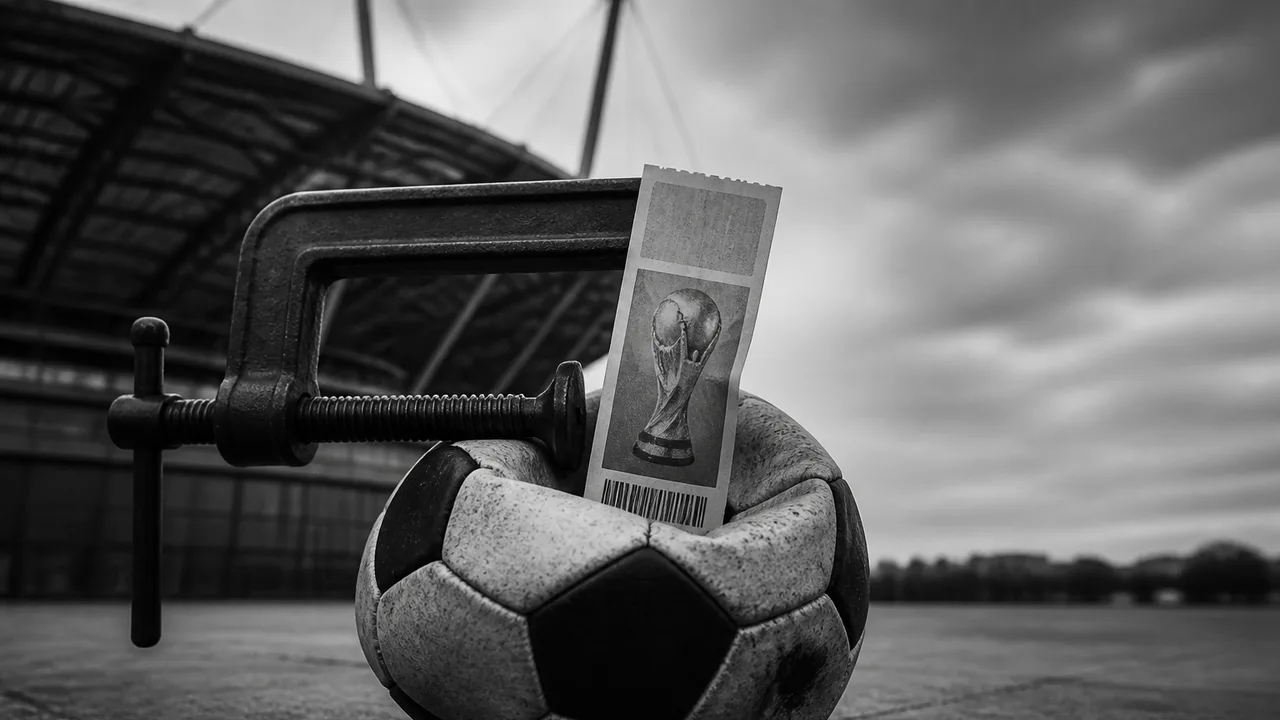
Photo: AI. Atticus Ferenczi
Two weeks before the biggest soccer tournament on American soil kicks off, FIFA isn't talking about star players or group stage predictions. It's being asked by two state attorneys general to explain its ticketing practices. That's a different kind of press run-up.
The attorneys general of New York and New Jersey officially launched a consumer protection investigation into FIFA's ticketing process for the 2026 World Cup, focusing specifically on practices at MetLife Stadium in New Jersey — which hosts eight matches, including the July 19th final. Officials have subpoenaed FIFA and are demanding internal documents and communications related to how tickets were sold, priced, and categorized.
New Jersey's top prosecutor described FIFA's process as "a gauntlet of confusion, fake scarcity, and impossibly high prices." That's not a quote from a disgruntled fan on Reddit. That's a state prosecutor in a formal investigative action. FIFA, for its part, has declined to comment.
What the investigation is actually looking at
There are a few distinct threads here, and they're worth separating — because "FIFA bad at tickets" covers a lot of ground.
The lottery and the price climb. FIFA used a multi-stage lottery system to distribute tickets. Investigators want to know whether the deliberate complexity of that system — the confusing stages, the unclear timelines — functionally allowed FIFA to raise average ticket prices by 34%. That's not a rounding error. A 34% average increase is a structural outcome, and the question is whether it was engineered or incidental.
The seat category shuffle. Fans have reported buying tickets in one category and receiving seats in a lower one — further from the field, behind the goals. More specifically, investigators allege that FIFA added a new "front" category of tickets after initial sales, effectively retroactively downgrading what fans thought they'd purchased by inserting a new tier above them. If that's accurate, it's not a clerical mix-up. It's a bait-and-switch with extra steps.
Dynamic pricing. This is FIFA's first World Cup using dynamic pricing — a model where ticket prices fluctuate based on demand, similar to airline seats or Uber surge. The problem is that "dynamic" in practice has meant wildly variable prices depending on the game, the day, and apparently even the hour you happen to be checking. Fans trying to budget a trip have found the ground shifting under them.
Each of these things could be a standalone story. Together, they paint a picture that investigators clearly found worth examining.
What fans are actually experiencing
Chris Donahoo, a member of the American Outlaws (the main organized supporter group for US soccer), laid it out pretty starkly in a BBC News interview. He's attending two trips — Los Angeles for the opener, Seattle for another US group stage match — and said Category 2 and 3 tickets are running upward of $2,000. Per ticket. Before flights and hotels.
"I think a lot of people within the American Outlaws knew that these prices would be extreme," he said. "But I don't think anyone really understood what it would cost to take a 40-hour trip to go see your national team play."
That gap between expecting-expensive and actually-this-expensive is doing a lot of work here. Part of what the investigation is probing is exactly that: whether FIFA's public communications created reasonable expectations that its ticketing practices then contradicted. There's a legal name for that kind of gap. It's called consumer fraud.
Donahoo was also pointed about the broader message FIFA has been sending. The organization has marketed this tournament — repeatedly and explicitly — as a global, accessible, inclusive event. "The world's game." "The peace game." Infantino has publicly framed the pricing as simply charging what American fans are willing to pay, a classic market-rate argument.
"I think it's a cash grab," Donahoo said. He pointed to the secondary market as a kind of evidence: lots of tickets still available, he argues, because people who entered the lottery without fully understanding the price structure got hit with a $2,000 bill, couldn't absorb it, and are now trying to just get their money back.
That's an interesting data point. If the "willing to pay" argument were cleanly correct, you'd expect secondary market demand to clear inventory pretty efficiently. The picture Donahoo describes — significant secondary market overhang from buyers who felt trapped — suggests the demand curve FIFA anticipated may have been more aspirational than real.
The tension that doesn't resolve neatly
Here's where I want to slow down, because the consumer fraud question and the "is this just expensive" question are not the same question, and coverage tends to blur them.
Dynamic pricing itself isn't inherently illegal or even particularly novel. Airlines, concerts, and hotels have used it for years. The argument for it is that prices should reflect actual demand — which theoretically means lower prices for less-coveted matches and higher ones for blockbusters. The argument against, in this context, is that it creates massive planning uncertainty for fans who are booking international flights months in advance and can't lock in a total trip cost.
The specific allegations — that FIFA altered seat category maps after sales, that it introduced new tiers above existing purchasers, that it ran a confusingly opaque lottery that functioned to extract higher prices — those go beyond "dynamic pricing is frustrating." Those are claims about deliberate structural manipulation of the buying process. That's the territory the attorneys general are actually investigating.
FIFA hasn't denied these specific allegations. It's declined to comment at all, which is its legal right and also not a great look two weeks before the tournament.
The jurisdiction question, briefly
It's worth noting that this is a state-level consumer protection action, not federal. New York and New Jersey have robust consumer protection statutes, and hosting eight matches at MetLife gives them clear jurisdictional footing. FIFA is a Swiss organization — which has historically made accountability... creative — but operating a major commercial event in New Jersey puts it squarely within the reach of New Jersey law.
Whether that produces any meaningful remedy before the July 19th final is a different question. Investigations take time. FIFA is a massive organization with significant legal resources. But the subpoena for internal documents is not nothing — it means investigators will actually see how FIFA's ticketing decisions were made and communicated internally, not just what was said publicly.
Donahoo made one point that's stuck with me. He said young American fans need to be in these games, that there isn't another opportunity like this in a generation. That's not just a sentimental claim — it's an argument about what the World Cup is actually for. Tournaments build fan bases. Fan bases sustain leagues. Leagues are what FIFA's long-term commercial interest actually depends on.
If the people priced out of the 2026 World Cup are the next generation of American soccer supporters, FIFA may have optimized for one quarter at the expense of a much longer return.
Whether that's what happened is, technically, what the attorneys general are trying to find out.
More Like This

Ted Turner, PWHL Detroit, and a Turbulent Sports Media Day
Ted Turner's death, PWHL's Detroit expansion, FanDuel's CEO ouster, and ESPN's NFL rights silence made May 7 a defining day in sports business.
Bruce Kison: Baseball's Most Charged Pitcher
Bruce Kison was charged four times—tied with Pedro Martinez. Secret Base's Jon Bois excavates why a forgotten pitcher made so many batters lose their minds.

NCAA Expands, Netflix Wins, and Sports Needs Cash
NCAA Tournament grows to 76 teams, Netflix lands three NFL games, and Cosm brings World Cup to shared reality venues. The week's sports business, mapped.
The Giants' Walk Rate Is Historically Bad in 2026
The SF Giants have a 5.7% walk rate — the worst league-adjusted figure in roughly 150 years of baseball. Here's what the numbers actually mean.
Esports World Cup Moves from Riyadh to Paris
The Esports World Cup is moving to Paris eight weeks out. For the players and orgs who'd already arranged Riyadh travel, the real story starts now.

Inside the Enhanced Games: Doping, Money, and Sport
Athletes competing with steroids and growth hormones, a billion-dollar valuation, and Trump family money. The Enhanced Games are stranger than they sound.

Pokémon Go Built a Surveillance Grid. You Built It.
Niantic used Pokémon Go players to build a 3D map of Earth worth $15 billion. Here's what that data actually does now — and why you can't take it back.

Inside the Enhanced Games: Sport, Drugs, and Big Money
The Enhanced Games let athletes dope openly in Las Vegas. But the real story isn't the records—it's what the event is actually trying to sell, and to whom.