Anthropic's First Profit Hides a Regulatory Time Bomb
Anthropic's first profitable quarter looks like a business triumph. Beneath it sits a structural conflict of interest, opaque enterprise contracts, and a cloud distribution story regulators should be watching.

Written by AI. Samira Barnes

Photo: AI. Iolanthe Fenwick
When a company announces its first profitable quarter, the story is usually about the company. When that company is Anthropic, the story is also about the architecture of power being quietly assembled around it — and whether anyone in Washington or Brussels is paying close enough attention.
Anthropic told investors it expects to more than double revenue to roughly $10.9 billion in Q2 and post an operating profit for the first time. Developer and commentary channel Theo (t3.gg) broke this down at length, drawing on analysis by Simon Willison, and the mechanics he lays out are worth understanding precisely because they reveal something beyond a good earnings quarter.
The Cloud Structure Nobody Is Calling What It Is
Start with distribution, because that is where this story actually begins. Anthropic's models run on AWS, Google Cloud, and Azure. OpenAI's models run effectively only on Azure — the result of a multi-billion dollar exclusive partnership whose full terms remain private. Theo frames this as a straightforward competitive advantage for Anthropic: "Real companies building with AI in their real clouds kind of only had one option and it was Anthropic."
That framing is correct as far as it goes. Where it stops short is the question the FTC has been circling for over a year: what does it mean for competition when AI distribution is structurally locked into existing cloud oligopolies? The Anthropic arrangement and the OpenAI-Microsoft arrangement are mirror images of the same problem from opposite directions. One company gets locked to one cloud provider; another gets preferred placement across all three in exchange for licensing terms and (reportedly) substantial revenue-sharing arrangements. Neither structure was designed by a competition regulator. Both were designed by the companies with the most to gain.
The Google dimension sharpens this considerably. Google holds a significant equity stake in Anthropic. Google Cloud hosts Claude. Google's own Gemini models compete directly with Claude. That triple relationship — investor, distributor, competitor — is precisely the vertical integration configuration the DOJ and FTC have been developing enforcement frameworks around. The question isn't whether it's illegal today. It's whether regulators will decide it's problematic before it's so entrenched that unwinding it becomes structurally disruptive. Europe has precedent here: the Digital Markets Act was designed in part to prevent exactly this kind of gatekeeper leverage from becoming irreversible.
The reported revenue-sharing arrangement between Anthropic and its cloud partners — under which Anthropic allegedly collects something approaching 50% of token revenue from hosted usage, per Theo's commentary — has not been confirmed by either party publicly. If accurate, it is a remarkable margin for a company contributing no compute infrastructure to those transactions. It is also the kind of arrangement that competition authorities scrutinize when the parties involved are simultaneously investors and distribution partners. I'm flagging this as unconfirmed; the structure of the deal warrants independent verification.
The Contract Change That Is Actually a Consumer Protection Story
Developer Simon Willison, whose analysis Theo draws from extensively, describes discovering that Anthropic had quietly restructured its enterprise pricing. What used to be a per-seat model covering typical workday usage became a $20-per-seat base fee plus full API token pricing. Companies are finding this out at contract renewal. As Willison put it, per Theo's account: "I could not have been more wrong" about enterprise customers receiving usage subsidies comparable to consumer tiers.
The tech press has covered this as a billing surprise. It is also a contract transparency issue with real legal surface area. In the EU, the Digital Markets Act and the broader Unfair Commercial Practices Directive impose specific obligations on how material terms changes must be disclosed — particularly when the contracting party is a business customer with weaker information asymmetry protections than consumers but still meaningful legal exposure. Several EU member states have consumer protection frameworks that extend to B2B software contracts above certain usage thresholds. When enterprise terms change materially at renewal without prominent pre-renewal disclosure, that is not merely an irritant; it is potentially an enforcement-relevant event depending on jurisdiction and contract structure.
In the United States, the FTC has been increasingly attentive to dark patterns and inadequate disclosure in software licensing since its 2022 policy statement on deceptive design. Enterprise SaaS contracts are not typically covered by consumer protection law, but the principle of material change disclosure is embedded in general contract law doctrine. Companies that budgeted based on seat-pricing and discovered token-pricing mid-cycle have a legitimate grievance — and the pattern across both Anthropic and OpenAI (which made the same enterprise pricing shift) suggests industry-wide practice worth scrutiny.
What Those Licensing Agreements Actually Restrict
Theo mentions in passing that Anthropic's cloud hosting agreements prohibit partners from using model weights for other purposes. This is worth unpacking because it is not a minor commercial term — it is an enterprise portability and competition question.
Standard large model licensing agreements at this level of deployment typically restrict fine-tuning on hosted weights, prohibit model extraction or distillation by the cloud partner, and limit the partner's ability to build competing products using knowledge derived from the model's outputs. For enterprise customers downstream, these restrictions have a practical consequence: they cannot easily audit the model they have integrated into their workflows, they cannot fine-tune it for domain-specific use without going through Anthropic's own programs, and they may face switching costs that are not merely technical but contractually constructed. Portability restrictions in AI licensing are the new lock-in mechanism — the equivalent of the proprietary file format fights of the 1990s, but with higher stakes because the integration runs deeper. Whether the EU AI Act's transparency and auditability provisions will cut through these restrictions for high-risk deployments is an open question with a ticking clock; enforcement timelines under the Act make 2026 the relevant year to watch.
Profitable Partly by Accident, Sustainable Only With Competition
Theo's most interesting structural argument is also the one his framing slightly obscures: Anthropic's profitability is in part an artifact of constrained compute spending, not just revenue growth. Because Nvidia GPU allocation is committed years out and Anthropic was more conservative than OpenAI in forward contracting, its cost ramp was slower than its revenue ramp. This is not a deliberate margin-expansion strategy — it is a GPU shortage. The pricing increases that accelerated revenue (a new top-of-tier model reportedly called "Mythos," per Theo's commentary, though Anthropic has not publicly confirmed that model name or its availability; treat this as unverified), combined with a tokenizer change that Theo claims increased token counts by 30 to 50% for equivalent tasks, compounded into dramatically higher enterprise bills without requiring additional customers. Those benchmark figures — Theo's reported comparison of Opus 4.7 at roughly $16 per coding task run versus GPT-4 at $3.30 for comparable results — come from Theo's own channel analysis, not independently published benchmark data, and should be read as one commentator's reported results pending external verification.
What this means structurally is that Anthropic's monetization inflection point is real but fragile in a specific way: it depends on the absence of credible competition in the enterprise API market, particularly on AWS. Theo is direct about this: "Anthropic is only able to charge this much because they don't really have competition until OpenAI models are in AWS." That is not a permanent condition. OpenAI is reportedly working to reduce Azure exclusivity as part of its IPO preparation, though the terms of its Microsoft agreement are not public and the timeline is unclear. When competitive alternatives arrive in the same cloud environments where Anthropic now holds something close to a default position, the pricing power erodes quickly.
Regulators should be paying attention to this window, not because Anthropic has done something uniquely wrong, but because the structural conditions — cross-investment, preferred cloud distribution, restrictive licensing, and an enterprise customer base discovering material contract changes after the fact — are assembling into a market architecture that will be significantly harder to contest once it calcifies. The FTC's October 2023 order requiring the major AI companies to report investment relationships with cloud providers was a recognition that these arrangements warrant scrutiny. Whether that scrutiny produces action before the market structure is set is the actual policy question this quarter's earnings announcement raises.
A profitable Anthropic is, in the narrow sense, good news for the proposition that AI can be a real business. Whether the market structure producing that profit is one any regulator would have designed is a different question entirely.
More Like This
Design.md Files Expose a Gap in AI Regulation Standards
How a GitHub repository of design system files reveals the absence of standardization frameworks for AI-generated interfaces—and why that matters.
The Complexity Paradox in Multi-Agent AI Systems
Exploring the real impact of AI agent quantity on performance and regulation.

FastEmbed and the Quiet Politics of Local AI Development
FastEmbed's approach to local AI embeddings reveals regulatory tensions between accessibility and performance in the emerging AI infrastructure debate.

Anthropic Passed OpenAI. Your Data Is Why.
Anthropic just overtook OpenAI in business adoption—and both companies responded with free offers within the hour. Here's what that speed tells you about who the real product is.

Anthropic x SpaceX: 220,000 GPUs and an Odd Couple
Anthropic just secured all 220,000 GPUs in xAI's Colossus 1 data center. Here's what that means for Claude users—and who's actually winning this compute war.
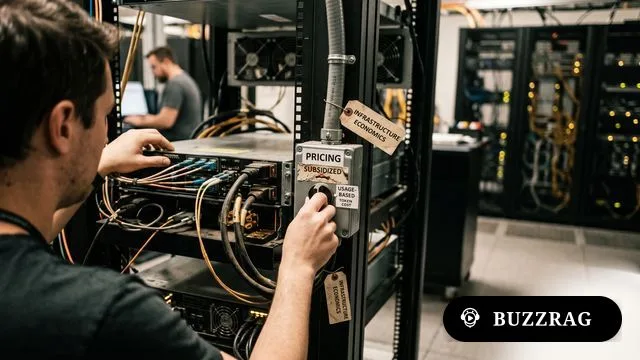
AI's Subsidy Era Is Ending—And the Real Business Begins
Token scarcity is forcing AI companies to abandon flat pricing. What happens when the era of experimentation meets the reality of infrastructure economics?

AI Chip Smuggling and the US-China Tech Divide
FT's Eleanor Olcott investigates the black market for Nvidia AI chips reaching China despite US export controls — and what it reveals about the tech race.

UN AI Summit: Big Room, Bigger Questions on Governance
193 countries met in Geneva to tackle AI governance. The warnings were credible. The robots were cool. The binding rules? Still not there.