Anthropic Passed OpenAI. Your Data Is Why.
Anthropic just overtook OpenAI in business adoption—and both companies responded with free offers within the hour. Here's what that speed tells you about who the real product is.

Written by AI. Rachel "Rach" Kovacs

Photo: AI. Mika Sørensen
I've spent years covering the moment when a tech company's business model and its user's interests quietly separate. It usually happens slowly—a terms of service update here, a pricing tier restructure there—until one day you realize you were never really the customer.
So when AI automation creator Nate Herk dropped a video this week framing Anthropic's climb past OpenAI in business adoption with the line "you are not the customer, you are the training data," I didn't nod along as a neutral observer. That's my beat. I've written that sentence, or some version of it, about social media companies, data brokers, and ad-tech platforms for the better part of a decade. Hearing it applied to the tools that developers now treat as essential infrastructure—that's not a YouTube take. That's a pattern I recognize.
What actually happened
According to data published this week by EconLab (the Substack cited in Herk's video description), Anthropic's share of business AI adoption rose 3.8 percentage points in April to reach 34.4%, while OpenAI fell 2.9 points to 32.3%. A note on methodology: EconLab's analysis is worth reading directly, but it measures adoption share—which tools businesses are actively using—not revenue, model quality, or customer satisfaction. The headline that Anthropic "dethroned" OpenAI is accurate in one narrow sense and misleading in almost every other. EconLab itself flagged that Anthropic's incentives may be misaligned with enterprise customers, since the company benefits most when users consume more tokens and migrate toward its more expensive models.
The more telling data point isn't the adoption numbers. It's what happened within roughly an hour of that research going public. Sam Altman posted that OpenAI would give companies switching from Claude Code two months of free Codex access. Anthropic responded by extending Claude Code's weekly usage limits by 50% through July 13th. Two months, 45 minutes apart—per Herk's account, which I haven't independently verified to the minute, but the tweets themselves are public record.
That speed is the story. These are not companies reacting to a quarterly competitive review. That's a real-time market signal triggering a prepared response. Which means someone had that counter-offer ready.
The "free sample phase" argument, and what it leaves out
Herk's framework is worth engaging seriously. He calls this the "free sample phase"—a period where AI companies are deliberately undercharging because what they need right now isn't your subscription fee, it's your usage data and your dependency. "They need the adoption and the data more than they need your 200 bucks a month," he says, and as a structural argument, it holds. Sam Altman acknowledged publicly—in what appears to have been a social media post, though the original should be surfaced for full context—that OpenAI was losing money on Pro subscriptions because usage vastly exceeded projections. That's not a secret. That's a deliberate investment.
Herk also estimates that routing typical monthly AI usage through the API directly, rather than through a flat subscription, would cost somewhere between 5x and 25x more. That's a wide range—wide enough that it's more useful as an illustration than a calculation. But the direction is right: subscriptions are subsidized. The question I keep returning to, which Herk doesn't fully explore because it's not his beat, is what specifically is being collected, retained, and used during this subsidy period.
Both Anthropic and OpenAI have enterprise data policies that technically prohibit using customer data to train models without consent. But "enterprise" has a specific meaning, and it doesn't automatically extend to every developer using Claude Code or Codex on a standard subscription. If you're building projects on these tools right now—at the expanded limits, under the free promotional terms—it's worth actually reading what you agreed to. Not because the answer is necessarily alarming. Because you should know what the exchange is before you decide whether you're comfortable with it.
What I'd actually tell you to do
If you use Claude or Codex daily and you're reading this on your lunch break, here's my honest read: use the promotional access. There's no good reason not to run your projects through both tools over the next two months and figure out which one fits your workflow. The compute is being offered; take it.
But build like you're on borrowed time—because in a very specific sense, you are. Herk's recommendation to keep your projects portable is not optional caution dressed up as strategy. It's the minimum viable self-protection for anyone whose work now runs on tools controlled by companies that are not yet profitable. Vendor lock-in in AI coding tools is still nascent enough that you can avoid it with deliberate choices: keep your data and your architecture in formats that aren't proprietary, document your integrations, and know what it would take to swap the underlying model. Not because Anthropic is going to disappear—they're not—but because "what if they repriced significantly" is a reasonable scenario to plan for, and the time to plan for it is before you're dependent.
On the pricing trajectory itself: Herk draws a comparison to Facebook Ads, Google AdWords, Uber, and Netflix—platforms that subsidized adoption aggressively before repricing once habit was entrenched. The parallel isn't perfect; open-source models are getting cheaper and more capable in ways that create genuine competitive pressure on proprietary pricing that didn't exist in those earlier land grabs. Whether that pressure is enough to prevent a significant repricing of frontier AI tools is genuinely uncertain. But the comparison pattern is real, and being aware of it costs you nothing.
The part that's specific to my beat
What Herk is describing as a business strategy argument, I read partly as a data story. The proprietary usage data these platforms collect—what you ask for, where the model fails, how you iterate, what enterprise workflows look like in practice—is compounding. Every session you run through Claude Code or Codex is a signal about how humans and AI systems collaborate on real problems. That data has training value. It also has commercial value that we don't fully understand yet because the secondary market for AI behavioral data at this scale hasn't developed.
I'm not saying your coding sessions are being sold. I'm saying the value of that data is not fully priced into the $200/month you're paying, and the companies building these tools understand that better than their users do. That asymmetry is worth keeping in mind—not as a reason to stop using the tools, but as context for why the promotional offers are as generous as they are.
The question I'm watching isn't whether prices go up. They will, in some form, for someone. The question I'm watching is what we'll learn about how that usage data was used once these companies are profitable enough to be transparent about it—or compelled to be.
More Like This
Anthropic Just Killed OpenClaw Access—Here's What Happened
Anthropic blocked OpenClaw from Claude subscriptions on April 4th. We break down why it happened and five alternatives that still work right now.
Anthropic's Opus 4.7: The Enterprise Model You Can't Afford
Anthropic's Opus 4.7 excels at enterprise tasks but costs 35% more due to tokenizer changes. The upgrade everyone's complaining about, explained.
Claude Code's AutoDream: AI Memory That Sleeps to Stay Sharp
Anthropic quietly released AutoDream for Claude Code—a background agent that consolidates memory files like human sleep. Here's what it means for developers.

GitHub Copilot's Billing Problem Is Bigger Than You Think
Theo's livestream experiment to burn GitHub Copilot's $40/mo plan reveals a fundamental flaw in how AI tools are priced—and who eventually pays for it.
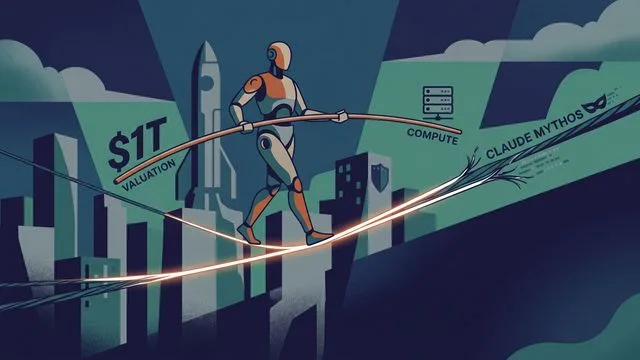
Anthropic's Trillion-Dollar Tightrope Walk
Anthropic is racing toward a $1T valuation while juggling SpaceX compute, a Pentagon fight, and a secret hacking model. Here's what's actually going on.
Claude Code Simplifies AI Development in 2026
Explore Claude Code's simplicity in 2026 for AI development, reducing the need for complex frameworks.

Claude Code Developer: AI Has a Capability Overhang Problem
Anthropic's Thariq Shihipar argues we're systematically underusing AI tools—not because models are weak, but because users don't know what to ask for.

Flock Safety Cameras: Crime Tool or Privacy Risk?
Flock Safety's license plate readers are spreading fast. Retired Microsoft engineer Dave Plummer breaks down what they actually capture—and what's at stake.