Everyday Prices in Poland: What Tourists Should Know
A look at everyday goods prices in Poland compared to the US, what Krakow's costs reveal, and what travelers miss when they budget by hotel rates alone.

Written by AI. Mariel Fontaine
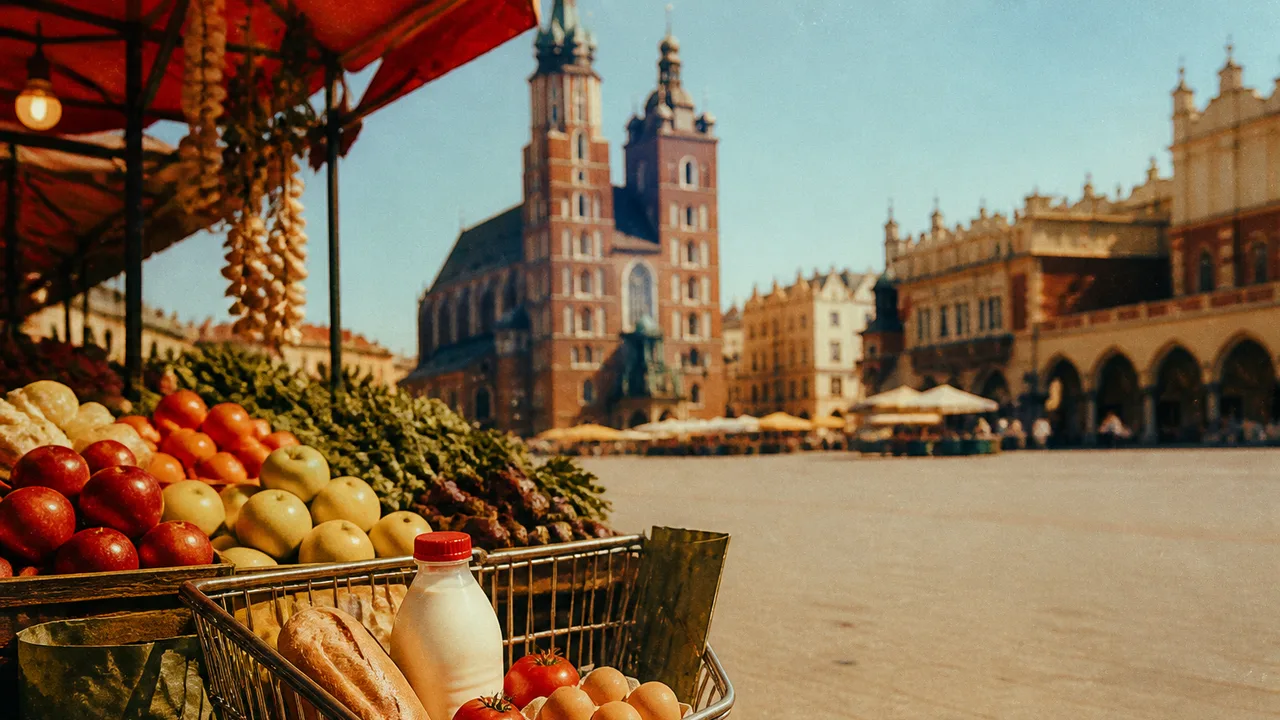
Photo: AI. Nikolai Brandt
There is a particular kind of travel math that doesn't add up until you're standing in a grocery aisle somewhere in Central Europe, holding a bottle of mineral water and trying to remember what you paid for the same thing at a Walgreens in Columbus. Restaurants and hotels give you a tourist's price. Supermarkets and gas stations give you the truth.
That's the premise behind a recent Wolters World video filmed in Krakow, where creator Mark Wolters walks through a gas station and a local market comparing the shelf prices of everyday goods — milk, bread, snacks, household staples — to their US equivalents. It's an unpretentious exercise, and more instructive than most destination cost guides for the simple reason that it bypasses the tourist economy entirely and looks at what Polish people actually pay.
The headline finding is measured rather than dramatic. As Wolters puts it: "Some things the prices were pretty close. Others Poland was a little bit more affordable, let's say, than travel around the US." That's a deliberately careful formulation — not a declaration that Poland is dirt cheap, but an acknowledgment that the picture is mixed, category by category.
That nuance deserves to be taken seriously.
What "Affordable" Actually Means Here
Poland has occupied a peculiar position in Western European travel discourse for years: consistently invoked as the budget alternative to Prague, Vienna, or Berlin, yet increasingly subject to the same inflationary pressures reshaping economies across the European Union. Poland joined the EU in 2004, has experienced sustained GDP growth since, and while it has not adopted the euro — the Polish złoty remains the national currency — its consumer prices have risen meaningfully over the past decade, particularly in its largest cities.
Eurostat data places Poland in the lower half of EU countries by price level index, meaning goods and services are, on average, cheaper than in Western Europe. But that average flattens real variation. Warsaw and Krakow are materially more expensive than Łódź, Białystok, or Rzeszów. And within those cities, the tourist districts operate at a premium that can blur the actual cost picture for short-stay visitors.
The Wolters approach — stopping at a gas station and a market rather than a restaurant on the main square — is a useful corrective. Accommodations can be gamed by booking windows and platform markups; restaurants in tourist zones price for tourist tolerance. Packaged goods on supermarket shelves are priced for the people who live there.
The Krakow Caveat
Wolters is direct about one thing worth foregrounding: Krakow is not representative of Poland's price landscape. "I will say here in Krakow is probably the priciest city in Poland," he notes. "You're going to get a lot cheaper hotels and accommodation and eating stuff in other parts of Poland than you do here in Krakow."
This is accurate and worth elaborating. Krakow's Old Town is a UNESCO World Heritage Site and one of the most visited city centers in Central Europe, drawing millions of tourists annually — estimates from Polish tourism authorities have placed annual visitor numbers above 14 million in recent pre-pandemic years, though the pandemic disrupted those figures significantly. The demand pressure on accommodation, dining, and services in the center is real, and it creates a two-speed economy: tourist-facing businesses in Kazimierz and the Rynek Główny operate at prices closer to Budapest or Vienna than to the rest of Poland.
Travel further — to Wrocław's less-trafficked neighborhoods, to Gdańsk outside high summer, to the smaller towns and cities of Podkarpacie or Warmia-Masuria — and the price differential becomes more pronounced. Poland is a country where your budget stretches or doesn't depending heavily on where you choose to be within it.
The Methodological Question
There's a legitimate question about what price comparisons filmed at a single gas station and market can tell you. The answer is: something useful, but not everything.
Spot comparisons of packaged goods are genuinely informative for a specific class of traveler — people planning longer stays, digital nomads running cost-of-living calculations, families who will self-cater. Knowing that a liter of milk or a loaf of bread costs roughly X in Krakow versus Y in their home city helps with real budgeting in a way that "Poland is cheap" does not.
What this format can't capture is the structural stuff: labor costs embedded in service prices, the tax treatment of short-term rentals, seasonal price swings, or the way that income levels shape what "affordable" actually means for Polish residents versus visiting Americans. A price that feels like a bargain to someone earning dollars can simultaneously represent a significant portion of a Polish worker's weekly budget. The goods are the same; the relativity is not.
Poland's median monthly net wage, according to Statistics Poland (GUS), was roughly 5,300 złoty in recent years — approximately $1,300 at current exchange rates, though that figure fluctuates with currency movements. The cost of groceries that strikes a visiting American as modestly cheaper than home can look quite different measured against that wage baseline. It's not that the comparison is wrong; it's that it's incomplete without the local frame.
None of this is a criticism of what Wolters is doing — he's making a practical tool for tourists, not an economics lecture. But it's the kind of context that turns a price-check video into something more useful for readers who want to understand a country rather than just visit it.
What the Currency Does (And Doesn't) Protect
Poland's retention of the złoty is, among other things, a buffer against the price harmonization that tends to follow eurozone entry. Countries that adopted the euro saw consumer prices rise — sometimes sharply — in the years following adoption, as wages adjusted more slowly than prices. Poland's central bank retains monetary policy control, which has both stabilized and, during periods of high inflation like 2022-2023, complicated the picture for Polish consumers.
For travelers arriving with dollars or euros, the exchange rate is a variable that can shift the affordability calculation meaningfully. When the euro is strong against the złoty, Warsaw and Krakow feel like bargains. When it isn't, less so. Checking the current exchange rate before budgeting is not optional; it's the difference between a realistic trip plan and an optimistic one.
The Broader Value of This Kind of Content
There's something I find genuinely useful about the format Wolters is working in here, even in its limitations. Tourism marketing — by national boards, by hotel chains, by aggregator platforms — has a structural incentive to present destinations in their most aspirational light. The "budget destination" label gets applied and re-applied to places long after their popular tourist centers have priced out the travelers who originally made them appealing.
Filming in a gas station instead of a restaurant is a small act of counter-programming. It won't solve the broader problem of tourists pricing locals out of their own neighborhoods, and it won't tell you whether Poland's labor conditions in tourism are fair or its short-term rental regulations adequate. But it at least tries to answer a basic and honest question: what do things actually cost for the people who live here?
That question is the right starting point. Where you go from there — how deeply you want to understand the economics of the place you're visiting — is yours to decide.
Poland remains, by most metrics, an affordable destination for travelers from Western Europe and North America, with meaningful variation by region, season, and how committed you are to eating and drinking outside the tourist orbit. Krakow in peak summer is one experience. Poznań on a Wednesday in March is another. The price difference between them is real, and worth knowing before you book.
More Like This
American Tourists in Europe: The Etiquette Gap
From date formats to tipping culture, the everyday customs that trip up American travelers in Europe—and what they reveal about deeper cultural differences.
What Poles Actually Want Tourists to Know
From geography to drinking etiquette, here's what Polish locals wish visitors understood before arriving—and why it matters more than you think.
Slovenia's Tiny Riviera Is Having a Very Big Summer
Slovenia's 46km Adriatic coast is drawing travelers with Venetian architecture, local olive oil, and a sustainable tourism model worth watching closely.
Fast Food Price Increases and the Data Strategy Behind Them
Fast food prices have surged well past inflation—but labor costs are only part of the story. The bigger driver is a deliberate shift in business strategy and data.

Travel Spending Is Rebounding—But Read the Fine Print
Travel spending rebounded in June and agents are booking again—but the data tells a messier, more interesting story than the headlines suggest.
What to Expect When Staying in European Hotels
European hotels operate by different rules than North American ones. Here's what actually differs—room size, beds, breakfast pricing, accessibility, and more.

JetBlue Buys Spirit's LaGuardia Slots for $58.5M
JetBlue won 22 Spirit Airlines LaGuardia slots for $58.5M. Here's what it means for fares, Frontier, and travelers who depended on cheap Northeast flights.
Where Pickpockets Thrive in Europe's Busiest Cities
From Barcelona's La Rambla to Lisbon's metro, here's a clear-eyed look at where pickpockets operate in Europe and how tourist crowds make it possible.