Drunken Goddess Reflux Cancels Public Demo Over AI Fears
Drunken Goddess Reflux's creator canceled a public Steam demo over AI copycat fears. The move reduces exposure while narrowing players' chance to try it.

Written by AI. Jordan Mercer
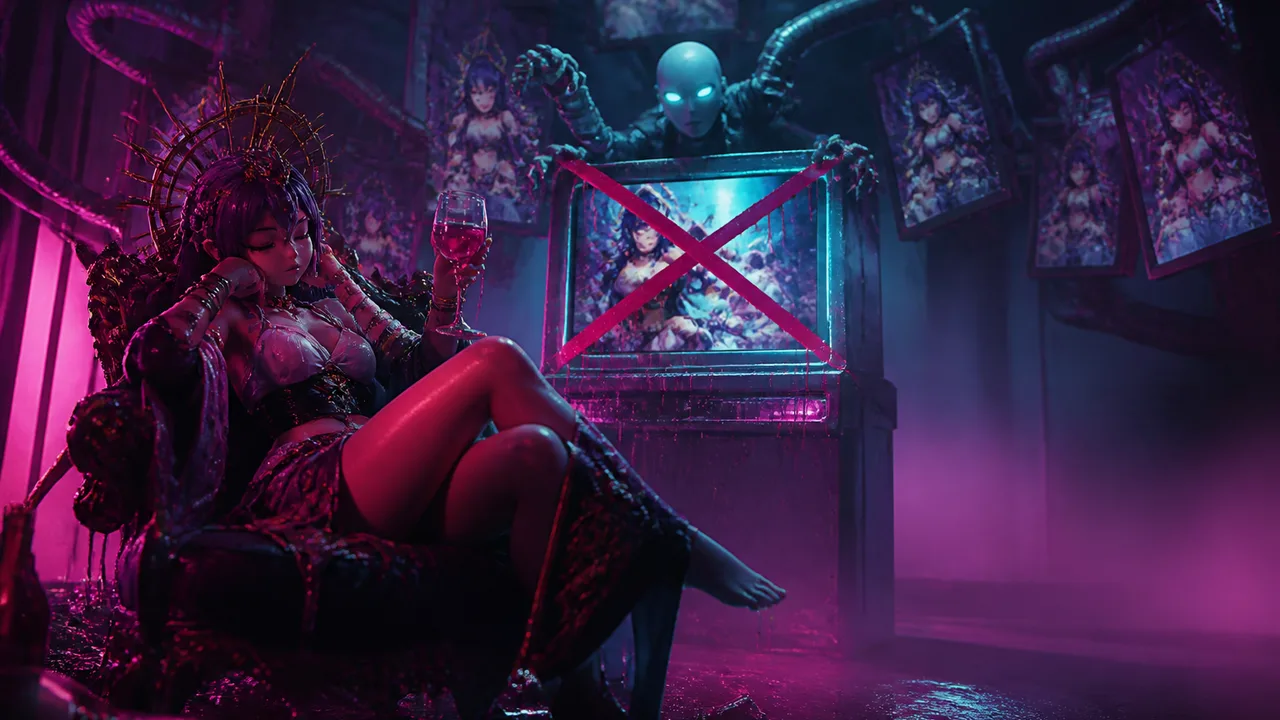
Drunken Goddess Reflux will no longer get the public Steam demo its developer had planned. The creator of the anime-styled Russian roulette drinking game canceled the preview over concern that people could use AI to copy it. Players lose an early chance to judge the game in their own hands; the developer gives up a familiar way to attract attention and gather feedback before release.
That is a hefty price to pay for a fear. The concern is prospective: no copycat release has been established in connection with this decision. Yet a small developer has already changed how people can encounter its work. The question now is what happens when an open demo, usually an invitation to play, also feels like an invitation to imitate.
Closed sessions are planned, offering a narrower route for people to try Drunken Goddess Reflux. That gives the creator more control over who gets access. It also changes whose reactions can shape the game: a public Steam demo can reach curious strangers, while a closed session reaches whoever gets through the door.
Why a Demo is a Hard Thing to Give Up
For an indie game, a demo does several jobs at once. It lets a player check whether the premise works as a game rather than as a collection of striking images. It can reveal whether the controls make sense, whether the pacing holds up and whether a tense idea stays tense after the first few minutes. The developer gets feedback from people who have no reason to be polite about any of that.
It also lowers the commitment required to pay attention. A trailer asks players to trust an edit. A playable build lets them test the pitch themselves. For Drunken Goddess Reflux, whose anime presentation and Russian roulette drinking-game premise make for a memorable description, that hands-on step could be especially useful. A memorable premise gets someone to click; play determines whether they want to stay.
Those benefits come from letting people in. The same access gives would-be imitators a closer look at the presentation, sequence of decisions and moment-to-moment feel than promotional images could. A public demo may also put game files in players' hands. It means the developer must weigh the upside of broad access against a risk it cannot easily take back.
Canceling the demo reverses the usual order of trust. Players are asked to build interest from a distance now and try the game later. That can be a sensible trade for a creator who believes the preview exposes too much. It still leaves prospective players with fewer ways to decide whether the finished game is for them.
What AI Changes, and What It Doesn't
The feared copycat doesn't need to reproduce every line of code to cause trouble. A rival could aim to borrow the visible concept, mimic the look or assemble a game that appears similar enough to compete for attention. Generative tools could help someone produce draft art, text or code faster. In that scenario, speed is the threat: an indie creator might spend considerable time developing a distinctive pitch while someone else tries to capitalize on its public reveal.
Speed also has limits. Making a convincing playable game still involves design decisions, testing and revision. A screenshot-like imitation tells a player little about whether the game underneath holds together. AI tools can accelerate pieces of production without supplying the judgment that makes a risk-and-reward loop satisfying. Treating every use of those tools as an instant clone button would obscure the practical question the developer faces: how much can a preview expose, and how much would an imitator need to make something competitive?
There is a second complication. Game ideas have always traveled. Developers study one another's work; genres develop through recognizable conventions and variations. Players routinely ask for more games with a premise they enjoy. A copycat concern becomes sharper when another project closely reproduces a creator's choices and tries to ride the same attention. The boundary between inspiration and imitation can look clear in an extreme case and frustratingly murky everywhere else.
The cancellation doesn't settle that boundary. It shows how a perceived increase in imitation speed can affect a release plan before a dispute ever reaches players. The developer has chosen to limit the most detailed public look at Drunken Goddess Reflux, accepting an immediate cost in reach and feedback to reduce an exposure it considers risky.
Closed Doors Bring a Different Trade-Off
Closed sessions offer a middle route. A creator can put the game in front of people, hear where they get confused and watch for problems that are hard to spot from inside development. Restricting access may reduce how widely a playable build circulates, even if it cannot guarantee that ideas or impressions stay private.
The harder part is audience selection. A public demo can surprise a team. Someone outside the expected crowd might find a mechanic confusing, spot an accessibility obstacle or discover that the game's strongest appeal differs from its marketing pitch. A small invited group can give deep feedback, but it may miss the reactions of people who arrive with no context beyond a Steam page and a download button.
For players, that changes the relationship too. Public previews give them a chance to assess claims before buying, following or recommending a game. Closed testing asks them to rely longer on the creator's chosen glimpses. Neither arrangement guarantees a better finished product. They answer different questions: one asks how the game plays for a broad audience; the other lets the developer learn while keeping a tighter grip on access.
This dilemma extends beyond Steam. On mobile storefronts, where an icon, screenshots and a short description often carry the first encounter, players also have to decide how much they can infer before installing. The distribution details differ, but the underlying challenge travels across platforms: creators need discovery, and players need enough access to make informed choices. A studio with a huge marketing budget can repeat its pitch until people recognize it. A small team has fewer chances to show what makes its game work.
Who Gets to See the Game Next?
The strongest case for canceling the demo starts with that imbalance. A small creator may have limited time and resources to respond if a fast-moving imitator grabs attention first. Holding back a playable build preserves some control over when the game's distinctive details become public. Closed sessions can still supply feedback without giving everyone the same access at once.
The cost is equally concrete. Fewer players get to test the pitch before release, and the developer loses the unpredictable reach of an open preview. People who might have become early supporters through play must find another reason to keep watching.
Drunken Goddess Reflux now has to make its case without the public demo that would have let anyone press Start. Closed sessions may help its creator improve the game. For everyone outside them, the next test of trust comes when the developer decides how much of it to show.
More Like This
Mole Is a PC Horror Game Mobile Devs Should Study
Jacksepticeye's nearly 3-hour Mole playthrough reveals a psychological horror game built around grief, cassette tapes, and Soviet-era dread.
Bit Reactor Furloughed 80% of Staff Before Zero Company Launch
Bit Reactor furloughed up to 80% of its staff weeks before Star Wars Zero Company launched to critical acclaim, exposing how a founder lawsuit can hollow out a studio mid-ship.
Media Molecule Reportedly Eyes a 2027 Social Sim
A reported 2027 social sim from Media Molecule could unite neighborhood life with creator tools, but platforms, preservation and scope remain unclear.
Diablo IV: Lord of Hatred Expansion Review
Explore Diablo IV's Lord of Hatred expansion. New classes, zones, and a thrilling campaign await.
Google and Unity's Playground Brings Text Prompts to Games
Google and Unity's Playground promises games from text prompts. Its bigger test is whether newcomers can edit prototypes, refine mechanics and finish what they start.

Lollipop Chainsaw's New Game Debuts at TGS 2026
Dragami Games brings a new Lollipop Chainsaw title to Tokyo Game Show 2026, complete with a world premiere demo and a self-described DEI-free stance.
War for Westeros Delayed to 2027: A Smart Call or a Risk?
PlaySide Studios has pushed War for Westeros to early 2027. Here's why that delay might be the smartest move a small studio could make with this IP.
Is AAA Gaming Headed for a Structural Collapse?
Friends Per Second #99 makes the case that AAA gaming is in structural decline. Here's what the argument looks like when you actually stress-test it.