Rust's 2026 Roadmap Overhaul Divides Its Community
Facepunch quietly rewrote Rust's 2026 roadmap, cutting the Battle Pass and delaying features. Here's what the debate reveals about live-service gaming's next move.

Written by AI. Jordan Mercer
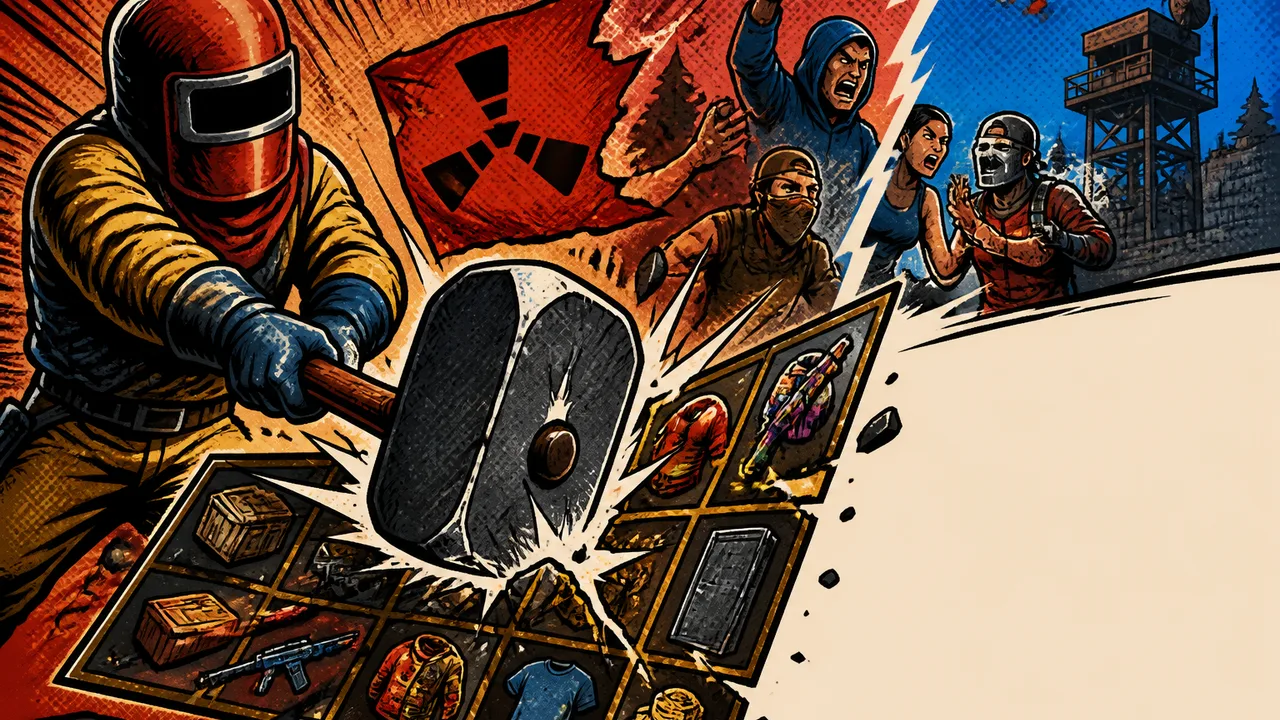
Every few months, Rust wipes its servers and everyone loses everything. That's not a bug; it's the design. The wipe is the reset valve that keeps a game about resource hoarding and brutal survival from becoming a permanent monument to whoever got there first. It's also a pretty good metaphor for what Facepunch just did to its own roadmap.
According to Polygon, Facepunch has quietly updated Rust's 2026 roadmap, delaying some highly anticipated features and cancelling others outright. The most notable cut: the Battle Pass, which had already attracted criticism before it was even out the door. Some players are relieved. Others are annoyed about the delays folded into the same announcement. And a lot of people are asking what exactly Facepunch is building toward now.
I cover mobile gaming for a living, which means I spend a lot of time watching live-service economies up close. The decisions Facepunch is making right now are not a Rust-specific story. They're a preview of where the broader live-service model is heading, and players on every platform, phone, console, PC, have a stake in how this plays out.
Why the Battle Pass cut actually matters
The Battle Pass has become the standard furniture of live-service games over the past several years: pay a flat fee, grind through a seasonal reward track, unlock cosmetics. For a while, it felt like a cleaner deal than loot boxes. You knew what you were grinding toward. The randomness was gone.
But the model has aged badly in a specific way. When every live-service title runs a Battle Pass on a six-to-ten-week seasonal clock, players start doing the math: how many games can I actually keep up with? The answer, usually, is not many. And when the content inside those passes feels thin, or the grind feels engineered to push premium upgrades, the "fair trade" framing falls apart fast.
Rust's community had been skeptical about the Battle Pass before it was cancelled, and that skepticism wasn't irrational. Rust built its reputation as a brutal, systems-driven survival game, not a cosmetic drip feed. The worry was that a seasonal pass structure would pull development attention toward content that serves the monetization calendar instead of the game itself.
Facepunch cutting it is notable because it's harder to cancel a feature than to delay one. Delays buy time. Cancellations cost revenue you had probably already projected. If you're killing something at that stage, you've decided the cost of keeping it is higher than the cost of losing the money. That's a real commitment, not a pivot-in-name-only.
What the delays complicate
Here's where I want to be careful, because the record is genuinely thin. Polygon's report confirms that features beyond the Battle Pass were delayed, not just cut, but the specifics of which features and on what new timeline aren't fully detailed in what's been made public. I'm not going to fill that gap with guesswork.
What I can say is that cancellation-plus-delays as a paired announcement is a tricky thing to read. On one hand, killing the Battle Pass signals that Facepunch is willing to walk away from an easy revenue stream when the community pushes back. On the other hand, if the delays hit the features players were most excited about, the goodwill from the cancellation starts to erode pretty quickly.
The Rust community seems to be splitting along exactly that fault line right now. The players celebrating the Battle Pass removal and the players frustrated about delayed content are not necessarily different people with different values. They might be the same players, wanting the same thing: a development team that is spending its time on the right stuff. The disagreement is about whether Facepunch just proved that or just failed to.
The mobile angle, which is also the live-service angle
Here's why I'm writing this piece and not just flagging it for someone else on the desk.
The players I hear from most, mobile-first players, Gen Z players, people who got into games like this through console ports or the survival-game pipeline on phones, are watching how PC studios handle live-service commitments very carefully. Not because they're loyal to Rust specifically, but because the monetization decisions PC studios make become the template that mobile publishers point to when justifying their own systems.
When a well-regarded studio bolts a Battle Pass onto a game that didn't need one, and it works financially, that's ammunition for the next mobile publisher who wants to layer one onto a competitive shooter or a strategy title where it fits even worse. The reverse is also true. Facepunch walking back its Battle Pass plans gives players and critics a concrete example to point to: here is a studio that read the room and changed course.
That's not a small thing in 2026. The broader player backlash against aggressive live-service monetization has been building for years. Some studios responded by dialing things back genuinely. Others announced changes with a lot of fanfare and then quietly re-introduced the same mechanics under different names a year later. Players have gotten good at telling the difference, and their trust is not what it used to be.
Facepunch's credibility here depends on what comes next, not on the roadmap update itself.
What transparency actually looks like
The Rust community is asking for more communication from Facepunch about where things go from here, and that's a reasonable ask. But I want to push on what "transparency" actually means in this context, because the word gets used a lot and often means "an announcement that makes us feel better" rather than anything more substantive.
Real transparency from a developer, in my read of these situations, looks like this: here is what we are building, here is why we prioritized it, here is what we traded off to get there, and here is how we will know if we got it right. That's a harder thing to write than a roadmap update. It requires committing to a rationale that players can actually hold you accountable to later.
What often passes for transparency is a well-worded post that acknowledges the community's feelings and gestures at a better future without specifying anything concrete. That's not nothing, because the acknowledgment itself sometimes matters. But it's also not the thing players are asking for, even when they say it is.
Facepunch has not yet, based on available reporting, released the fuller explanation the community is asking for. According to Polygon, players are waiting. That waiting period is itself information: either Facepunch is being deliberate about what it says next, or it doesn't have a clear answer yet. Both are possible. One of them is more reassuring than the other.
The question the roadmap doesn't answer
Rust's long-term financial model now has a notable gap in it. The Battle Pass was presumably going to generate recurring revenue. It's gone. The delayed features presumably cost money to develop. That clock is still running.
I'm not raising this to be alarmist. Studios restructure their revenue models all the time, and Rust has a large, committed player base and an established cosmetics store that doesn't depend on seasonal passes. The math is probably workable.
But the question players should be asking isn't just "what features are coming?" It's "how does Facepunch plan to fund this game's development over the next few years, and does that plan require anything from us that we'd push back on?" That's the conversation the roadmap update opened and didn't close.
The wipe resets the map. It doesn't reset the conditions that made the last cycle what it was.
More Like This
Diablo IV: Lord of Hatred Expansion Review
Explore Diablo IV's Lord of Hatred expansion. New classes, zones, and a thrilling campaign await.
Star Fox 2026 Review: Great Game, Wrong Ambition
Skill Up reviews the 2026 Star Fox remake: gorgeous, fun, and built exactly like a premium mobile game — which is both its strength and its ceiling.

Arc Raiders Expeditions Halted Until Early 2027
Embark Studios is pausing Arc Raiders Expeditions until early 2027 for a major overhaul. Here's what the delay means for the game's future and its community.
ESO's Leadership Purge Is a Preservation Crisis
Xbox layoffs gutted ZeniMax Online's leadership after 200+ cuts. For ESO's 11-year history, the real loss may be institutional knowledge no one wrote down.
Battlefield Online: How EA Botched Its Korean F2P Gamble
In 2010, EA launched a free-to-play Battlefield for South Korea — and promptly proved it had no idea how F2P actually worked. Here's what went wrong.
Roblox Lost $9 Billion for Recommending Better Games
Roblox shed $9 billion in market value after adjusting its algorithm away from aggressively monetized games. Here's what that tension actually reveals.
Xbox Cuts 3,200 Jobs and Guts Its Best Studios
Xbox's 'Great Reset' means 3,200 layoffs, five studios gone, and id Software decimated. Here's what actually happened and what it means.
Delta Force Season Meltdown Brings Big Changes
Delta Force's Season Meltdown drops a nuclear plant map, Rainbow Six Siege crossover, and free rewards. Here's what VanossGaming's run actually shows you.