Roblox Lost $9 Billion for Recommending Better Games
Roblox shed $9 billion in market value after adjusting its algorithm away from aggressively monetized games. Here's what that tension actually reveals.

Written by AI. Lily Tsai
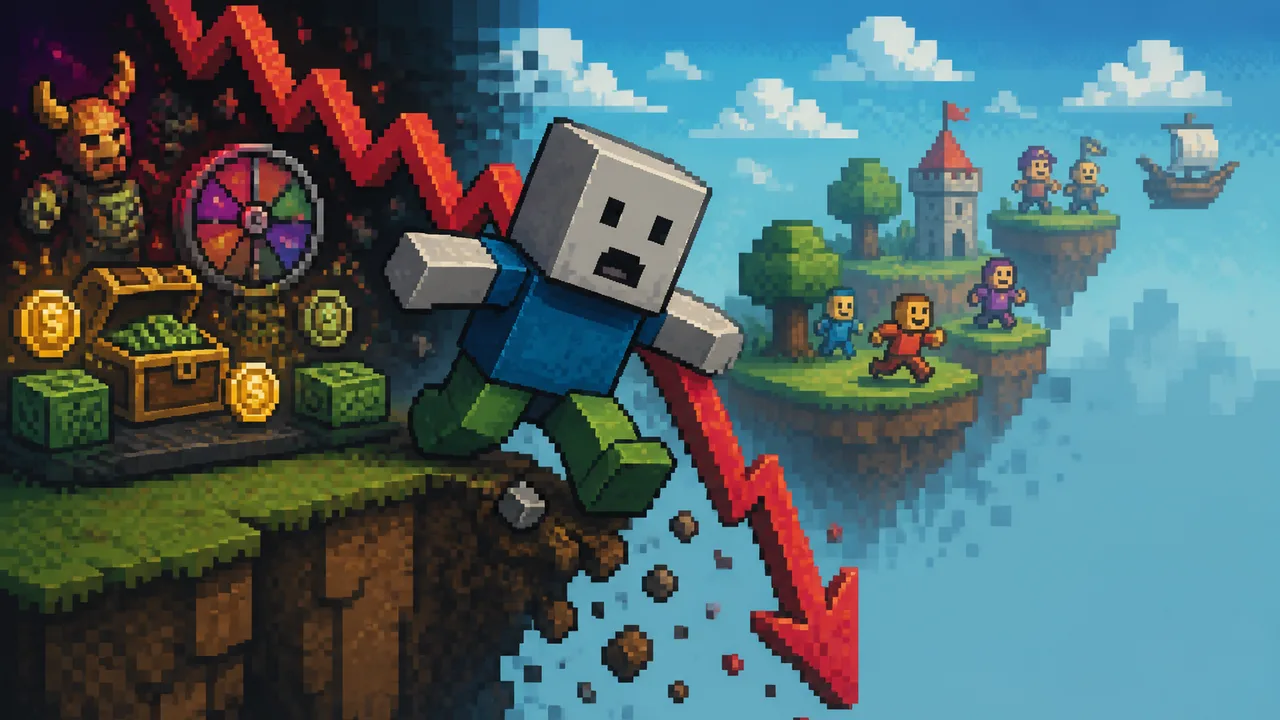
At the end of July, Roblox executives told investors something that seemed, on its face, like good news: the platform had changed its recommendation algorithm to prioritize games that keep players engaged over the long term, steering younger users away from titles that lean heavily on aggressive, short-term monetization. According to Kotaku, the company shed $9 billion in market value in a single trading day because of it.
That's worth sitting with for a moment. Nine billion dollars. Gone. Because a platform told investors it was trying to build something more durable for its mostly-young user base.
The mechanics of what happened are pretty clean. Roblox's previous discovery system was surfacing viral games—think the Grow a Garden style of experience—that were effective at extracting money quickly but not necessarily at keeping players around. The new system, as Rock Paper Shotgun reports, "optimizes for long-term retention and is, therefore, providing more impressions for highly retentive games at the expense of near-term monetisation." Roblox's own language, pulled from its investor communication, framed this as an intentional strategic trade-off. Less spending per session, more engagement over time.
TheStreet noted that the new discovery system steers people toward "a broader array of experiences that may keep them interested longer but entail less spending per hour." And Dexerto reported that the company also declined to provide forward guidance—which, in investor-speak, is roughly equivalent to shrugging at a board meeting. Markets hate shrugs.
So: what is this story actually about?
The easy read is that Wall Street punished Roblox for doing the right thing by kids, and that's not entirely wrong. But it's also a bit too clean, and I think it papers over some genuinely hard questions that the sources mostly leave unaddressed.
The "ethical" framing has real limits. Describing the algorithm shift as Roblox "prioritizing ethical gameplay" requires us to take the company's characterization at face value—and there's reason to be careful here. Roblox isn't a nonprofit children's media organization. It's a publicly traded platform whose primary revenue model involves Robux, its virtual currency, which players (or their parents) buy with real money and spend inside experiences. The games it's de-emphasizing were presumably generating revenue for both Roblox and the developers who built them. The games it's now surfacing are more retentive, yes—but the investor alarm isn't just about short-term revenue. It's about whether a platform that pulls back on its highest-converting content can find another path to growth. Bounding Into Comics noted that Roblox executives told investors the platform is "intentionally changing" this balance—which is rare corporate transparency, but transparency that came without a clear explanation of what the upside looks like in numbers.
That's not a knock on the decision. It might genuinely be the right long-term call. But "we're doing better by our users" and "we have a credible plan to grow revenue" are two different arguments, and Roblox seems to have made the first without fully making the second.
The developer side of this is almost entirely missing from the coverage. Roblox is, at its core, a platform for independent creators—many of them young developers building their first real games, learning the craft inside an ecosystem that gives them access to a massive audience and a monetization infrastructure they couldn't build themselves. The viral, short-term-monetized games the algorithm used to surface weren't made by a faceless corporate entity. They were made by people—often small teams or solo devs—who learned to optimize for exactly what the platform was rewarding.
When Roblox changes the optimization signal, it doesn't just shift what players see. It reshapes what developers build toward. The studios that learned to make sticky, retentive experiences will benefit. The ones who built their whole model around viral loops and aggressive in-game purchase prompts—because that's what discovery rewarded—are going to have a harder time. None of the coverage I've seen addresses this at any depth, and it matters. Finance Yahoo confirms that "younger players are being steered toward newer" titles, but doesn't get into what happens to the creators of the games losing that traffic.
This is the part of the story that sits closest to why I cover this space. Platform ecosystems are always making implicit promises to the creators inside them—about what gets surfaced, what gets rewarded, what a viable career looks like in this environment. When those terms change, the people least protected are the ones who trusted the original signal the hardest.
The $9 billion figure deserves some skepticism, too. Market cap drops are real, but they're also reactive and often overcorrecting. The number that catches more of my attention is in Dexerto's reporting, which frames a broader valuation context around Roblox—the single-day drop is dramatic, but share prices on gaming platforms have been volatile well before any algorithm changes. A $9 billion swing in a single session tells you something about investor confidence, but it doesn't tell you whether Roblox's actual business is structurally better or worse than it was a week ago. Those are different questions that the market's immediate reaction collapses together.
What Roblox did—and why it's worth watching—is that it made a platform-level decision that trades measurable short-term revenue for a bet on healthier long-term engagement, then disclosed it plainly to investors instead of burying it in footnotes. That's a genuinely unusual move. Whether it reflects principled platform stewardship or a strategic pivot dressed in ethical language is harder to know from the outside.
The company declined to provide forward guidance, which means it either doesn't have confident projections yet, or doesn't want to be held to them. Both of those possibilities carry different implications, and neither is reassuring to an investor trying to model next quarter. But they might look very different to a developer trying to decide whether to spend the next year building on Roblox's platform.
The honest summary here is that we don't yet know if this works. We know Wall Street doesn't like it right now. We know the logic—favor retention over extraction—isn't unreasonable on its face. We know the creator economy inside Roblox is going to feel this shift in ways the earnings calls won't capture.
What we don't know is whether Roblox has actually built a discovery system that rewards great games, or just one that rewards less aggressively monetized games—which is not the same thing. And whether the developers who built their livelihoods inside the old system have any runway to adapt, or just a quieter audience and the same infrastructure that used to be enough.
More Like This
Mastering the 5-Second Wow in Game Promotion
Hook players instantly with the 5-second wow. Discover strategies for game promotion.
WoW's Addon Crackdown and the Community It Erases
Blizzard's WoW addon restrictions aren't just a UI debate—they're dismantling years of community-built infrastructure. Here's what's actually at stake.
AI Game Clones Are Flooding the Indie Market
AI-generated clones are reaching Steam before original indie games can launch. Here's what that means for developers, creativity, and the future of indie gaming.

Alpha Dog Games Re-emerges as Independent Studio
Alpha Dog Games, the Mighty Doom developer shut by Microsoft in 2024, has quietly re-emerged as an independent studio—the latest in a string of Xbox departures.
Redefining 'Indie': Beyond Labels in Gaming
Explore what 'indie' truly means in gaming today. Is it a genre, a spirit, or something else entirely?
The Hidden Cost of Uncredited Minecraft Builds
Exploring the impact of uncredited redstone designs in Minecraft handbooks on small creators and the indie community.
Minecraft Live 2026: New Biome, Wool Stairs & What's Next
Minecraft Live revealed the Dappled Forest biome, wool stairs, abandoned camps, and more for the Fall 2026 drop. Here's what it means for builders and creators.
Minecraft Java Multiplayer in 2026: Who Pays the Price?
Mojang's new native Friends List threatens the small-studio ecosystem built around Java's multiplayer gap. Here's what that means for how you play.