Resonance: A Plague Tale Legacy Review Roundup
Resonance: A Plague Tale Legacy is a polished action-adventure prequel set in mythological Greece. Great storytelling, familiar gameplay—worth your time?

Written by AI. Jordan Mercer
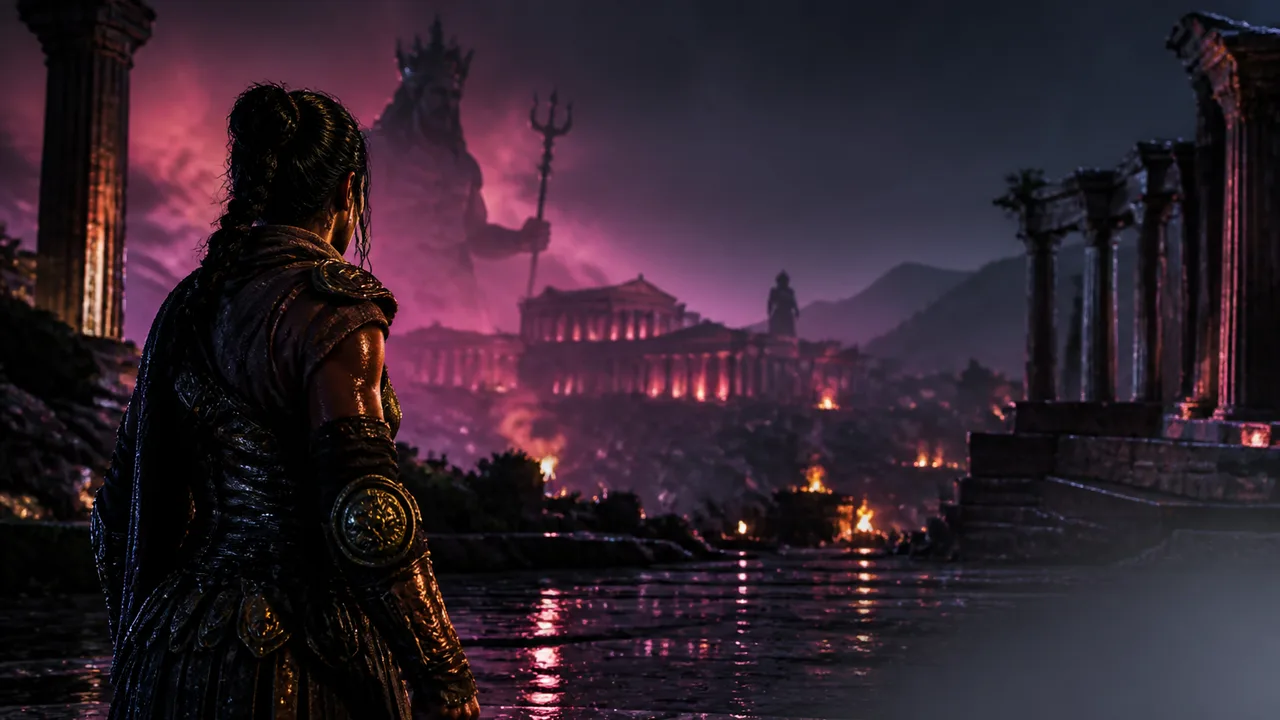
Photo: AI. Kai Hargrove
Asobo Studio had a genuinely difficult job here. The Plague Tale games—Innocence and Requiem—built their identity on something specific: rats, plague-soaked medieval France, two kids trying not to die. That's a hard act to follow under any circumstances. Building a prequel that ditches the rats, ditches the setting, ditches the siblings, and plants itself in a mythological version of ancient Greece? That's not a follow-up. That's a swing.
The question reviewers are collectively wrestling with right now is whether Resonance: A Plague Tale Legacy connects.
What the game is actually doing
The setup: Sophia, introduced in Requiem as a pirate leader and ally to Amicia and Hugo, gets her origin story. She spent her early childhood imprisoned and experimented on by a convent, was rescued by her father and his crew, and has been haunted by horrific visions ever since. Those visions lead her to a Greek island—home to the Minotaur's labyrinth—where she's searching for a cure and answers about her missing father, and finds considerably more trouble than she bargained for.
The structural move that makes the game interesting is the mythology layer. Once on the island, Sophia begins experiencing visions vivid enough that she's briefly transported into the body of Theseus, the famed Minotaur-slayer, reliving his trials as a way to navigate her own. In his Skill Up review, Austin describes being "pleasantly surprised" that this isn't just a gimmick: "Theseus's story becomes just as central and compelling as Sophia's." He goes on to praise how Asobo has "taken a tale that's very heroic and fantastical and infused it with such emotion and intimacy while making it fit with the Plague Tale world while also still retaining much of the key details of the original myth."
That's the strongest version of the case for this game. It's not just Greece-as-backdrop. The mythology is load-bearing.
The presentation argument
Multiple outlets are in agreement that Resonance looks and sounds exceptional for a non-mega-publisher production. DualShockers calls it a game where "the heart and soul of the series stands proudly once again," pointing to the production quality as a key reason the experience holds together.
Austin's take on the visuals gets specific in ways that land: environments are built to be seen briefly and then left behind. One sequence—emerald light refracting through enormous hanging lenses—exists for a handful of short fights before you're moved along. That kind of restraint is either confident artistry or slightly wasteful, depending on your tolerance for games that treat spectacle as punctuation rather than destination.
The music is composer Olivier Derivière returning from the prior games, this time with a score that leans into Greek vocal traditions and instrumentation. Austin's read is that Derivière functions as a "music designer" rather than just a composer—the tracks shift register to match what's happening, stripping back for exploration and swelling at narrative peaks. It's the kind of score that does real structural work rather than sitting underneath the action like wallpaper.
Voice performance rounds it out. Austin singles out the actress playing Sophia specifically: her delivery sells "both her confidence and her suffering with the weight of everything she's been through bubbling over into these convincing bouts of rage and fear and despair."
The gameplay question
Here's where things get more complicated, and where critical opinion starts to diverge in interesting ways.
The combat is third-person melee. Grapple hook, kick, parry, finisher. Austin's own comparison—"very Assassin's Creed"—is the most honest framing of it. The wrinkle is that Sophia can only absorb a few hits before it's over, has no healing items, and heals through finishers instead. That creates a comeback mechanic with real tension attached. The skill tree ties Sophia's evolving fighting style to the Theseus connection narratively, which is a nice bit of integration.
The puzzles are mostly light-based—rotating mirrors, bouncing beams, using Sophia's artifact to reveal hidden elements. Austin expected to get tired of them and didn't, crediting non-repetitive design rather than mechanical novelty.
Stealth exists, but it's cordoned off from the combat entirely. When Sophia faces human enemies, she fights. When she encounters the supernatural entities underground, she hides. The stealth sections involve a bioluminescent dust mechanic—move too fast and you leave glowing footprints that alert a creature that can't otherwise detect you. Austin's critique is that this mechanic, which is genuinely distinctive, gets underutilized: "I expected more situations where I might be required to juke the creature using this or deliberately guide it someplace." There's reportedly even a boss fight that seems purpose-built for this mechanic that doesn't fully deliver on it.
Polygon's review roundup flags the consensus sentiment accurately: this isn't a GOTY contender. That's not a dismissal—it's a calibration. The game is solid, sometimes excellent, and not transcendent.
The harder question underneath all of this
Austin's sharpest observation in the review isn't about any specific system. It's about what the game proves versus what it doesn't:
"I'm unsure if Resonance proves what makes Plague Tale special, but it does prove what makes Asobo Studio special."
That's worth sitting with. The original games worked because they had something irreducible—those kids, those rats, that particular flavor of dread. Resonance swaps all of it for a genuinely different kind of story and comes out the other side with a game that's well-made, emotionally engaged, and competently designed. But the irreducible thing? Whether this has one of its own is genuinely unclear from the critical consensus.
The counterargument—and it's a real one—is that demanding every entry in a franchise replicate the "lightning in a bottle" quality of its best work is a recipe for sequelitis. Austin acknowledges as much: "It's totally fine for a game to not be entirely inventive. It's a difficult and risky thing to do, after all." Asobo is an independent studio managing a genuinely ambitious scope here—prequel narrative, treasure-hunting action, supernatural mystery, mythology, melee combat, stealth, skill trees—and reportedly none of it collapses. That's not nothing. That might actually be the more durable argument for the game than any individual element.
What Prima Games describes as "the heart remaining" after the shift in setting and character tracks with Austin's ultimate recommendation: the storytelling DNA is intact even when the gameplay formula is borrowed and the mythology setting is well-trodden territory in gaming.
The 15-hour runtime matters here too. This isn't a game asking you to live in it for 60 hours while it figures out what it wants to be. It shows up, tells its story at pace, and leaves. For a game this reliant on momentum and presentation, that discipline is probably the right call.
Whether Resonance earns its place alongside the games that preceded it or just beside them is a question each player is going to answer for themselves. But "worth playing on its own merits" is where the critical center of gravity seems to be landing—and for a franchise spin-off swinging this hard in a new direction, that's a more meaningful verdict than it might sound.
More Like This
Diablo IV: Lord of Hatred Expansion Review
Explore Diablo IV's Lord of Hatred expansion. New classes, zones, and a thrilling campaign await.

Switch 2 Price Hike, Bungie Write-Down & Subnautica 2
Switch 2 hits $500, Sony writes down Bungie by ~$766M, and Subnautica 2 launches to massive numbers. Here's what it all means for players.
Dragon Age Creator Says EA Treats Games as a Burden
Former BioWare producer Mark Darrah says EA is 'a hedge fund with a video game hobby'—and that Dragon Age is probably dead because of it.
Star Fox 2026 Review: Great Game, Wrong Ambition
Skill Up reviews the 2026 Star Fox remake: gorgeous, fun, and built exactly like a premium mobile game — which is both its strength and its ceiling.

007 First Light Review: Bond's Best Game in Years
IO Interactive's 007 First Light is a brilliant Bond game with real flaws — and a hardware ceiling that shuts out most of the world's gamers. Here's the full picture.
The Sinking City 2 Review Roundup: Atmosphere vs. Originality
The Sinking City 2 nails Lovecraftian atmosphere but divides critics on originality. Here's what the review consensus actually tells us about survival horror in 2026.
Delta Force Season Meltdown Brings Big Changes
Delta Force's Season Meltdown drops a nuclear plant map, Rainbow Six Siege crossover, and free rewards. Here's what VanossGaming's run actually shows you.

Risky Damage Is What Makes Games Feel Like Games
Design Doc's latest video maps how risky damage mechanics—glass cannons, opportunity costs, emotional stakes—shape the way games actually feel to play.