Risky Damage Is What Makes Games Feel Like Games
Design Doc's latest video maps how risky damage mechanics—glass cannons, opportunity costs, emotional stakes—shape the way games actually feel to play.

Written by AI. Jordan Mercer
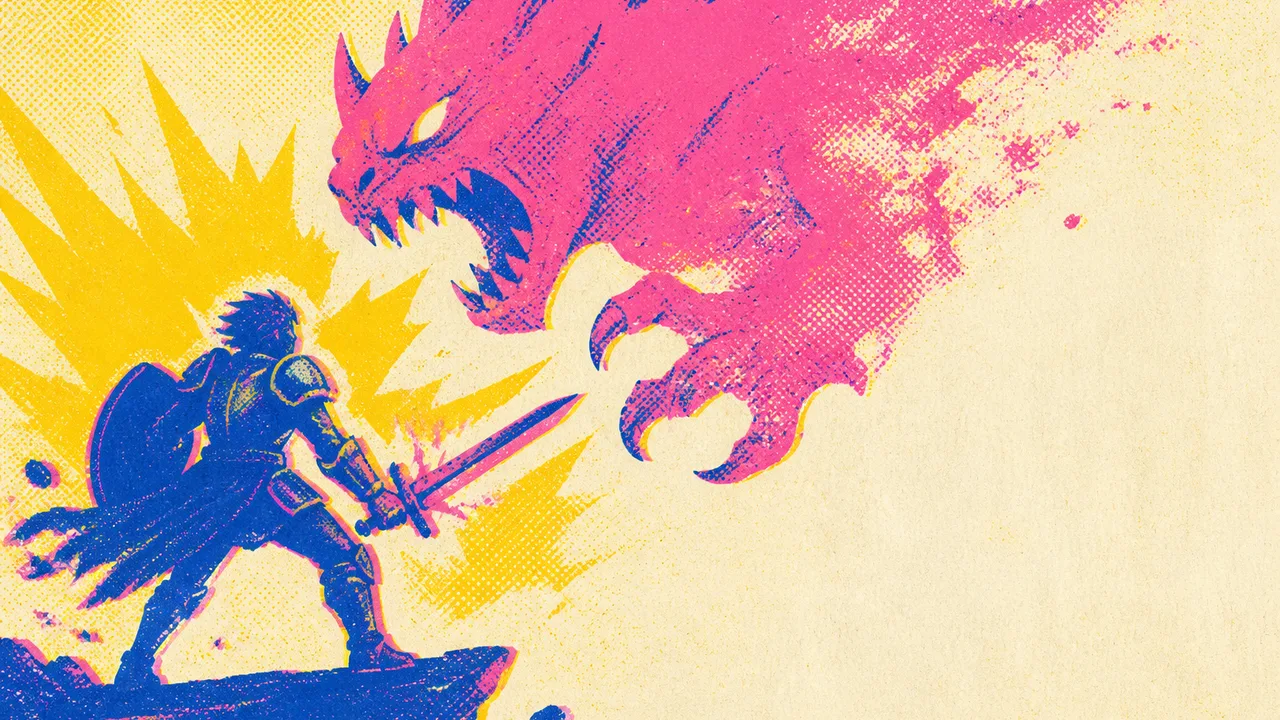
Photo: AI. Jorah Maktoum
Here's a question that sounds dumb until it doesn't: why don't developers just hand players the most powerful move in the game from the jump and let them go absolutely feral?
Design Doc's latest video — a deep-dive on what they call "risky damage" — opens with exactly that question, and the answer is the whole thesis. Give a player unlimited, consequence-free destruction and you haven't made a game. You've made a screensaver with a controller. As Design Doc puts it: "Balancing moves can turn a bunch of flashy graphics into a game." The decisions, the friction, the moment where you ask yourself is now the time? — that's where the game lives.
I've been thinking about this from the angle I always think from, which means I immediately started cataloguing every mobile game that's been doing versions of this for years, sometimes brilliantly and sometimes in ways that should probably be prosecuted. More on that in a second. First, let me walk through the framework, because it's genuinely useful and covers more ground than you'd expect.
The Taxonomy of Risk
Design Doc breaks risky damage into several distinct flavors, and the distinctions matter.
Vulnerability trade-offs (the glass cannon). The simplest version: you hit harder, you die faster. Mina the Hollower hands players an accessory early that doubles both damage dealt and damage received. No tricks, no hidden catch — just a clean dial. The elegance is in the transparency. You know exactly what you're signing up for.
The failure mode of this approach shows up in Paper Mario: The Thousand-Year Door. The "Danger Mario" build stacks badges that activate when Mario is near-dead, in theory creating a perpetually fragile glass cannon. Except by the time you have enough badges to run the build properly, you also have enough badges to neutralize every downside. The glass cannon becomes just a cannon. Design Doc's warning here is worth repeating: "If you've built a powerful move with a downside, then you build a thing that nullifies the downside, you're back to where you started." Intentional or not, that's the Paper Mario problem — and it's a trap that catches a lot of designers who forget to audit their own systems holistically.
Opportunity cost. This is the one mobile designers have been stress-testing for decades, and I mean that with full complexity. The question isn't "can you use your big move?" It's "should you use it now, knowing you won't have it later?" Scarcity forces prioritization, and prioritization is strategy.
Design Doc uses Resident Evil: Requiem to illustrate this — specifically, the survival horror sections featuring limited-use weapons that can permanently neutralize threats. I'll note that the game's specific campaign details are as Design Doc presents them in the video, so I'm going to attribute the particulars to them rather than characterize this as settled common knowledge. The broader point, though? Sound. When a powerful resource is finite, every use is a decision with a permanent consequence. "A core part of why that survival horror resource gameplay loop is such a draw is that it makes players have to weigh their options."
If that sounds familiar to anyone who's ever sat on a maxed-out inventory in a gacha game afraid to spend their saved-up premium currency — yeah. That's the same psychological machinery. The difference is that in survival horror, hoarding has a cost too (you're dying in hallways you could have cleared). In gacha, the house often benefits from you never spending. Same system, very different incentive structures on the back end. Something to think about.
Commitment risk. Monster Hunter built an entire genre around this one. Heavy weapons, long animations, the sick feeling when you commit to a swing and the monster sidesteps during your windup. You're locked in. The monster is not. Learning that rhythm — learning when the window is open — is the game. Design Doc makes the point that this same dynamic runs through fighting games, just at much tighter timing windows with a human opponent trying to bait those commitments out of you. High-level play is basically an extended conversation about who can force whom into a bad animation lock first.
Emotional cost. This is where Design Doc's video earns some real respect for range. Fuga: Melodies of Steel features a soul cannon that can end any boss fight instantly — by permanently sacrificing one of the child characters you've been building relationships with throughout the game. The character is gone. Their interactions are gone. The crew spirals into depression. You win the fight and the game's tone cracks open.
Design Doc draws a clean distinction between this and Fire Emblem's permadeath: "In Fire Emblem, permadeath isn't entirely within your hands... In Fuga, you have to pull the trigger." That's not a small difference. One is a consequence you cope with. The other is a choice you made. The moral weight lands differently, and the design is intentional about that. I find this the most underexplored category in the video's taxonomy — games that use emotional architecture as the actual cost of power. There's so much room here that hasn't been mapped yet.
Backfire risk. Clair Obscur: Expedition 33 runs its entire combat philosophy through this lens. Parrying in E33 isn't just defensive — a successful parry converts your defense into a counterattack, gaining AP and dealing damage. But the timing window is narrow, and if you miss it, you take the full hit. Build a character around parrying and you can become an unstoppable damage engine. Miss your windows and you evaporate. The game is constantly asking: do you trust yourself enough to take that risk? High-level E33 play is basically a series of confidence assessments at speed.
Self-directed risk. Ace Combat handles this without any formal mechanic at all. There's no system telling you how close to the ground you can fly. You just... know when you've pushed it too far, usually right before you don't. The risk emerges from player impatience colliding with consequence. Star Fox 64 forgives you the same crashes, which Design Doc notes isn't a lesser approach — it's a different one, enabling a looser, more chaotic level geometry that wouldn't work if every contact was fatal.
Role-based risk. TF2's Spy gets a full section, and it deserves it. The Spy's knife is a one-hit kill on a backstab — one of the highest-damage single hits in the game. The cost is that you're playing a completely different game than everyone else on your team: disguising, cloaking, reading paranoia levels, committing to approaches that collapse completely the moment someone decides to check. Design Doc acknowledges the trade-off involved, and I'll leave the competitive viability question to people actively running TF2 scrims right now. What's interesting from a design perspective is the concept itself — a character balanced not by stat tuning but by requiring an entirely different cognitive mode to play.
What I Actually Think
The framework Design Doc builds is solid, and the examples are well-chosen. But there's one thing I'd push back on, or at least extend: the video treats all these risk types as roughly equivalent tools in a designer's kit. I'd argue they're not. Emotional risk (Fuga's soul cannon) and mechanical risk (Monster Hunter's animation lock) operate on fundamentally different layers of the player psyche. Mechanical risk trains out over time — you learn the timing, you improve. Emotional risk doesn't work that way. You don't get better at sacrificing a character you've spent twenty hours with. That asymmetry is worth sitting with when you're deciding which lever to pull.
The design sin I most want developers to stop committing? Building the downside in, then accidentally building the workaround in too, and shipping both because the broken version tested well. Paper Mario's Danger Mario build is the gentle example. Mobile gaming has harder examples — the ones where the "risky" resource is so easily replaced with real money that the risk was always theatrical. That's not risky damage. That's a subscription fee wearing a combat mechanic's clothes.
The difference between a system that makes you feel the weight of a decision and one that just simulates the feeling of weight — that gap is where game design actually lives. And it's the question every designer using any of these tools needs to answer honestly before shipping.
More Like This
I Tested Claude Design: Here's What Happened to My UI
Developer OrcDev spent hours testing Anthropic's Claude Design AI tool. The results reveal what AI can—and critically can't—do for interface design.
Diablo IV: Lord of Hatred Expansion Review
Explore Diablo IV's Lord of Hatred expansion. New classes, zones, and a thrilling campaign await.
Claude Design's Hidden Cost: Why Your Usage Quota Vanishes
Claude Design makes iterating on UI blazingly fast—but you'll burn through 25% of your weekly quota before you finish a landing page. Here's what actually matters.
Spellbound Weapons: The Minecraft Mod Mojang Wouldn't
Skip the Tutorial tests the Spellbound Weapons data pack's 20 magic weapons against Minecraft's warden. Some are brilliant. Some hit their own user. All are fascinating.

Markiplier's Subnautica 2 Shows Why Survival Games Hook Us
Markiplier's Subnautica 2 Part 5 is a masterclass in survival game pacing — lost footage, the Tadpole sub, and lore that's genuinely unsettling.
How to Pick the Right Art Style for Your Indie Game
Imphenzia's framework for choosing an indie game art style covers 15+ options and four must-pass tests. Here's what it gets right — and what it leaves open.

GTA VI Pricing, Bungie's Fall, and Xbox Price Hikes
GTA VI's $100 tiered pricing, 292 Bungie layoffs, and Xbox's third price hike in 15 months — a week that clarified who gaming is actually for.
Star Fox 2026 Review: Great Game, Wrong Ambition
Skill Up reviews the 2026 Star Fox remake: gorgeous, fun, and built exactly like a premium mobile game — which is both its strength and its ceiling.