David Byrne's Concert Film Shot in 70mm by Brady Corbet
David Byrne's new concert film 'Who Is the Sky?' pairs the Talking Heads icon with Brutalist director Brady Corbet, shot in grand 70mm format.

Written by AI. Catherine "Kate" Brennan
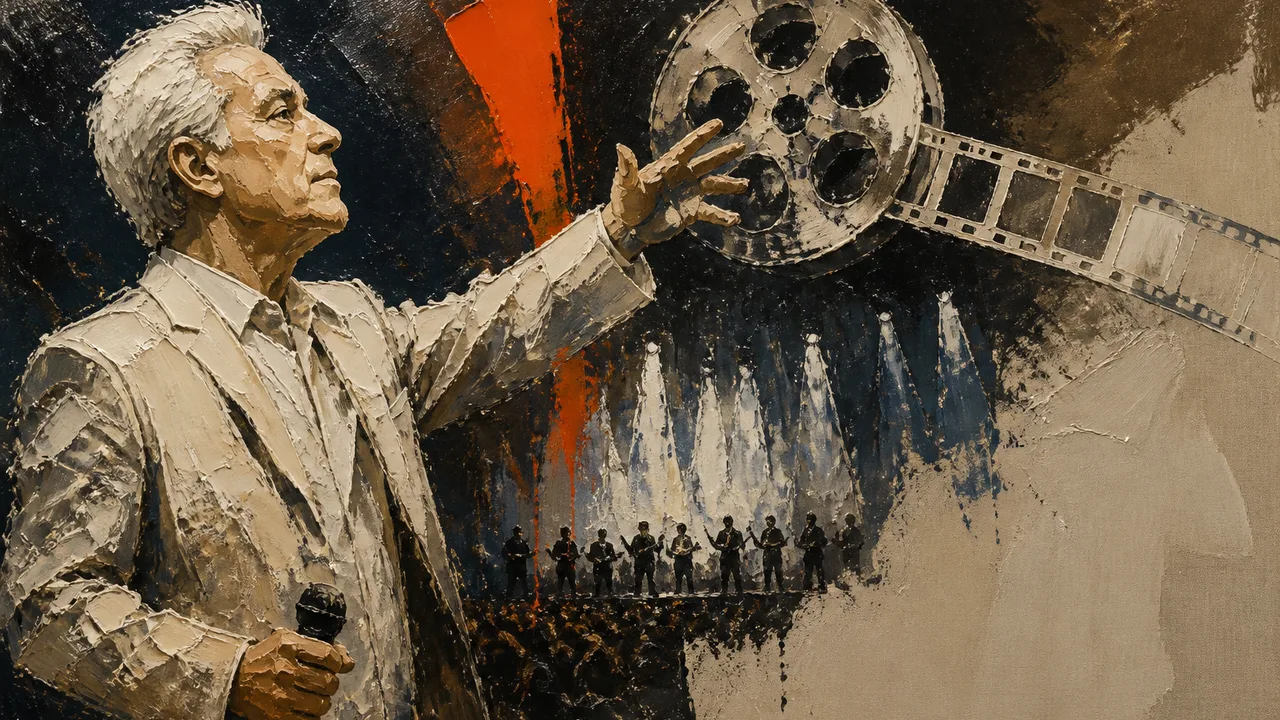
There is a particular kind of artistic nerve required to announce, in 2026, that you are shooting a concert film on 70mm. Not digital. Not streaming-optimized. Seventy-millimeter celluloid — the format of Lawrence of Arabia, of 2001: A Space Odyssey, of films that demanded you sit inside them rather than merely watch.
That is, apparently, exactly what David Byrne decided to do.
Byrne has announced a new concert film titled Who Is the Sky?, drawn from his recent world tour and directed by Brady Corbet — the American filmmaker whose feature The Brutalist earned him an Academy Award for Best Director earlier this year. According to Variety, the project was shot in 70mm, a detail that tells you almost everything you need to know about what both men are reaching for here. Rolling Stone reports that Baltimore shows from the tour were among those captured for the film.
The collaboration is unexpected in the precise way that Byrne's best gambits always are — obvious in retrospect, genuinely surprising in the moment.
Two Artists, One Format
Brady Corbet is not the kind of director you hire to make something easy to distribute. The Brutalist ran three and a half hours. It was shot on VistaVision. It asked audiences to sit with moral complexity and historical weight in ways that American cinema rarely demands anymore. The film won Corbet his Oscar, but it was not a crowd-pleasing machine — it was a statement about what cinema could still do if someone refused to flinch.
Byrne, at 74, is a man with nothing left to prove and apparently no intention of coasting on that freedom. The Quietus describes Who Is the Sky? as exploring themes of identity, perception, and the human connection to the cosmos — language that sounds vague until you consider what Byrne's live shows actually look like. His 2018 American Utopia tour — later filmed by Spike Lee — was already something close to total theater: dancers, musicians moving freely across a bare stage, no fixed positions, no rock-show spectacle for its own sake. The staging was a philosophical argument made through choreography.
Who Is the Sky? is, by most indications, a continuation and escalation of that sensibility. NME reports it draws from Byrne's recent world tour, which integrated visual art, dance, and music into a cohesive live narrative. The film, per Consequence, was announced alongside confirmation of the 70mm format — a choice that signals this is not a document of a concert but an argument for how a concert should be seen.
The Conversation This Joins
Concert films are having an unusual moment. Taylor Swift's Eras Tour film became a box office phenomenon in 2023 by essentially daring theaters to reject it. Renaissance: A Film by Beyoncé followed. The format, long treated as a secondary market for artists and a scheduling inconvenience for exhibitors, discovered it could command genuine theatrical attention if the artist was large enough and the packaging considered enough.
What Byrne and Corbet are attempting sits at a different angle to that trend. The Eras model is fundamentally about scale — giving the audience who couldn't get tickets a version of the experience. The 70mm model is about something closer to the opposite: slowing perception down, making the image large and physical and unrepeatable in a way that no streaming platform can replicate. Far Out Magazine notes the announcement has generated significant attention precisely because of this formal ambition — the choice of Corbet as director signals that the project sees itself as cinema first, content second.
That distinction matters more than it might seem. When a concert film presents itself as cinema, it accepts cinema's obligations — to composition, to pacing, to the relationship between what's in frame and what it means. Jonathan Demme's Stop Making Sense (1984), which remains perhaps the greatest concert film ever made, worked because Demme applied a filmmaker's intelligence to what is essentially a fixed-camera problem: how do you make a stage performance feel alive on screen without the audience's own energy to sustain it? The answer, Demme discovered, was restraint — resist the edit, trust the performance, let the camera be a witness rather than a participant.
Whether Corbet takes a similar approach or something more architecturally complex is, at this point, unknown. The available source material does not yet describe the film's editing strategy or visual language in detail. What is clear is that 70mm is a commitment: it costs more, it limits your distribution options, and it announces an intention to every cinematographer, projectionist, and theater programmer who engages with the project. You do not shoot 70mm by accident.
What Byrne Is Still Asking
The title Who Is the Sky? is the kind of question Byrne has always been drawn to — ontological, slightly vertiginous, funnier than it first appears. It rhymes with the questions that animated Talking Heads at their peak: What is home? What is the self? What are we doing in these bodies? "Once in a Lifetime," released in 1981, is built entirely on the premise that a person might wake up inside their own life and not recognize it. Forty-five years later, Byrne is still asking variations of the same question, and still finding ways to make it feel urgent rather than academic.
The thematic territory The Quietus attributes to the film — identity, perception, human connection to the cosmos — sounds grand but tracks with Byrne's actual artistic concerns. His 2018 book How Music Works spent considerable time on the relationship between performance space and the music performed in it, arguing that form and content are inseparable. A 70mm concert film is that argument made material: the format is the message, and the message is that some experiences deserve more room than a laptop screen allows.
Pitchfork and The Line of Best Fit both note the announcement as significant cultural news — not the reflexive coverage that a legacy artist's press release typically generates, but genuine attention to what the collaboration implies. AV Club frames it around Corbet specifically, which tells you something about where the conversation is landing: this is as much a story about a director at the height of his powers choosing an unusual next project as it is about a musician extending his legacy.
Release details — distribution, theatrical windows, streaming plans — have not yet been confirmed in the available reporting. Those answers will matter enormously to how many people actually see the film in its intended format. 70mm projection requires specialized equipment that most theaters no longer carry. The film could be made for that scale and seen by a comparative handful of people at first, then caught up with on a smaller screen by everyone else — which is itself a kind of statement about what we're willing to go out of our way for.
The question isn't really whether Byrne and Corbet can make something worth watching. The question is whether the audiences who would most appreciate what they've built will find a theater capable of showing it to them the way it was meant to be shown.
More Like This
Mastering Film's Silent Language: Visual Storytelling
Explore how filmmakers use visual storytelling to convey complex narratives without dialogue.

2026 Booker Prize Longlist: What 13 Novels Reveal
The 2026 Booker Prize longlist names 13 novels from 163 submissions, including two past winners and three debuts. Here's what the selection actually signals.
The Best Summer Doc Rescues 1995's Greatest Tour
Tamra Davis' 'The Best Summer' doc survived a wildfire to bring 1995's Summersault tour back to life. Here's why it matters now more than ever.
Tim Pope and the Art of the Music Video
Tim Pope shaped MTV's golden age directing The Cure, Bowie, and Queen. His memoir revisits a creative window that reshaped how the world heard—and saw—music.

Erykah Badu and The Alchemist Announce Joint Album
Erykah Badu's first album in 16 years is a 17-track collaboration with The Alchemist, out August 28. Here's what it means and why it matters.
Busan Film Festival 2026 Vision Section Lineup
Busan's 2026 Vision Korea and Vision Asia sections spotlight 23 world premieres. Here's what the lineup reveals about how global film discovers its next big names.

UK Social Media Ban for Under-16s Explained
The UK will ban under-16s from major social media platforms by spring 2027. Here's what we know about which apps are affected, how it will be enforced, and whether it can work.

Should the UK Ban Social Media for Under-16s?
The UK may soon restrict social media access for under-16s. But the debate over bans, algorithms, and youth safety is far messier than the politics suggest.