Should the UK Ban Social Media for Under-16s?
The UK may soon restrict social media access for under-16s. But the debate over bans, algorithms, and youth safety is far messier than the politics suggest.

Written by AI. Catherine "Kate" Brennan
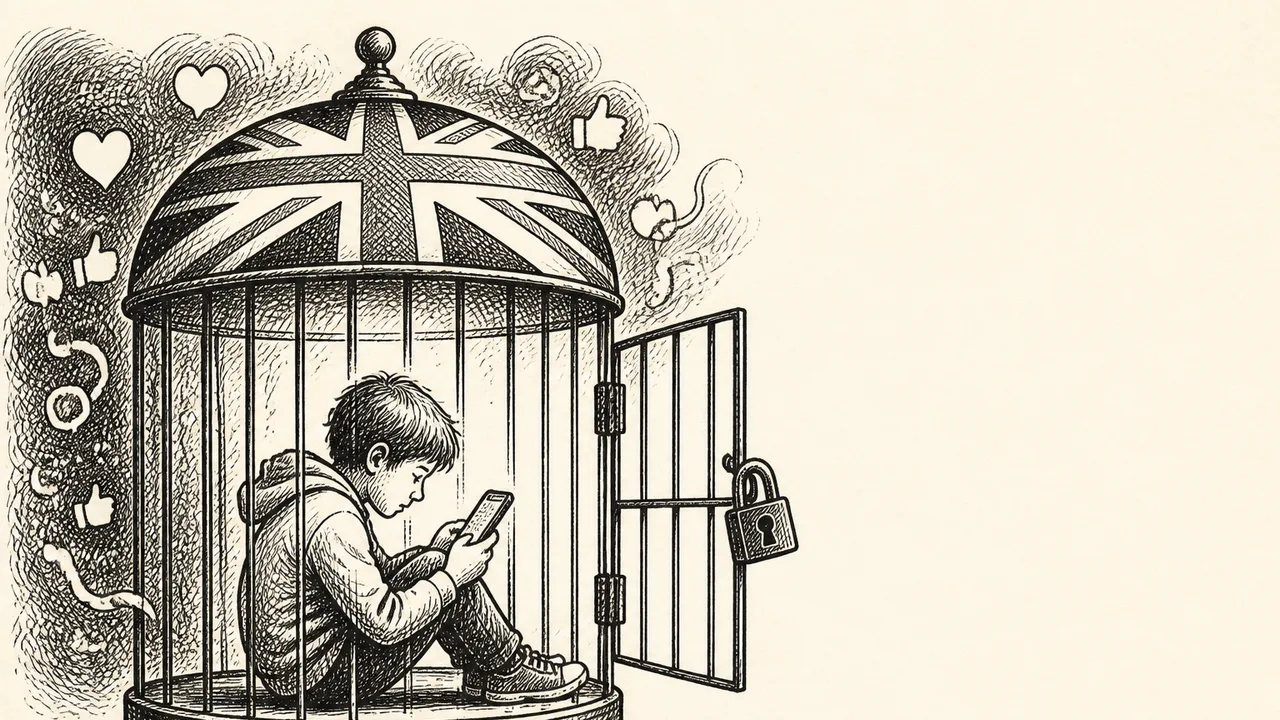
Photo: AI. Eira Pendragon
There is a statistic buried in the UK government's own consultation on youth social media use that tells you something important about what we're actually measuring. Sixty percent of three-to-five-year-olds, it reports, have their own social media account. That number lands with a thud — until you ask the obvious question, which is whether a four-year-old's YouTube account, cobbled together by a parent to play Teletubbies on loop, is the same thing as a teenager using Instagram at midnight.
That distinction matters, and the fact that the consultation apparently doesn't make it cleanly tells you something about the quality of evidence underpinning what could become some of the most consequential digital regulation in recent British history.
Keir Starmer's government is expected to announce significant restrictions on young people's social media access imminently — with the under-16s ban that the House of Lords has long pushed for now apparently inevitable. Alongside it: possible blocks on gaming platform communications with strangers, and limits on AI chatbot use. The political backstory, as Matt and Marianna on the BBC's Top Comment podcast lay out, is that Starmer was initially reluctant and has effectively been cornered — by the Lords, by public opinion, and by the kind of cross-party attack window that populist policy creates.
It's worth sitting with that for a moment. This is not a story about a government seized with a bold regulatory vision. It's a story about a government being pushed by political gravity toward a policy that 74% of the public supports, that costs essentially nothing to announce, and that opponents can only criticize at some political risk to themselves.
That doesn't make the policy wrong. But it should inform how we read what follows.
What the kids actually want
One of the more clarifying data points in the BBC discussion is that young people themselves want regulation — just not necessarily this regulation. Half of 16-to-24-year-olds say they wish they spent less time on social media. Three-quarters of that age group want tougher rules to protect young people from harmful content. These are not the views of a generation that sees platforms as sacrosanct.
What teenagers describe wanting, based on reporting from journalists who've actually spoken to them, is fairly specific. As Marianna Spring put it on the podcast: "We kind of want to be able to use social media in so much as we want to be able to talk to our friends and to look at stuff we find funny or interesting, but we don't want to be recommended stuff that we don't like seeing."
That is a precise complaint about algorithmic recommendation systems. It is not a complaint about social media as such. And the frustration teenagers describe — clicking "see less of this" and being served more of the same — is not a design flaw. It's a feature of systems optimized for engagement over preference. Ofcom's findings on TikTok and YouTube bear this out: these platforms are not accidentally failing young users; the mechanics of failure are baked into how they make money.
The accountability vacuum that produced this moment
The reason we've arrived at blunt-instrument policy is because of the absence of any other kind. Social media companies have had years to build safer environments for minors and have largely declined to do so in any meaningful way. The UK's medical establishment has been raising the alarm long enough that the question has shifted from whether harm exists to what governments are prepared to do about it.
Molly Russell died in 2017. A coroner found in 2022 that Instagram and Pinterest content had contributed to her death — material that a recommendation algorithm had actively surfaced to a 14-year-old who was already struggling. Her father, Ian Russell, has since become one of the most prominent advocates for platform accountability. His position, notably, is not that a ban is the answer. He wants structural regulation: the kind that addresses how content gets amplified, not just who can log on.
The mother of Brianna Ghey — a 16-year-old trans girl murdered in 2023, whose killers had been radicalized in part through violent online content — takes a different view and does support the ban. She has also floated an idea that doesn't get enough attention: hardware-level restrictions, devices designed for under-16s that can only access pre-approved applications. It's a more elegant solution than an age gate, and one that doesn't depend on teenagers being unable to find workarounds — which, as anyone who has spent time around teenagers knows, is not a safe assumption.
The enforcement problem nobody has solved
Age verification is the load-bearing wall of any ban, and it is not yet structurally sound. Frances Haugen, the Meta whistleblower, has invested considerable effort in studying the problem. The unresolved tension is real: requiring ID verification to access social media protects some young people while potentially exposing others — particularly LGBTQ youth in hostile environments — to genuine danger. If a 15-year-old in a small town is using an online community to quietly figure out who they are, forcing that teenager to submit government ID to stay in that space is not a neutral act.
This is where the critique from commentators like Taylor Lorenz carries legitimate weight, even if the political company it sometimes keeps is uncomfortable. The argument that bans can function as tools to suppress minority congregation online is not paranoid. In the US, some of the most enthusiastic support for youth social media restrictions comes from conservative advocacy groups that explicitly want to limit queer community formation. That alliance — between child safety advocates and those with very different motivations — deserves scrutiny, not dismissal.
So does the opposite coalition. The loudest corporate opposition to this legislation comes from trillion-dollar tech companies whose business model depends on capturing young attention. Influencers and creators whose livelihoods depend on platform access have been vocal. The fact that some critics of these bans have material interests in opposing them doesn't make their arguments wrong, but it belongs in the frame.
The democratic question
The BBC discussion raises the most uncomfortable argument last, and it's the one that lingers. Youth-led social media movements have toppled governments — in Kenya, Bangladesh, Nepal. Authoritarian states have historically moved to restrict social media access precisely because it enables political organization. Iran did it. When democratic governments start legislating who can access platforms, the anti-democratic analogy is imperfect but not frivolous.
The counter-argument is that there is a category difference between a government restricting access to prevent political dissent and a government restricting access to protect minors from algorithmically-delivered harm. That distinction is real. But the podcast's point holds: the mechanisms can look similar, and once established, they are not always easy to reverse. A senior Labour figure told the podcast explicitly that the ban is partly a demonstration of governmental teeth — a warning to platforms that if they don't clean up their act, the restriction stays. That framing treats the ban as leverage rather than settled policy, which suggests that even its architects see it as provisional.
What's actually on the table
The spectrum of interventions being discussed runs from the nuclear option — hard age gates, no access — to surgical alternatives: eliminating infinite scroll, requiring recommendation systems to be opt-in rather than opt-out, building what researchers call algorithmic pluralism into platforms so that younger users aren't fed the same engagement-maximizing diet as adults. The podcast's hosts make the point that this middle path would probably have been preferable — but it may no longer be politically available, because the companies that were positioned to offer it didn't, and now blunter instruments are on the table instead.
The political ping-pong is real too. Regulatory appetite in the UK has visibly tracked the winds coming from Washington — and with an administration now in the US that is actively asking Britain not to impose these restrictions (nominally on free speech grounds, practically because it would burden US-based platforms), the geopolitics of this are not simple.
What's clear is that the debate has for too long been conducted as if users — particularly young ones — were either victims to be protected or savvy operators to be trusted, with nothing in between. The evidence suggests they are neither. They are people who can articulate with some precision what they want from platforms and what they don't, and who have been watching institutions fail to act on that for years.
The question now is whether a ban, even an imperfect one, forces a reckoning that more targeted regulation never quite managed to produce — or whether it simply drives the same harms underground, where they're harder to see and impossible to regulate at all.
More Like This
Is Nature Good? Harari and Žižek Say No
Yuval Noah Harari and Slavoj Žižek agree: nature isn't inherently good. Their debate reveals why "natural" is almost always a political argument in disguise.

UK Doctors Say Social Media Harms Kids. Now What?
UK's top doctors say social media harms kids like smoking harmed adults. Here's what that actually means for schools, clinics, and parents right now.

Kane Parsons on the Backrooms Film and YouTube Filmmaking
Kane Parsons, described as 20 years old in his BBC Newsbeat interview, made a Backrooms feature film from a YouTube series. Here's what that path actually required.
Why Regulators Should Care About C Programming Skills
A file compression tutorial reveals the technical knowledge gap undermining tech regulation—and why lawmakers need to understand what they're trying to govern.
TikTok and YouTube Fail Kids' Safety Test, Says Ofcom
Ofcom says TikTok and YouTube aren't safe enough for children. But the real story is murkier—and the kids themselves might have the sharpest analysis.
Netflix's Bold February: A Visual Culture Dive
Explore February's Netflix lineup through a design lens, from heists to satire.

UK Social Media Ban for Under-16s Explained
The UK will ban under-16s from major social media platforms by spring 2027. Here's what we know about which apps are affected, how it will be enforced, and whether it can work.

NASA Names Artemis III Crew for 2027 Moon Mission
NASA has named the four-person crew for Artemis III, a complex multi-launch test mission targeting 2027 that will rehearse docking with both Blue Origin and SpaceX landers in low Earth orbit.