Darkwing Duck Returns by Rewriting Its Recent Past
Disney+'s Darkwing Duck revival brings Mark Hamill aboard, drops the 2017 DuckTales setup and reveals how flexible legacy continuity has become at Disney.
Written by AI. Theodore "Teddy" Ashworth III
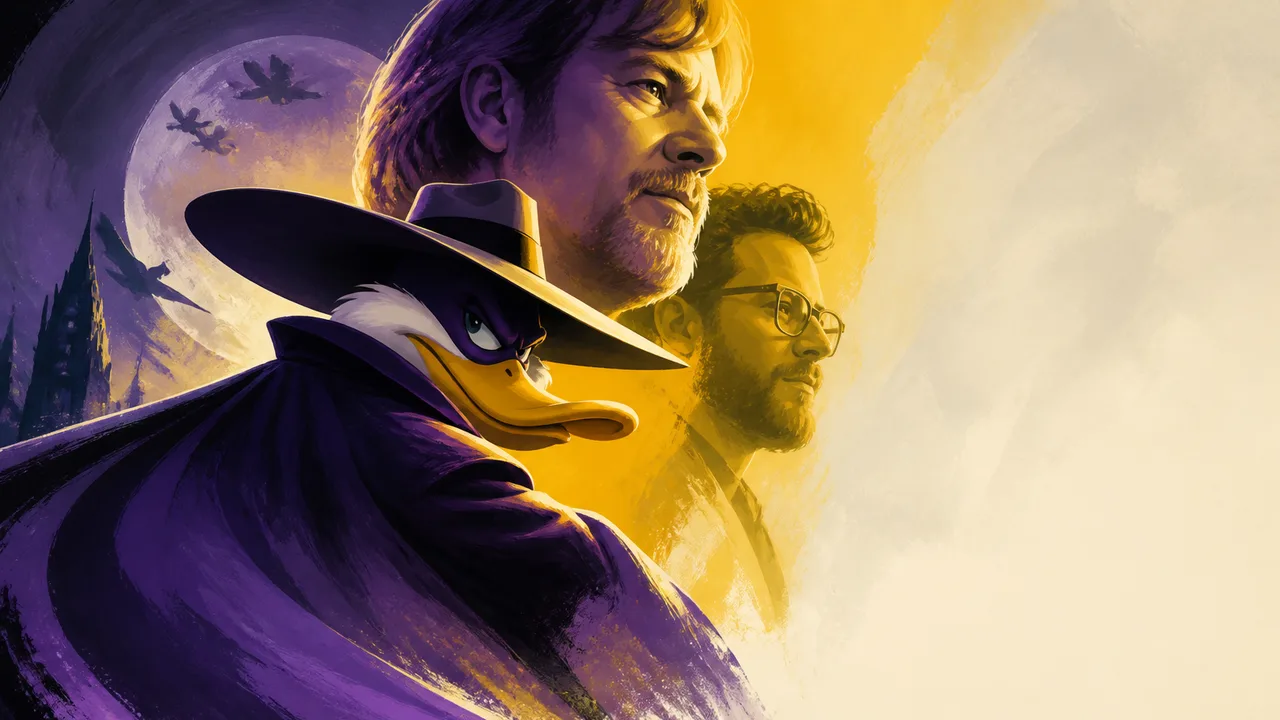
Disney+ greenlit a new Darkwing Duck series on September 22, with Mark Hamill inheriting the purple cape and Seth Rogen taking the controls as Launchpad McQuack. Lizzy Caplan will voice Gosalyn Mallard, Lilimar will play a new teenager named Duckie, and original creator Tad Stones consulted during development. The announcement arrives six years after news of the project first surfaced in 2020, an interval long enough for a small child to develop strong opinions about canon.
The production history supplies one story. The official premise supplies a more revealing one. Disney has returned to Darkwing by stepping around the version introduced in its 2017 DuckTales reboot, where the character's legacy had already been ingeniously reconstructed. The new series instead treats Drake Mallard as a hero stranded for 35 years in an alternate world that has never heard of him.
That choice appears to trade a continuation built on succession for a premise built on restoration. It may also show how Disney now regards Darkwing: as a character whose cape, ego and supporting cast can survive another rearrangement of the furniture. Continuity becomes one tool in the box rather than the deed to the house.
A Revival that Spent Six Years in the Fog
The original Darkwing Duck, created by Stones, premiered in 1991 and ran for 91 episodes. The Hollywood Reporter's broadcast history places its ABC conclusion in 1993, the end of its initial syndication run in 1995 and another syndication run in 1996 and 1997. Jim Cummings supplied the original voice. The hero subsequently migrated into NES and Game Boy titles, comics and, eventually, the 2017 DuckTales series.
That history helps explain why the character lends himself to revival. Darkwing began as a television hero but did not remain confined to one broadcast run or medium. His basic equipment is portable: a theatrical crime fighter, a suburban father and an ego large enough to require its own secret headquarters. The costume evokes pulp vigilantes; the comedy depends on watching Drake Mallard repeatedly fail to inhabit his own legend with dignity.
Development of a new standalone series surfaced in 2020, but a greenlight did not follow until 2026. Neither Disney's announcement nor the available production reporting explains the duration, so the six-year interval cannot responsibly be assigned to one creative dispute, corporate strategy or changing streaming economics. It does establish that this incarnation passed through a substantial development period before Disney committed it to series.
Sean Tretta and Borja Peña Gorostegui are executive producing. Rogen, Evan Goldberg, James Weaver, Alex McAtee and Gabby Grantham are producing through Point Grey Pictures. The company has recently worked on another Disney legacy property through a special-event installment of The Muppet Show, while its wider credits include The Boys, Invincible, The Studio and Teenage Mutant Ninja Turtles: Mutant Mayhem. That résumé does not predict the new show's tone, but it explains why Point Grey might suit a character balanced between affectionate homage and cheerful demolition.
The Darkwing that Disney Left Behind
The clearest comparison sits inside Disney's own recent history. As Reactor's account of the 2017 storyline explains, DuckTales initially presented Darkwing as a fictional television character played by an aging actor named Jim Starling. A younger actor, Drake Mallard, took the role in a proposed movie. After Starling was presumed dead, Launchpad encouraged Drake to become a crime fighter outside the soundstage. Starling survived and transformed into Negaduck, giving wounded celebrity vanity a cape and a grudge.
It was a sharp premise because it made reboot culture part of the plot. Starling represented the possessive original; Drake was the fan who inherited the fiction and tried to live by it. Launchpad served as the bridge between spectatorship and heroism. Negaduck emerged from the original performer's fury at replacement. A children's adventure series had smuggled in a compact satire about recasting, fandom and the inability of former stars to leave the convention centre gracefully.
The newly announced show begins elsewhere. Disney's official synopsis, reproduced by IGN, says Darkwing has spent 35 years trapped in an alternate world where nobody knows his exploits. Duckie, a rebellious teenager familiar with his past, pulls the “ego-fueled vigilante” back into action. Together they will confront Negaduck and Megavolt, reconnect with Launchpad, Gosalyn and Morgana, and attempt to save the universe.
The two versions still rhyme. Each places an admirer near a hero whose public identity has collapsed. Each uses Launchpad and Negaduck. Each asks whether Darkwing exists because Drake performs the role or because somebody else believes in him. The 2017 story answers through succession: a fan becomes the hero. The new synopsis answers through recovery: a forgotten hero needs a younger believer to restore him.
The comparison has limits. Disney has released a synopsis and cast list, not episodes, and an alternate-universe story possesses more than enough narrative plumbing to reconnect incompatible continuities. The new series could acknowledge the DuckTales version, reinterpret it or leave it untouched in another corner of the multiverse. Based on the announced premise alone, however, the Jim Starling succession story no longer provides the main foundation.
Darkwing as Folklore, with Corporate Paperwork
Stones offered a useful framework for the change. In Disney's announcement, he placed Darkwing in the tradition of Robin Hood, Zorro and Sherlock Holmes, figures repeatedly moved among creators, media, relationships and universes. That is an ambitious family tree for a duck whose entrance routinely involves excessive smoke, although Drake would certainly approve the billing.
The analogy works at the level of adaptability. Sherlock Holmes has survived changes of period, nationality and genre because audiences recognize a cluster of durable features. Stones's formulation proposes a similar core for Darkwing: theatrical self-belief, comic fallibility, a family around Drake Mallard and a compulsion to turn public safety into personal show business.
The analogy also has boundaries. Robin Hood and Sherlock Holmes have accumulated interpretations across generations, ownership regimes and centuries of cultural circulation. Darkwing Duck remains a Disney property created for television in 1991. One company controls the official versions discussed here. Calling the character folklore describes a creative method, while the legal and commercial structure remains modern franchise management in a very large hat.
That structure can benefit viewers. Releasing a new series from every detail of the 2017 continuity gives its writers room to introduce Darkwing to children who did not complete prerequisite viewing before breakfast. It also allows Hamill, Rogen, Caplan and Lilimar to establish their own chemistry instead of reproducing another ensemble's choices. A rigid canon can turn a cartoon into assigned reading, complete with an exam administered by somebody called Megavolt.
The cost is equally clear. The DuckTales storyline had already built an emotionally and thematically coherent route to a standalone show. Leaving it behind risks teaching invested viewers that setup is provisional whenever a cleaner launch becomes available. That does not make the new premise inferior. It raises the burden on the series to make its alternate-world device more than a trapdoor beneath previous continuity.
Disney's “35 years” also functions as anniversary arithmetic. The count runs from the original show's 1991 premiere to 2026. The programme itself continued through 1995, returned to syndication in 1996 and 1997, and Darkwing appeared in the 2017 DuckTales. The number therefore describes the new character's fictional imprisonment and the age of the franchise, rather than 35 years of total cultural absence.
Several practical questions remain. Disney has announced no release date. The AV Club noted that voices for Megavolt, Gizmoduck and Morgana Macawber had yet to be identified, despite those characters' place in the announced world. The synopsis also leaves Gosalyn's relationship with Duckie unexplained, although both appear central to Drake's revived life.
The answer will come from execution rather than continuity diagrams. If the writers preserve Darkwing's comic vanity, his bruised affection for his makeshift family and his heroic habit of succeeding one pratfall late, the character may tolerate another universe. Disney has already demonstrated that it can recover the cape. The harder feat is making this discarded past feel like creative freedom instead of smoke used to conceal a reset button.
More Like This
The Last Maya Cities: Tulum, Mayapan, and Cobá
A new documentary examines Tulum, Mayapan, and Cobá—the final Maya cities—through archaeology, LiDAR mapping, and a more complicated story of collapse.
Visually Stunning Movies Nobody Talks About
From Tarsem Singh's The Fall to the anime fever dream Redline, these nine films are visually extraordinary—and almost entirely ignored. Here's why that matters.