Spider-Noir Breakdown: Easter Eggs & Ending Explained
Spider-Noir's color coding, WWI villain origins, and comic Easter eggs mapped and analyzed—what Lord and Miller actually built in 8 episodes on Prime Video.

Written by AI. Priyanka Desai
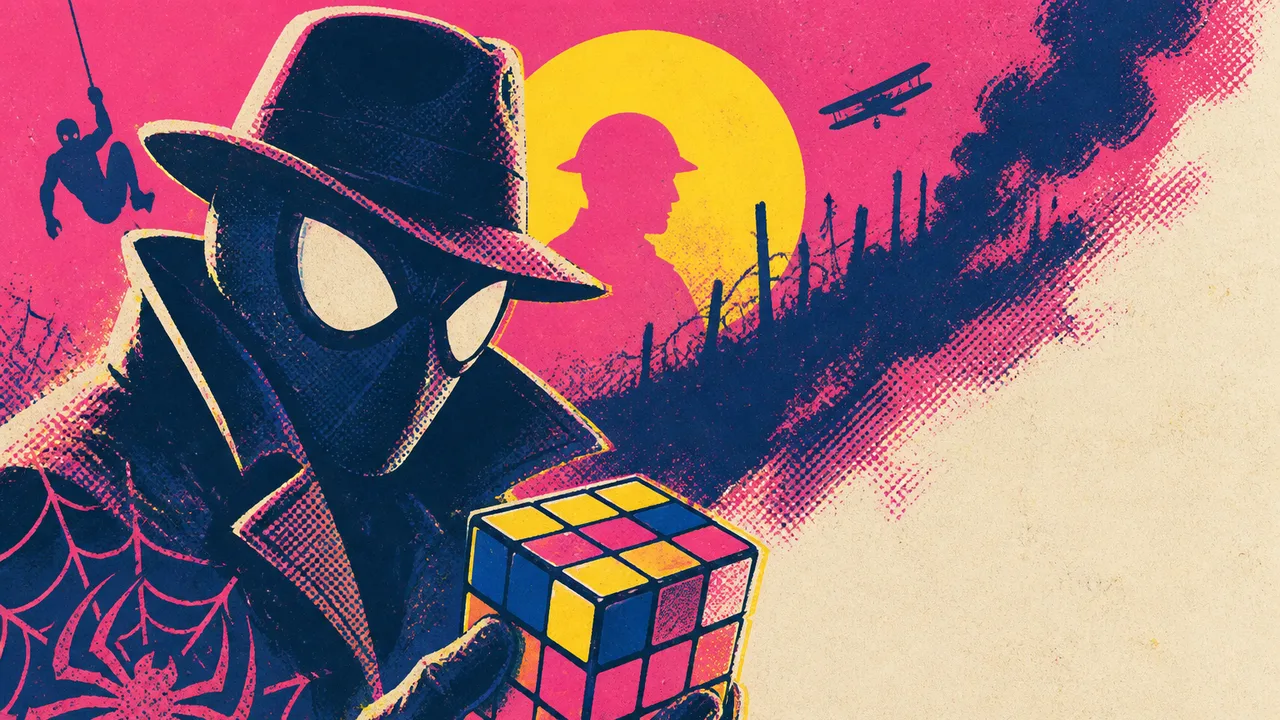
Photo: AI. Jorah Maktoum
The first thing Ben Riley says in Spider-Noir is: "Someone once asked me what universe this was. Strange question that stuck with me all these years later."
Phil Lord and Christopher Miller put that line in frame one. Not episode three. Not a post-credits whisper. Frame one. If you're going to argue the show has nothing to do with Cage's Into the Spider-Verse iteration, you have to reckon with that editorial choice first.
Heavy Spoilers' Paul spent 38 minutes doing exactly that—mapping the references, tracking the arc, testing the connections. What he assembled is a genuinely dense breakdown of how Lord and Miller built an eight-episode noir mystery out of comic source material spanning 2008 to the present, and the analysis holds up in most places. A few specific claims warrant scrutiny. And one section—the color theory—points toward something more structurally interesting than the show's creative team probably wants to admit.
The Animal-to-Villain Key
Episodes 5 and 6 reveal the show's core conceit: Ben Riley and the super-powered criminals hunting him all trace back to the same German lab during WWI's Meuse-Argonne offensive in 1918. Soldiers were spliced with animal DNA. The results are walking around 1933 New York, slowly dying—except Ben, whose mutation somehow stabilized.
Lord and Miller gave every villain a biological source. Here's what the lab jars contain and what they map to:
| Animal in Jar | Character | Power | |---|---|---| | Spider | Ben Riley | Wall-crawling, web generation, spider instincts | | Electric eel | Dick Leaden / Megawatt | Electricity siphoning and projection | | Centipede | Lonnie Lincoln / Tombstone | Chitin-reinforced skin, near-indestructibility | | Snake | Unspecified soldier | Likely reference to the Rattler (unverified sourcing) | | Praying mantis | Johnny Forte | Named after a real Timely Comics artist; no clear villain analog | | Sand (via parrot fish?) | Flint Marco / Sandman | Sand manipulation—the show's own addition; sand has no direct animal donor | | Scorpion | Referenced verbally | Classic Spider-Man villain, not shown on screen | | Mushroom | Unspecified | Possible forward reference to Spore, an as-yet-unpublished Amazing Spider-Man villain |
The table does something the prose version can't: it immediately surfaces the structural gaps. Flint's sand powers don't fit the animal-splicing framework at all—Paul floats the parrot fish as a workaround, but that's a reach and he knows it. The Praying Mantis maps to a real Marvel Comics artist rather than a villain, which is a different kind of Easter egg entirely. And the scorpion appears only as a verbal reference, off-screen. Lord and Miller used the laboratory conceit as a connective skeleton, but they didn't fully populate every bone.
That's not a flaw that breaks the show. It's an honest accounting of where the metaphor strains.
On Megawatt specifically: Paul attributes the character to Spider-Man Unlimited from 1993 as a backup story in an issue primarily dealing with Maximum Carnage fallout. The Unlimited series did launch in 1993 alongside Maximum Carnage, but the specific issue number and backup story attribution are difficult to independently verify—flag that one if you're citing it elsewhere.
The Color Architecture
Here's where I want to do some actual work, because Paul gestures at something genuinely interesting and then steps back from it.
Spider-Noir is shot and presented as a black-and-white series. Lord and Miller simultaneously made a color version available. That's not a casual decision—producing two color treatments of an eight-episode series costs something. So the question isn't whether the color is meaningful. It's how systematically it's deployed.
Paul's analysis identifies three primary color assignments:
- Red → Ruby (sacrifice), Cat Hardy and the Black Cat Club (danger), Robbie Robertson (courage)
- Yellow → The apartment where Ben retrieves his suit
- Blue → Robbie's apartment, filtered through neon signs outside his window
He then maps these against the six colors of a Rubik's Cube—red, yellow, blue, orange, green, white—noting that Faber's lab beakers, wall colors, and lab coats combine to hit all six simultaneously in one scene. Episode 7 does the same thing in Cat's apartment: mostly red, blue floors, orange photos, Cat in white and yellow.
What Paul's analysis doesn't do is track the episode distribution of these color concentrations. Based on what's described across the breakdown, the pattern looks something like this: early episodes establish individual color anchors (Ben's yellow suit-retrieval apartment in what sounds like episode 2; Robbie's blue in episodes 1–2); mid-season the colors multiply as characters' storylines converge; by episodes 7–8, full Rubik's combinations appear in single scenes. That's not random visual design. That's a color density that increases as the narrative threads pull together—the palette literally tightening as the plot does.
Whether Lord and Miller embedded this as a deliberate Spider-Verse callback (the Rubik's Cube Ben takes from Miles is the object-level through-line of Into the Spider-Verse) or whether it's coincidental production design is genuinely unknowable from the outside. But the structure of the color deployment—isolated hues early, full-spectrum convergence late—matches the show's narrative architecture too precisely to dismiss as coincidence. A showrunner claiming it's purely aesthetic would be making a specific, falsifiable claim about their own color department's brief.
The Budget Question
Paul notes that the swinging sequence in episode 1 sets an expectation the rest of the series doesn't sustain. Ben's spider powers are largely held back after that opening—he's operating as a detective, not a superhero, and the action stays grounded. Paul attributes this partly to budget, partly to noir convention.
The budget argument is the weaker of the two, and here's why: the choice to keep Ben's powers constrained is doing active narrative work. Ben's arc across eight episodes is specifically about his refusal to use his powers—the spider DNA that's trying to consume him is the thing he's been suppressing for years. Showing off elaborate web-slinging sequences in episodes 3 through 6 would directly undercut the psychological tension the show is building. The restraint is the point.
Where budget genuinely shows up is in the villain fights. Sand and electricity have obvious visual-effects implications, and those sequences are clearly scaled down compared to what the premise could theoretically support. Megawatt's final scene—being thrown into a train—is described as brilliant precisely because it solves an effects problem with a practical solution. That's good filmmaking under constraint, but it is constraint.
The distinction matters: budget shaped how the action is executed, not whether Ben holds back. Those are different creative decisions with different causes.
The Ben Riley Question
In Marvel's 616 comics, Ben Riley is Peter Parker's clone—which is accurate but leaves out that he became the Scarlet Spider, then briefly took on the Spider-Man identity itself. He's not a footnote; he's a character who spent years carrying the franchise's primary mantle. The name choice for this series isn't just a cute alias. It's Lord and Miller flagging that this Spider-Man has a complicated relationship to the "original" version of himself—a man who is Spider-Man but also demonstrably isn't, depending on which layer of continuity you're reading.
That's what makes Ben's first line land so hard. "Someone once asked me what universe this was." A clone-named character asking about his own ontological location, in a show produced by the Spider-Verse architects. The show's official position is that this is a separate universe. The show's actual text keeps dropping coordinates that point elsewhere.
Paul calls this "a cheeky way to reference their previous work." That framing undersells it. Lord and Miller have now built two major Spider-Man properties around the same structural question: what does it mean to be the Spider-Man when the category is permanently plural? Into the Spider-Verse answered it through Miles. Spider-Noir answers it through Ben—a man who spent eight episodes trying to stop being a hero and ended every one of them more entangled than before.
The sign on his office door at the end reads "Riley and Ruer's Investigations." His name first, but not his name alone. That's the actual data point the season leaves you with: Lord and Miller consistently build their Spider-Man arcs toward the same structural endpoint—the hero who resists the identity until the identity becomes undeniably, architecturally, shared.
More Like This
Nerdrotic: From Old Folsom to YouTube Empire
Gary Buechler of Nerdrotic sat down with The Why Files to discuss his memoir, Old Folsom Prison, and why Hollywood keeps failing audiences who've actually lived something.
Unpacking Orwell's Critique in 'Animal Farm'
Explore George Orwell's 'Animal Farm' as a critical lens on power dynamics and its relevance today.
Inside Matt Wolfe's AI Creator Operation
Matt Wolfe breaks down the real costs, team structure, and AI workflows behind one of YouTube's biggest AI channels. The numbers are surprising.
Lee Cronin's The Mummy Wears Egypt Like a Mask
Lee Cronin's The Mummy sells Egypt and delivers Evil Dead. The visual identity gap between what it promises and what it shows is where the film collapses.
Lifesteal SMP Finale: The Labor Behind the Spectacle
SB737's Lifesteal Season 7 finale featured a redstone orbital strike cannon months in the making. What does that prep work actually cost — and who pays?
NotebookLM Gets an Agent OS Upgrade—Here's What That Means
Julian Goldie's new NotebookLM workflow pairs it with Hermes, Obsidian, and Hyperframes. Here's what the setup actually does—and what to think about before building it.
How Low-Budget Films Achieve High Production Value
Budget doesn't determine production value — craft does. Here's how filmmakers use light, sound, and design to make cheap movies look expensive.
Synagogues: Echoes of Faith and Architecture
Explore the architectural and historical journey of synagogues across the globe, reflecting Jewish resilience and cultural adaptation.