Star Wars: Visions – The Ninth Jedi, Reviewed
Production I.G.'s The Ninth Jedi expands Star Wars: Visions into a full anime series. Critics are split on whether it sticks the landing.

Written by AI. Devon Quincy
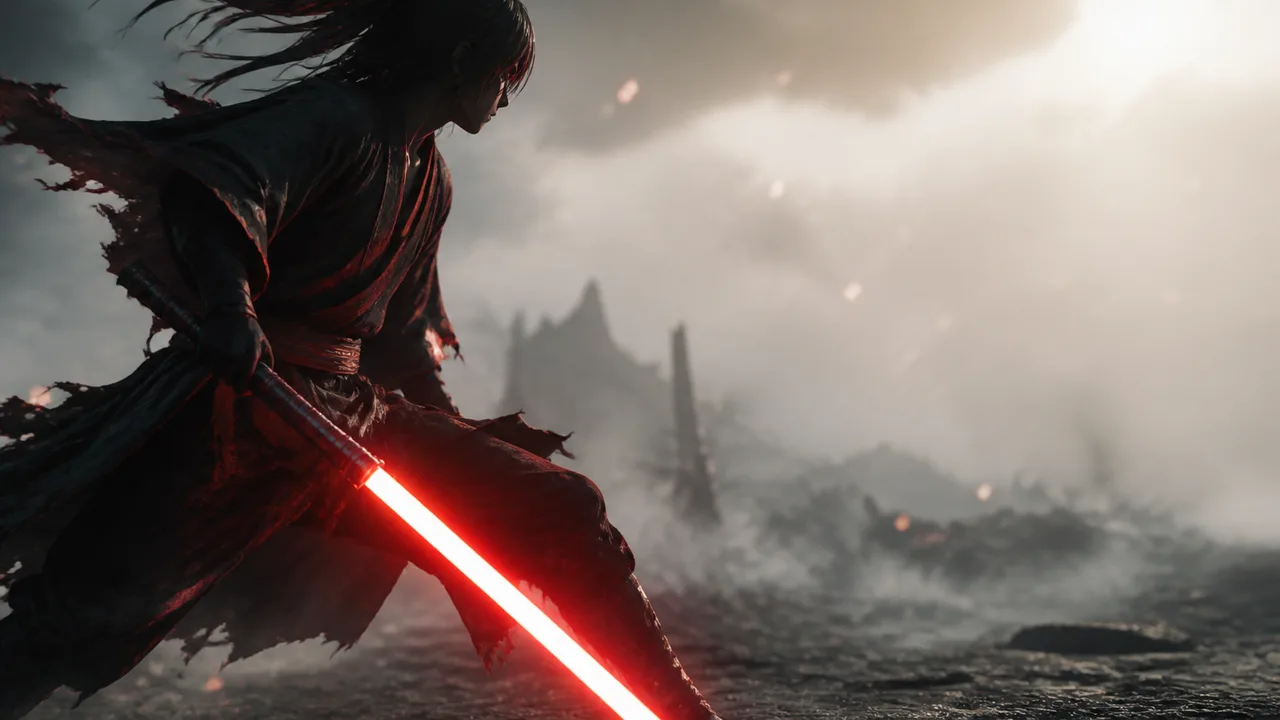
Here is a thing worth holding in your head before the discourse dissolves it: George Lucas did not invent Star Wars out of thin air. He assembled it — samurai films from Akira Kurosawa, Joseph Campbell's hero myths, the visual grammar of Flash Gordon serials, a lot of John Ford. The Force, as a concept, owes a measurable debt to the Eastern philosophical traditions that Japan's anime industry has been dramatizing for decades. Which is to say, when Star Wars: Visions Presents – The Ninth Jedi arrived on Disney+ in August 2026 as the franchise's first full-length anime series, it wasn't a crossover so much as a homecoming of sorts. The circle completing itself, finally, with production credits to match.
The series was produced by Production I.G. — the Tokyo studio behind Ghost in the Shell: Stand Alone Complex, Haikyu!!, and Vinland Saga — and it carries that pedigree visibly. GateCrashers calls it "a fantastic dive deeper into their Star Wars universe," noting Production I.G.'s "flair, action, and brilliant design." That's not wrong. The aesthetics here — fluid lightsaber choreography rendered with the kinetic weight that anime handles better than almost any other medium, character designs that are distinctly not the house style of The Clone Wars or Rebels — give the Star Wars universe visual room it rarely gets to occupy.
The Ninth Jedi began as a short in the original Star Wars: Visions anthology in 2021, a brief, gorgeous standalone about a young woman named Kara whose father is secretly crafting kyber crystals for a new generation of Jedi. Expanding that premise into eight episodes is either a gift to everyone who wanted more time in that world, or a stress test for whether the premise can sustain the weight. Critics are, politely, divided on this.
Screen Rant lands firmly in the triumphant camp, calling it "an absolute triumph, a gorgeous blend of traditional Star Wars storytelling and new, inventive lore." The HoloFiles stakes out similar ground, describing eight episodes that "interestingly reconceptualize core components of the Skywalker Saga, intrigue with a mysterious origin story for a key character, and find a point of novelty" in expanding what we thought we understood about the franchise's mythology.
Then there's the other register.
Anime News Network — arguably the most technically credentialed voice in the room when it comes to anime as a craft — lands on a considerably more measured note: "While there are great individual episodes here, the awkward execution of its larger plot leaves this arc falling just a little short of being the whole sum of its parts." That's a careful sentence, and it deserves to be read carefully. The reviewer isn't saying it's bad. They're saying it doesn't quite cohere — that the ambition of the episode-level storytelling isn't matched by the architecture holding those episodes together.
Laughing Place is the bluntest: "what we got is a perfectly functional, adequate repurposing of some very familiar tropes and themes from A Galaxy Far, Far Away. While the animation is nice to look at and the protagonists are charming enough, those attributes are offset..." The review trails off in the excerpt, but the direction is clear. Gorgeous to watch. Familiar to think about.
This gap in the critical conversation — between reviewers who experience the visual and tonal freshness as genuinely transformative versus those who find franchise scaffolding underneath the anime paintjob — is actually the more interesting story here, and it points at a tension that runs through all Visions content.
The original Visions anthology worked because the contract was explicitly anti-canonical. The studios were told: make Star Wars through your own aesthetic lens, unconstrained by continuity. What came back was genuinely strange and alive — Kamikaze Douga's stark The Duel, Trigger's frenetic The Twins, Kinema Citrus's melancholy The Village Bride. The anthology format gave each short permission to be its own complete thing.
The Ninth Jedi as an expanded series is operating under a different contract. It needs to tell a multi-episode story, develop characters across time, and build a satisfying arc. That's not a failure of ambition — it's a harder problem. Shorts can sustain on vibe and image; series have to have architecture. And the Anime News Network critique specifically lands on architecture: individual greatness not adding up to structural coherence. Production I.G. knows how to make beautiful episodes. Whether the season-level story justified the expansion is where the record currently splits.
What's worth sitting with is that this tension isn't unique to The Ninth Jedi. It's the central formal problem facing every franchise expansion into new creative territory. The Visions shorts succeeded partly because Lucasfilm kept its hands relatively off. The question lurking in the ANN and Laughing Place reviews is whether a full series — which by definition requires more Lucasfilm involvement in things like continuity, character rights, and story approvals — ends up smoothing out exactly the idiosyncrasy that made the format valuable.
There's precedent in both directions. The Clone Wars ran for seven seasons and at its best (the Umbara arc, the Ahsoka arc) produced some of the finest Star Wars storytelling in the franchise's history. Star Wars Rebels developed deeply emotional characters over four seasons. Both series spent their early going working through familiar tropes before finding their footing. Whether The Ninth Jedi is in its early going or has already shown its ceiling — that's genuinely unclear from a first-arc evaluation.
What isn't unclear: Production I.G. can draw. GateCrashers' praise for the design work is visible in every screenshot circulating since the trailer dropped on August 3. The lightsaber mechanics in particular have been called out by multiple reviewers for achieving something that live-action rarely pulls off — genuine physicality, the sense that these weapons have weight and momentum, that the people wielding them have bodies that feel the effort. Anime has a structural advantage here: it doesn't have to work around stunt choreography or the physics of practical effects. The imagination is the limit.
There is also the cultural-exchange angle that the brief gestures at, and it's real enough to take seriously without overselling it. Star Wars has historically exported itself to Japan with enormous success — the franchise has a dedicated fandom there that dates back to 1977. What Visions does is reverse the flow: Japanese studios aren't just receiving Star Wars, they're generating it, filtering it through aesthetic traditions that predate the franchise and will outlast it. That Production I.G. specifically brings its own visual grammar — one honed on stories about memory, war, identity, and the weight of history — to a galaxy whose foundational franchise concerns are arguably the same things, feels like more than coincidence. Whether the series fully earns that framing or whether it's just a beautiful Star Wars adaptation is the question the critical split doesn't quite resolve.
Eight episodes is enough to suggest a direction. Whether the next arc tightens the architecture or confirms that this is the ceiling — that's the actual story, and it hasn't been told yet.
More Like This
Dragon Striker Season 2 Confirmed for Early 2027
Disney confirmed Dragon Striker Season 2 at Anime Expo 2026, setting an early 2027 premiere on Disney XD and Disney+. Here's what the renewal signals.
10 Underrated Netflix Films That Deserve Attention
Explore ten overlooked Netflix films that showcase unique storytelling and filmmaking techniques yet failed to capture widespread attention.
Inside Hollywood's Stunt Revolution: A YouTube Journey
Explore the evolution of stunt work through YouTube, where creativity meets technical prowess in action-packed sequences.
Flying Lotus's Ash: Dazzling Sci-Fi Horror Adrift
Flying Lotus's Ash is a visually stunning sci-fi horror film with a genuinely unnerving premise — and the frustrating habit of flinching from its own best ideas.
Cool Machine Closes Whitehead's Harlem Trilogy
Colson Whitehead's Cool Machine brings his Harlem Trilogy to a dazzling close with heists, 1980s New York, and a moral vision that earns every page.
Ghost in the Shell Returns with Science SARU at the Helm
Science SARU's Ghost in the Shell reboot debuted at Anime Expo 2026. Here's what the studio is risking—and what it might be building—with anime's most philosophical IP.

When ABS Challenges Go Wrong: A Rules Breakdown
Umpire Carlos Torres denied two ABS challenges in one A's-Orioles game. Here's what the tape reveals about a protocol still working out its kinks.

Tom Bombadil's Power: Why You're Asking Wrong
Tom Bombadil is Tolkien's most debated enigma. A new In Deep Geek breakdown reframes the question of his power—and the reframe is more interesting than any answer.