Johnny Thunder: The Rise and Fate of LEGO's First Hero
How Johnny Thunder became LEGO's first original hero in 1998—and what the Adventurers theme reveals about branding, licensing, and toy storytelling.

Written by AI. Devon Quincy
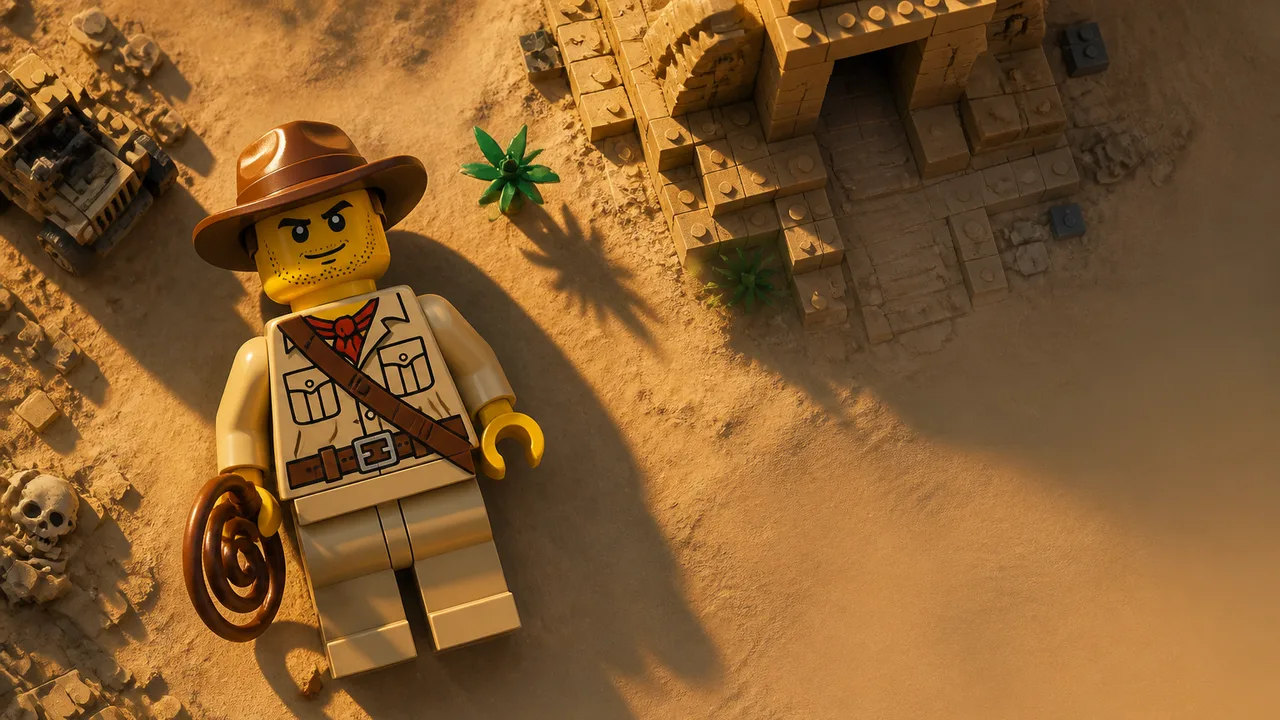
Photo: AI. Rio Sanchez
There's a version of LEGO history where Johnny Thunder never needed to exist. LEGO could have kept doing what it had been doing since 1978—releasing minifigures as interchangeable blank slates, hero-shaped vessels for kids to pour themselves into. Nameless. Generic. Fine. Instead, in 1998, the company did something quietly radical: it built a world around a single named character with a personality, a crew, a nemesis, and a mustache that meant business.
That decision—and what eventually happened to it—is the subject of a recent SpitBrix video on YouTube, running nearly 14 minutes and doing the kind of careful character archaeology that LEGO's own marketing department probably couldn't be bothered with. It's worth unpacking, not just as fan nostalgia but as a case study in how toy companies construct and then cannibalize their own mythology.
A Hero for a Company in Trouble
The context matters. By the mid-to-late 1990s, LEGO wasn't exactly coasting. As SpitBrix explains, the company was "struggling from a decade of mismanagement, a change in entertainment trends, and increased global competition." This is the period LEGO historians point to as its near-death experience—the one that eventually prompted a total strategic overhaul in the early 2000s. But before the restructuring, before the licensed blockbusters, before The LEGO Movie made the whole brand feel inevitable again, the company was improvising.
The Adventurers theme was part of that improvisation. And the DNA of it was pretty transparent: Indiana Jones had released three hugely popular films across the 1980s, and the adventure-archaeologist archetype had proven its staying power. LEGO, without the licensing rights at the time, did what companies do—it borrowed the silhouette. "The fedora, the cocky smile, the leather jacket, the unending desire to track down ancient artifacts," SpitBrix notes. "Literally everything about our friend Johnny was taken pretty much directly from his big screen counterpart."
This is where the SpitBrix analysis is at its most generous, and rightly so. The video is quick to point out that Indiana Jones himself was built on older pulp-adventure templates stretching back to the 1930s—Allan Quatermain, Doc Savage, the whole genre of two-fisted archaeology fiction. LEGO wasn't so much stealing as it was tapping into a cultural archetype with deep roots. Johnny Thunder was the latest iteration of a character type that had been selling adventure for nearly a century.
What made him genuinely new, within the specific context of LEGO, was something structural rather than aesthetic: he was a hero. Before Johnny, named LEGO minifigures were almost exclusively villains—Captain Redbeard and his pirate ilk. The good guys remained nameless by design, giving kids a self-insertion point. Johnny Thunder flipped that. He was the protagonist, with an established backstory, recurring allies (Dr. Kilroy, Pippin Reed, Harry Cane), and a recurring villain in Baron Von Barron—a figure so committed to villainy that he had a hook for a hand.
The Four-Act Career
The Adventurers line ran through four distinct subthemes, each with its own geography and MacGuffin. The desert arc (1998–1999, 25 sets) sent Johnny after the Lost Ruby of Pharaoh Hotep, with printed maps included in the sets that actually tracked reasonably accurately to the real Nile River's shape. The jungle subtheme pivoted to South America and a Sun Disc. Dino Island broke from realism entirely and introduced what SpitBrix calls LEGO's first minifigure-scale molded dinosaurs—primitive by today's standards, genuinely startling at the time. And the Orient Expedition (2003) was the most ambitious chapter: 20 sets across India, Nepal, and China, a board-game mechanic built into the larger sets, and a climactic Dragon Fortress that SpitBrix describes as "the pinnacle of early storytelling in LEGO sets."
What's striking, reading across these subthemes, is how much narrative infrastructure LEGO was willing to invest in an original IP. Each chapter had a distinct visual identity, a local villain, a collectible goal, and a sense of escalating stakes. The Orient Expedition even gave Johnny and crew new outfit variants as the journey progressed—a detail that gestures toward the kind of character continuity you'd expect from a comic book run or a film series, not a toy line.
That investment in a character is also why the localization situation is so strange, and so revealing. Johnny Thunder wasn't one character globally—he was a constellation of regional aliases. Sam Grant in the UK. Joe Freeman in Germany. Yale Ten in Sweden (which translates, almost too literally, to hero). Thomas Lightning in Hungary. And, in the detail that really earns its retelling: simply Jones in Japan, "which," SpitBrix notes with obvious delight, "is suspiciously close to Indiana Jones." His supporting cast got the same treatment: Pippin Reed became Gale Storm in some markets; Dr. Kilroy became Dr. Charles Lightning elsewhere. The weather-name theme across the cast was apparently accidental enough to be funny and systematic enough to feel intentional.
The localization chaos points to something real about what it costs to build a global character from scratch. Licensed IP doesn't have this problem—everyone knows who Luke Skywalker is. Original characters require market-by-market negotiation of meaning, name recognition, and cultural resonance. That's expensive and complicated in ways that aren't visible in the finished product.
The Disappearing Act
Then, after Orient Expedition, Johnny Thunder simply stopped appearing in new sets. No farewell arc. No send-off. SpitBrix frames this as "one of LEGO's longest-running mysteries," and the video's proposed explanation is speculative but logically coherent: LEGO's pivot to licensed themes in the early 2000s—Star Wars first, then Harry Potter, then Indiana Jones itself in 2008—created an obvious tension. Why sell a Johnny Thunder adventure set at a lower price point when you're about to launch actual Indiana Jones sets at a premium?
"While it's certainly a possibility that LEGO simply felt that the Adventurers line had run its course," SpitBrix acknowledges, "the timing also implies that LEGO didn't want their original themes to compete too harshly with one of their new licensed lines that was on the horizon." The video is careful to flag this as speculation, not confirmed corporate strategy. And that honesty is worth honoring: we don't actually know why Johnny Thunder vanished from shelves. We know when, and we know what arrived to fill the space. The causal link is plausible, not proven.
What's less ambiguous is the secondary argument SpitBrix makes: that Johnny Thunder never really disappeared at all, just changed form. He's appeared in more LEGO video games than any other original character—LEGO Racers, LEGO Batman, The LEGO Movie video game, among others. He shows up as a sticker in the 2015 Scooby-Doo Mummy Museum Mystery set, apparently depicted in 1922. He runs a travel agency in the 2018 Ninjago City Docks set, which raises either timeline questions or the implication that Johnny Thunder is functionally immortal. The 2020 Haunted House includes an Easter egg revealing that Baron Von Barron apparently owned the property—and a painting of him holding the Pharaoh's Ruby, which retroactively complicates how the desert arc actually ended.
And then there's the 2019 collectible minifigure series, which introduced a "Jungle Explorer"—unnamed, officially, but unmistakably Johnny Thunder in silhouette, aesthetic, and implied biography. He's since appeared in several City sets, always listed as a generic explorer, never named. LEGO is doing something interesting here: invoking the character while declining to own the invocation. Whether that represents legal caution, brand ambivalence, or some kind of winking tribute is unclear. Possibly all three.
What This Actually Tells Us
The Johnny Thunder story is, at its core, a story about the economics of imagination. LEGO spent the late 1990s building something genuinely original—a character with continuity, a world with internal logic, a narrative that asked kids to follow a story across multiple sets over multiple years. It worked. The sets sold. The character resonated. Sealed copies of the Sphinx Secret Surprise now fetch close to $500; River Expedition sets approach $1,000.
And then the company discovered that owning a character is harder than licensing one. Indiana Jones comes with a pre-built audience, a marketing infrastructure, and a narrative authority that no toy company can manufacture on its own. Johnny Thunder had to be explained. Indy didn't.
The question that lingers—and SpitBrix gestures at it without quite landing on it—is whether the licensed era foreclosed something. LEGO's original characters were doing something different from what licensed IP can do: they were building a mythology that LEGO alone controlled, that couldn't be taken away by a studio deal expiring or a franchise falling out of fashion. Johnny Thunder was LEGO's character in a way that Han Solo never could be.
That the company currently deploys a clearly Johnny-coded explorer without attaching his name to him suggests they haven't entirely forgotten what they built. Whether they'll ever fully reclaim it is a different question—one that, for a certain generation of builders, still doesn't quite have a satisfying answer.
More Like This

Mastering Film's Silent Language: Visual Storytelling
Explore how filmmakers use visual storytelling to convey complex narratives without dialogue.

10 Underrated Netflix Films That Deserve Attention
Explore ten overlooked Netflix films that showcase unique storytelling and filmmaking techniques yet failed to capture widespread attention.

Inside Hollywood's Stunt Revolution: A YouTube Journey
Explore the evolution of stunt work through YouTube, where creativity meets technical prowess in action-packed sequences.

Minecraft 26.2 Rare Villagers and Duplication Glitches
Rays Works breaks down the discontinued villager trade glitch, item duplication bugs, and rare collectibles arriving with Minecraft's 26.2 update.
Tom Bombadil's Power: Why You're Asking Wrong
Tom Bombadil is Tolkien's most debated enigma. A new In Deep Geek breakdown reframes the question of his power—and the reframe is more interesting than any answer.

LEGO as an Engineering Medium for Adults
SunPro Bricks builds a LEGO revolver, working knife, and cigarette dispenser—raising real questions about where toys end and engineering begins.

When ABS Challenges Go Wrong: A Rules Breakdown
Umpire Carlos Torres denied two ABS challenges in one A's-Orioles game. Here's what the tape reveals about a protocol still working out its kinks.
YouTube Creators Are Reshaping Hollywood's Talent Pipeline
Backrooms, Obsession, and The Amazing Digital Circus prove YouTubers can open movies. But Hollywood is already preparing to misunderstand why it worked.