Dan Hicks's Death Leaves NBC a Cross-Sport Vacancy
Dan Hicks called golf, Olympic swimming and Notre Dame football for NBC. His death leaves a Saturday vacancy and a longer question about cross-sport continuity.

Written by AI. Jai Trivedi
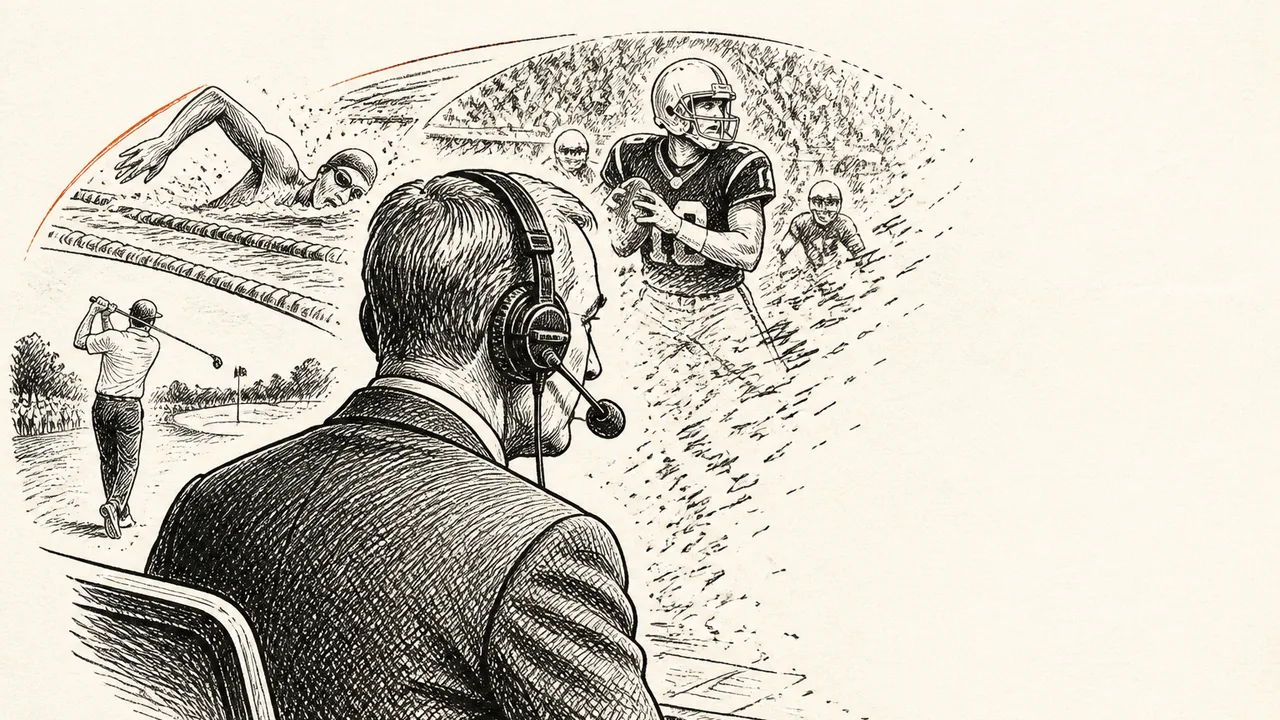
Dan Hicks, the NBC Sports broadcaster whose voice connected Tiger Woods at Torrey Pines, Michael Phelps at the Olympics and Notre Dame football, died Thursday at 64. His wife, broadcaster Hannah Storm, said he died suddenly following an acute illness.
NBC now has an immediate broadcast to fill and a longer question to answer. Hicks had been scheduled to call Saturday’s Boston College-Notre Dame game. Jason Benetti is set to take his place alongside Jason Garrett for that game. A one-game replacement answers who calls Saturday; NBC’s future golf, swimming and football assignments are a separate decision.
Hicks’s career explains why. A network can put another announcer on a game. Replacing the familiarity one person built across several sports takes a different kind of time, especially when viewers encountered him at events that shared little beyond the NBC logo.
The Route to the Biggest Calls
Hicks joined NBC Sports in 1992. His earlier work included lower-tier NFL and NBA games and a position in the tower during golf coverage. When Dick Enberg left NBC for CBS, Hicks became NBC’s lead golf announcer, arriving in that role in time to call Woods’s 15-stroke victory at the 2000 U.S. Open.
That route is more revealing than a highlight reel. A golf tower assignment meant covering part of a sprawling event; the lead role put Hicks at its center. NBC already knew his work when a vacancy opened. The same sequence helps explain how a broadcaster can become associated with a sport’s biggest moments: first comes the less glamorous job of being there for all the other ones.
Then came the 2008 U.S. Open. Woods made a 12-foot birdie putt to force a playoff with Rocco Mediate, and Hicks asked, “Expect anything different?” Woods won the title the next day. The question gave the putt room to do the work. It also illustrates a hazard in judging announcers by their most replayed seconds. Hicks’s call had years of assignments behind it, including games and shots that rarely become clips.
Swimming required another gear. In the men’s 4×100-meter freestyle relay at the 2008 Olympics, Phelps was chasing an eventual eight-gold-medal Games, but teammate Jason Lezak produced the comeback on the anchor leg against France. Hicks called the finish. The swimmer everyone knew was part of the stakes; Lezak supplied the turn nobody could assume was coming.
Golf asks a caller to wait through the setup for a single stroke. A relay can reverse itself in the final meters. Hicks worked in both rhythms, and NBC also used him for Notre Dame football and Olympic skiing. That range is the basis for seeing him as a piece of the network’s continuity. It does not require treating every assignment as equally prominent.
Familiarity Travels with the Viewer
Hicks was the lead voice on NBC’s PGA Tour coverage and worked across its Olympic and football broadcasts. A viewer who watched golf and swimming could encounter the same announcer in two very different viewing routines. That is a possible advantage of cross-sport casting: the voice supplies a point of familiarity before the event supplies its own drama. It is an inference from Hicks’s assignments, not a measure of how many people followed him between sports.
Michael Phelps called Hicks “a friend” in an Instagram tribute. Phelps also had looked forward to being back in the booth with Hicks and Rowdy Gaines at the 2028 Los Angeles Olympics. That was Phelps’s hope for a reunion, not an announced NBC booth assignment.
Al Michaels marked Hicks’s death during Prime Video’s Thursday Night Football broadcast. In the on-air tribute, Michaels recalled Hicks joining NBC in 1992 and working alongside Gaines on swimming coverage at multiple Olympics. He called Hicks “genial” and “compassionate” and sent love to Storm and their three daughters.
Those responses describe relationships a famous call cannot show on its own: a colleague recalling a long-running partnership and an athlete remembering a friend. NBC may eventually distribute Hicks’s assignments among several voices. For the people who knew him, though, a discussion about the next broadcast sits alongside a loss no schedule can describe.
The Verne Lundquist Comparison, with Boundaries
Verne Lundquist offers a useful parallel. He spent decades at CBS and called the ending of the college football game known as the “Kick Six.” Hicks spent decades at NBC and called the Americans’ comeback in that 2008 Olympic relay. Both careers show how an announcer can become attached to a moment that keeps circulating long after the live broadcast ends.
Their assignments also show the limits of the comparison. CBS and NBC gave them different portfolios, and a football play and an Olympic swimming relay ask different things of a caller. Neither career supplies a formula for NBC’s next hire. What the parallel clarifies is how a memorable clip can obscure the ordinary run of broadcasts that made each voice familiar in the first place.
Hicks’s own progression makes that concrete. The announcer calling Woods at the 2000 U.S. Open had previously handled less prominent games and worked from a golf tower. Years later, his voice was present for Lezak’s finish, Woods’s 2008 putt and a Northern Illinois upset of Notre Dame. Those events happened in different sports and different years. The connective tissue was the person NBC kept putting on the microphone.
That does not mean NBC must find one broadcaster to take every assignment Hicks held. Separate specialists could serve each sport well. A recurring voice, meanwhile, could give viewers who move between golf, football and the Olympics some of the familiarity Hicks accumulated over decades. Either choice would be a programming judgment; Benetti’s Saturday assignment answers only the first, urgent scheduling question.
Hicks went from a golf tower and lower-tier games to lead golf and major Olympic calls. That path gave NBC something it cannot hand to a successor with a single Saturday booking: a history with the audience.
More Like This

Bill Foley Bids for NBA Las Vegas Team
Bill Foley launches an NBA expansion bid in Las Vegas, tennis confronts a billion-dollar fragmentation problem, and the World Cup hands LA28 a political lifeline.
The NFL Has Canceled the Pro Bowl Game
The NFL has officially ended the Pro Bowl game, replacing it with an 88-player honor class and an L.A. celebration. Here's what the decision actually signals.
Mike Tomlin’s NBC Role Keeps Coaching Questions Alive
Mike Tomlin says he has not considered coaching again, though he expects questions soon. His NBC role keeps him visible, but no team or timetable has emerged.

Presidents Cup Comeback Draws Two Million to NBC Finale
NBC's Presidents Cup final round drew two million viewers amid a U.S. comeback. The audience shows the appeal of live drama, but leaves rights economics unresolved.
MLB's 60-Game Clause Reshapes Lockout Leverage
A reported 60-game trigger could extend MLB's media deals through 2029, reshaping 2027 lockout leverage as local TV pressures divide club incentives today.

How NASCAR Went From Moonshine Runs to TV Gold
NASCAR's rise from backroad bootlegger races to 16 million CBS viewers is a masterclass in sports media timing, chaos, and unlikely opportunity.

How a Mechanical Watch Stores Energy, Explained
Chronova Engineering's Mike machines watch barrels from scratch, revealing how mechanical watches store and release energy through coiled springs and clever design.

Nielsen Warns Networks to Stop Mixing Audience Data
Nielsen told sports networks to stop blending its ratings with third-party data. Here's why that warning matters for advertisers, leagues, and broadcast rights.