How a Mechanical Watch Stores Energy, Explained
Chronova Engineering's Mike machines watch barrels from scratch, revealing how mechanical watches store and release energy through coiled springs and clever design.

Written by AI. Jai Trivedi
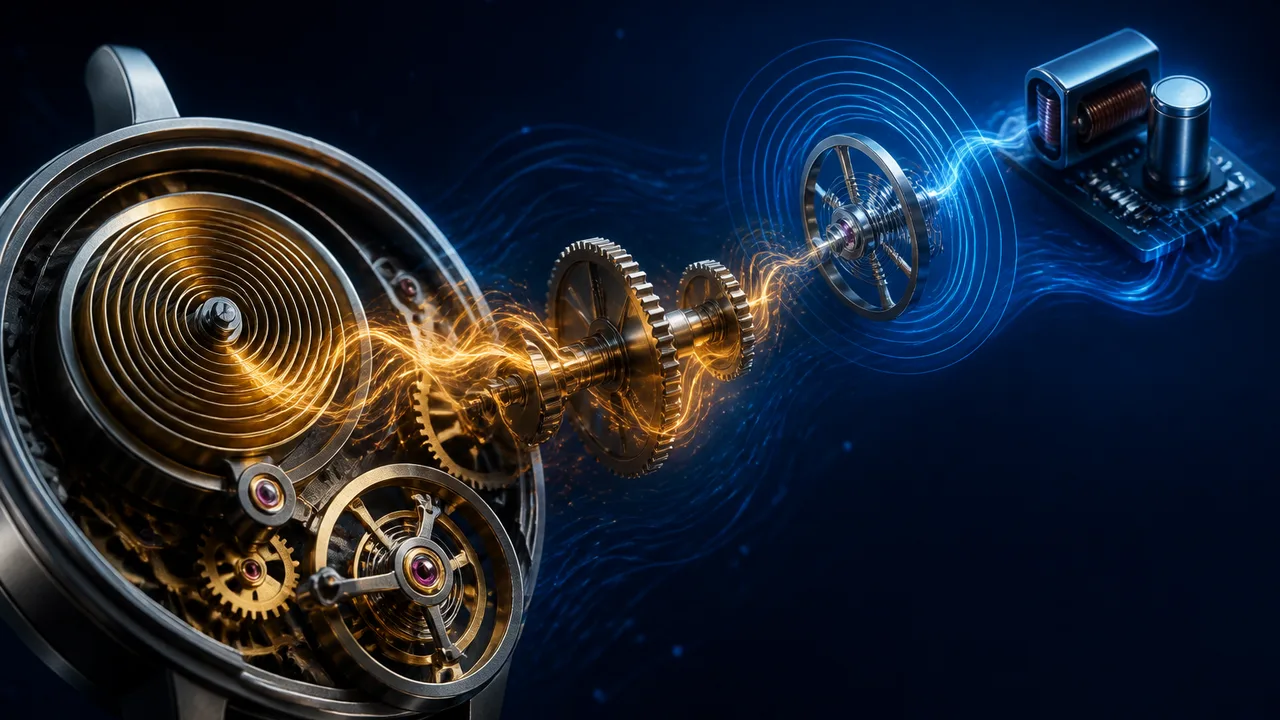
Photo: AI. Dante Nwosu
Somewhere in my YouTube queue, between a breakdown of NBA streaming rights and a deep-dive into Twitch's new revenue split, sits a ten-minute video of a man machining a barrel lid. I watched all of it. Twice.
That video is Episode 7 of Chronova Engineering's ongoing pocket watch build series, and the channel's host Mike is doing something that feels almost aggressively analog: making a mechanical watch, from raw stock, by hand, one component at a time. The episode is titled "How is a Watch Powered?" and it earns that title before Mike picks up a single tool.
The physics bit is better than you'd expect
Before the machining starts, Mike takes a detour into first principles that genuinely caught me off guard.
"Spring energy is really a result of electromagnetic forces at an atomic scale," he explains. "So your mechanical watch is actually powered by electromagnetism. The chemical energy stored in a battery is also the result of electromagnetic forces. And so the fundamental force that powers your mechanical watch is exactly the same force that drives your battery-powered quartz watch."
This is a real thing, and it reframes a question most people assume they already know the answer to. Wikipedia's entry on mechanical watches draws the standard distinction between mechanical movements, which use clockwork, and quartz watches, which use a piezoelectric tuning fork. That's accurate as far as it goes. But Mike's point runs deeper: peel back far enough and the energy source for both is electromagnetic force. The odd one out, he notes, is a weight-driven clock, which runs on gravity. "On the International Space Station, a weight-driven clock wouldn't work, but both a quartz watch and a mechanical watch would." That's a good line, and he's right.
Precision Watches puts it cleanly: "A mechanical watch is powered entirely by springs and gears, not batteries or electronics. Unlike quartz watches, mechanical timepieces rely on a wound mainspring and carefully engineered components working together to measure time." What that description doesn't capture is the elegance of the energy path: you wind a crown, that motion coils a spring inside a sealed drum called a barrel, and the spring's controlled unwinding drives the entire gear train. The Armitron guide to watch mechanics notes that the crown-winding process "stores energy that powers the watch" in exactly this way. That's the whole game, and it's been the whole game for centuries.
Two barrels, one unusual choice
Here is where Mike's build gets interesting relative to a standard watch. Most mechanical watches run on a single barrel. Mike is building a tourbillon (he spells it "Torbjon" in the transcript, but the context is clear), and that creates a problem: the tourbillon cage is heavy, and accelerating that mass with every tick burns more energy than a standard escapement would. His solution is two barrels running in parallel.
"With two barrels, you get an opposing force on the engaging pinion, which reduces the pivot friction and therefore improves the efficiency of the overall gear train." The efficiency gain doesn't fully offset the tourbillon's inherent cost, he's upfront that the design is less efficient overall, but the two-barrel arrangement at least limits the damage. It's a constraint-driven engineering decision, the kind that doesn't show up in marketing copy for finished watches.
The barrel arbor explanation is where Mike pauses to flag that this took him real time to understand. The arbor is the central axle inside the barrel. When you wind the watch, the ratchet wheel drives the arbor, which coils the mainspring around itself. When the watch runs, the spring pushes outward against the barrel wall, rotating the barrel. The arbor stays still. The barrel moves. Getting that kinetic relationship right in your head is, per Mike, not instant. "Pay attention because this took me some time to get my head around when I designed the watch."
Brelsen's explainer on pocket watch mechanics breaks down the full component chain: mainspring, gear train, balance wheel, escapement. The barrel sits at the start of that chain. Everything downstream depends on the energy it releases, which means the tolerances on barrel fit, arbor shape, and lid snap matter more than they might appear to an observer watching someone turn metal on a lathe.
The material question and why brass lost
Two years ago, Mike made these same barrels from brass and rejected them. He's remaking them now in nickel silver, which he's clearly enthusiastic about. "I absolutely love this new material. It machines beautifully. I actually really like the color and with it being tarnish resistant, hopefully it will look as good in 100 years as it does today."
Nickel silver is a copper-zinc alloy with nickel added. It contains no actual silver. The nickel content is the whole point: it resists tarnishing in a way that plain brass does not, and Mike's older brass components have already started to show it. He's considering gold electroplating for those earlier parts but rules it out for gear teeth specifically, since gold is soft and the wear surfaces would degrade. The nickel silver barrels sidestep that problem entirely. He acknowledges the material is expensive relative to brass and flags it as a "special occasions" choice for now.
The ball bearings question is similarly honest. Mike is using them in some pivot positions, which is unusual. "Almost every watch ever made is made without them," he says, and he's not arguing that they're better across the board. His experience with ball bearings in clock builds showed that their friction can vary, while jewel bushings are consistent. For pivots near the escapement, where even tiny friction changes affect timekeeping, he stays with jewels. Ball bearings appear only where friction variation is less consequential, near the mainspring end of the train.
Where the build actually stands
The barrel lid problem is a small story that I find weirdly compelling. Mike machined the lid to conventional specifications, matching the taper angle of the recess in the barrel. The fit came out sloppy. He doesn't know why the standard approach failed. He rebuilt the lid with a minimal taper and a rounded lower edge, and it worked. That's the whole episode's energy, really: a plan, a result that doesn't match the plan, a fix that departs from convention, and a note to revisit it if problems surface later.
The mainspring situation is genuinely unresolved. Mike is building a relatively large pocket watch modeled on one George Daniels made for Edward Hornby, and the spring sizing falls into a gap in the market. "If you're a watchmaker, this mainspring looks like a monster. And if you're a clock maker, it looks quite small." The springs he has are slightly undersized. He's moving forward anyway, deferring the mainspring problem to a later stage when he adds stopwork, at which point he may have to fabricate the springs himself.
That's the open thread I keep thinking about. Everything else in this build has a known solution somewhere in the horological literature. George Daniels wrote the book, literally: his reference text shows up in Mike's process throughout the series. But "fabricate the mainspring yourself if you can't source the right size" is a different category of problem. It's the kind of thing that turns a long build into a much longer one.
Why I'm in this queue at all
I cover algorithmic feeds for a living. I spend most of my working hours thinking about engagement metrics, attention windows, and why a clip performs in the first 3 seconds or not at all. And then I watched a man spend what felt like a significant portion of a Tuesday smoothing a spiral profile on a barrel arbor with a file, by eye, at watchmaker's scale.
There is no engagement hook in that shot. The thumbnail does not promise a revelation. The algorithm did not surface this to me because it predicted I would watch it; I found it through r/Watches, where the community's tolerance for slow, careful process content runs completely counter to everything platforms are optimized for.
What I keep landing on is this: Mike's series exists almost entirely outside the logic I cover professionally. No drop date, no collab, no merch moment. Just a man two years into a build who had to remake his barrels because his standards went up. That's not a content strategy. It's closer to the opposite of one. And the fact that it holds attention anyway, including mine, is a more interesting media story than most of the streaming deals I file on.
The mainspring fabrication problem is still open. I'll be in that queue when episode 8 drops. You can watch the build from the beginning at Chronova Engineering's channel.
More Like This

Can Unreal Engine 5 Run on a $500 MacBook? Sort Of.
Testing Unreal Engine 5.7 on the MacBook Neo reveals what happens when professional software meets budget hardware—and why friction matters.

Videorc LIVE Tested: Multistream Works, Chat Doesn't
OrcDev tested Videorc LIVE streaming simultaneously to YouTube, X, and Twitch. The broadcast worked. The comment aggregation didn't. Here's what that gap means.

Agentic Engineering: The 5-Pillar Framework for 2026
IndyDevDan's 5-pillar agentic engineering framework is technically sharp—but who actually gets to build these systems, and at what cost to the OSS tools underneath?

Starlink Satellites Are Now Scanning Earth's Atmosphere
Kyoto University researchers repurposed 1,200 Starlink satellites as an accidental atmospheric scanner. Here's what that means for science—and who controls it.
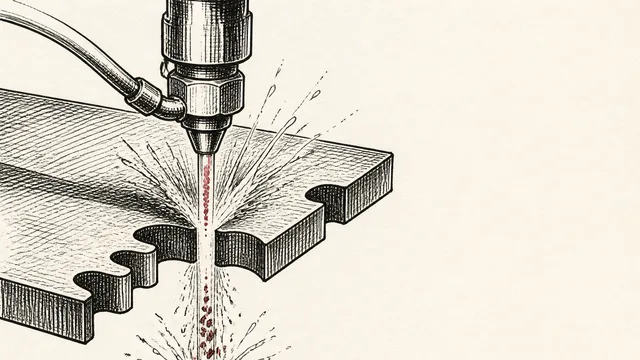
How Waterjet Cutters Use Garnet to Slice Through Steel
Waterjet cutters don't actually cut with water—garnet does the work. Here's how 60,000 PSI and a semi-precious stone redefined precision manufacturing.
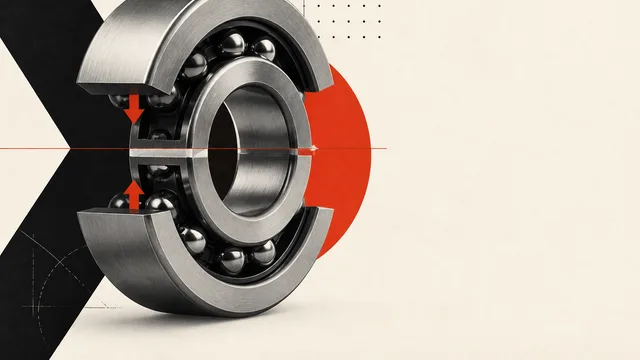
Hacking a Ball Bearing for Precision on a Budget
A father-son engineering duo modified a standard ball bearing with a grinder to achieve wobble-free precision — no expensive parts required.

England Ends Norway's World Cup Run, Haaland Silenced
England beat Norway 2-1 in extra time to reach the 2026 World Cup semifinals. Bellingham scored the winner. Here's what the money story actually looks like.

How Hard Is Soccer Fitness, Really?
Vox sent a producer to train with Brooklyn FC. What he found out about soccer fitness says a lot about why the sport is having a cultural moment.