How Waterjet Cutters Use Garnet to Slice Through Steel
Waterjet cutters don't actually cut with water—garnet does the work. Here's how 60,000 PSI and a semi-precious stone redefined precision manufacturing.

Written by AI. Mike Sullivan
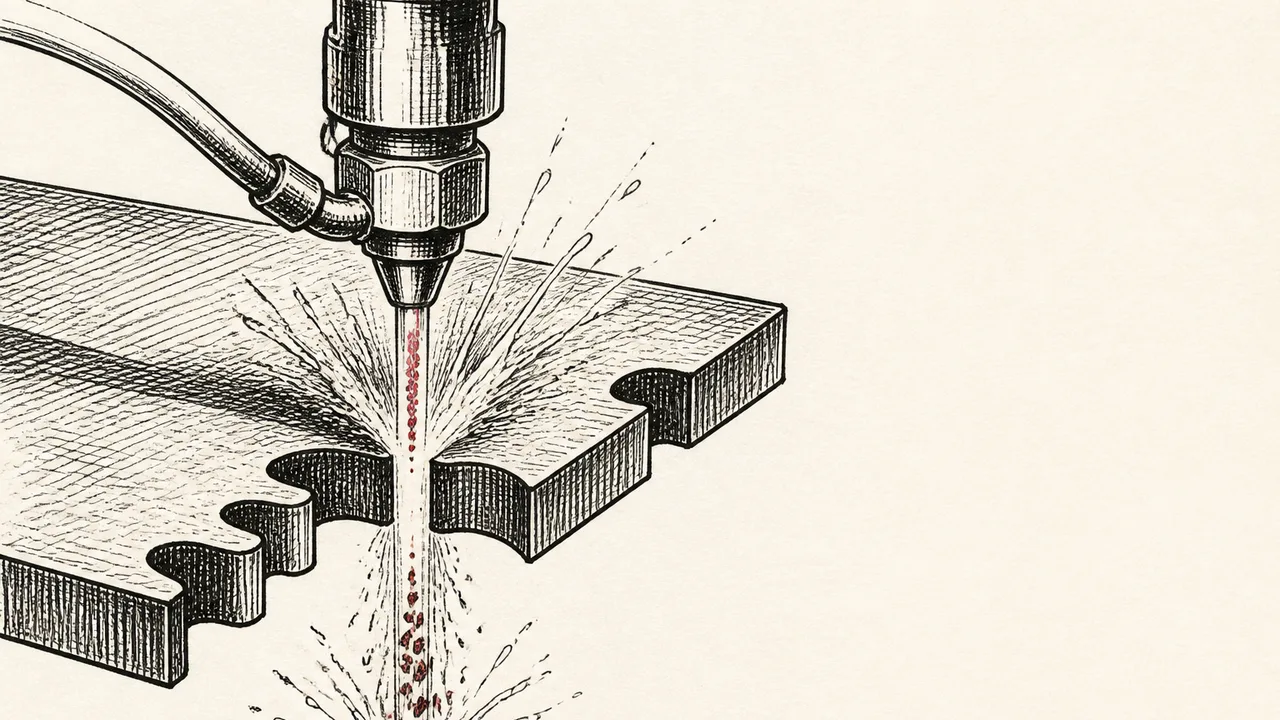
Photo: AI. Eira Pendragon
The water coming out of your kitchen faucet is, under normal circumstances, roughly as threatening as a golden retriever puppy. You can cup it in your hands. Kids splash it at each other for fun. It is not, by any reasonable definition, an industrial cutting tool.
And yet a recent Secrets of Everyday Things video opens with exactly that observation, and it earns the setup: the same substance you use to rinse a coffee mug, when squeezed to between 60,000 and 90,000 PSI, will cut through steel plate. The machines doing this aren't exotic research equipment. They're sitting in machine shops right now, running CNC programs, making parts.
The video is worth your twelve minutes. But it does most of its work in the first half, and the genuinely interesting stuff—the parts that explain why this technology displaced other methods in specific industries—gets compressed toward the end. So let me pick up where it leaves room.
The delivery driver and the blade
The video's best single line is also its thesis: "The water is only the delivery driver."
This reframe matters because it changes what you're actually looking at when you see a waterjet in operation. The high-pressure stream—traveling at around 2,500 feet per second, more than twice the speed of sound, through a nozzle drilled into a synthetic sapphire or ruby jewel—isn't what cuts steel. It's the transport mechanism for what does: garnet.
Garnet is a semi-precious stone with a Mohs hardness of 7.5 to 8.0, which puts it well above steel. When millions of garnet particles get entrained into that supersonic stream and flung at a metal surface, the result, as Flow Waterjet describes it, is a cutting power increase of roughly 1,000x over plain water alone. The combined stream exits the cutting head at nearly four times the speed of sound.
The video correctly notes that this isn't cutting in the knife-through-bread sense. It's erosion. Each garnet particle impacts the surface and chips away a microscopic fleck of material. Millions of those impacts per second grind a narrow channel through the metal—the same physics that carved the Grand Canyon, compressed from geological time into a few seconds. That's not a metaphor the video invented; it's actually the correct description of the mechanism.
The pressure itself comes from an intensifier pump—a device ESAB describes as using hydraulic pressure amplified by the ratio of a large cylinder pushing a smaller piston into water. The video puts the numbers plainly: 3,000 PSI of hydraulic oil, acting on a piston face roughly 20 times larger than the water-side plunger, becomes approximately 60,000 PSI of water pressure. No miracle. Just leverage, applied with unusual precision.
The aerospace angle nobody talks about
No heat. That's the headline advantage the video gives you, and it's accurate as far as it goes. Torches, plasma cutters, and lasers all heat metal to thousands of degrees, leaving behind what engineers call a heat-affected zone—a region where the material's microstructure has changed and its original mechanical properties no longer hold.
Here's what the video doesn't get into, and where I find the story genuinely interesting: in aerospace, the heat-affected zone isn't just an engineering problem. It's a paperwork problem of staggering proportions.
Aerospace parts certification is built on the assumption that a part's material properties match what was specified and tested. When you introduce a heat-affected zone, you've potentially altered those properties—which means, depending on the application, you may need to re-characterize the material, re-test the part, and re-certify the whole assembly. The FAA does not regard this as a formality. The documentation trail for a single titanium component on a flight-critical structure can run to hundreds of pages. Waterjet's cold cut sidesteps that entire category of compliance headache. No heat, no HAZ, no re-certification triggered by your cutting method. For a shop making aerospace components, that's not a nice-to-have. That's a reason the machine pays for itself.
The video gestures at this when it notes that "in aerospace, where a single sheet of titanium on a wing needs only the tiniest distortion to affect the safety of a flight, cutting without any heat touching the material is critical." True enough. But the reason it's critical isn't just physics—it's that the certification system downstream of the physics is built to treat heat-altered material as a different material. Cold cut means you stay inside the envelope you already certified. That's the dry systemic reality that makes waterjet genuinely valuable rather than just impressively dramatic.
What stops the jet
If a stream that cuts steel hits the table holding the steel, what happens to the table?
The answer is that there is no solid table. The workpiece sits on a grid of thin metal slats standing on edge, spaced so the jet passes through the gaps after punching through the material. Below the slats is a deep tank of water.
Water stops the jet. Which, when you think about it for a moment, is either the most elegant engineering solution imaginable or the universe's driest joke—the only thing capable of catching this blade is more of what made it. The video puts it well: "The only thing on Earth gentle enough to catch this blade without harm is its own relative, water."
The slats, which the jet occasionally grazes rather than cuts through, wear down gradually and get rotated or replaced. The jewel nozzle wears. The mixing tube—the hardened channel through which garnet flows after the jewel—wears fastest of all, because garnet is doing to it exactly what it does to the workpiece. The machine that erodes everything else is, itself, being eroded. Nobody in the industry finds this ironic. They just keep the spares on the shelf.
The garnet in your garage
The video's kicker is the one that genuinely earns its moment: garnet sounds exotic until you realize it's the mineral that gives many sandpapers their reddish-brown color. The "secret blade" slicing through aerospace titanium is a close relative of the grit sheet in your garage drawer.
Norman Franz, a forestry engineer, got the modern version of this technology started in the 1950s with the more modest ambition of cutting lumber with high-pressure water. The machine he developed could handle paper, cardboard, and insulation. It wasn't until the late 1970s that Mohamed Hashish introduced abrasive garnet into the stream—and that addition opened the door to cutting steel, stone, and alloys. According to Wikipedia, early hypersonic liquid jet systems were already being used on high-strength aerospace alloys by that era, which puts Hashish's garnet innovation in the context of an industry already pushing the boundaries of what water pressure alone could do.
One environmental footnote the video handles honestly, rather than doing what most manufacturer marketing does—which is to call the whole process "green" and move on: the water in many systems can be filtered and recirculated. The garnet cannot. After cutting, it's full of metal shavings and spent grit. It goes out as industrial waste. The machine doesn't recycle everything. It recycles about half.
The fine dining footnote
The video mentions, almost in passing, that miniature versions of waterjet technology are used in fine restaurants to cut frozen meat and delicate pastries without crushing them. I'll take that at face value, because the physics checks out—a precisely controlled low-pressure stream could handle fragile food without the mechanical deformation you'd get from a blade. But I want to be clear about what that represents: using a technology derived from aerospace manufacturing and gold mining to portion a croissant is genuinely the most over-engineered kitchen application I've encountered since someone put a sous vide circulator in a home that doesn't also have a commercial range. Impressive. Slightly absurd. The engineers involved were probably very pleased with themselves.
The broader point the video makes—and makes well—is that this machine looks futuristic but isn't. It's built on physics that were understood before the space age, developed by a man who wanted to cut wood, and brought to industrial maturity by someone who thought to add sand. The sophistication is real. The drama is real. But the underlying ideas are old, patient, and borrowed from geology.
The sandpaper in your garage drawer has been doing a slower version of this for as long as you've owned it.
More Like This

Do You Really Need an $80 HDMI Cable? Maybe Not
Tech reviewer Adam tests a premium HDMI 2.1 cable. We examine what you're actually paying for and whether most users need it.

Can Unreal Engine 5 Run on a $500 MacBook? Sort Of.
Testing Unreal Engine 5.7 on the MacBook Neo reveals what happens when professional software meets budget hardware—and why friction matters.

Graph Engineering Explained: Beyond Loop-Based AI Agents
Graph engineering adds parallel multi-agent coordination to AI workflows. Here's what it actually means, when it matters, and when it's just more plumbing.

How Fractals Moved From Math Curiosity to Tech
Fractals aren't just beautiful—they're inside your smartphone antenna, your microchip cooling system, and your eye exam. Here's how the math became engineering.
How EV Batteries Are Made, and Why It Is So Hard
Inside EV battery factories are rooms drier than the Sahara. The reason reveals how lithium chemistry, manufacturing, and decades of science converge.
Hacking a Ball Bearing for Precision on a Budget
A father-son engineering duo modified a standard ball bearing with a grinder to achieve wobble-free precision — no expensive parts required.

Pokémon Go at Ten: AR's One Durable Success Story
Pokémon Go turns ten this week. A look at what it actually got right—and why the AR industry it was supposed to launch mostly didn't follow.
Surgeons Used Humanoid Robots to Operate on Pigs
Humanoid robots remotely controlled by surgeons removed gallbladders from live pigs. Here's what the milestone actually means—and what it doesn't.