Czech Sanctuary Near Chleby Predates Stonehenge by 1,000 Years
A 6,500-year-old Neolithic sanctuary in Czechia tracked the Sun and Moon long before Stonehenge. What the Chleby site tells us about prehistoric astronomy.

Written by AI. James Morrison
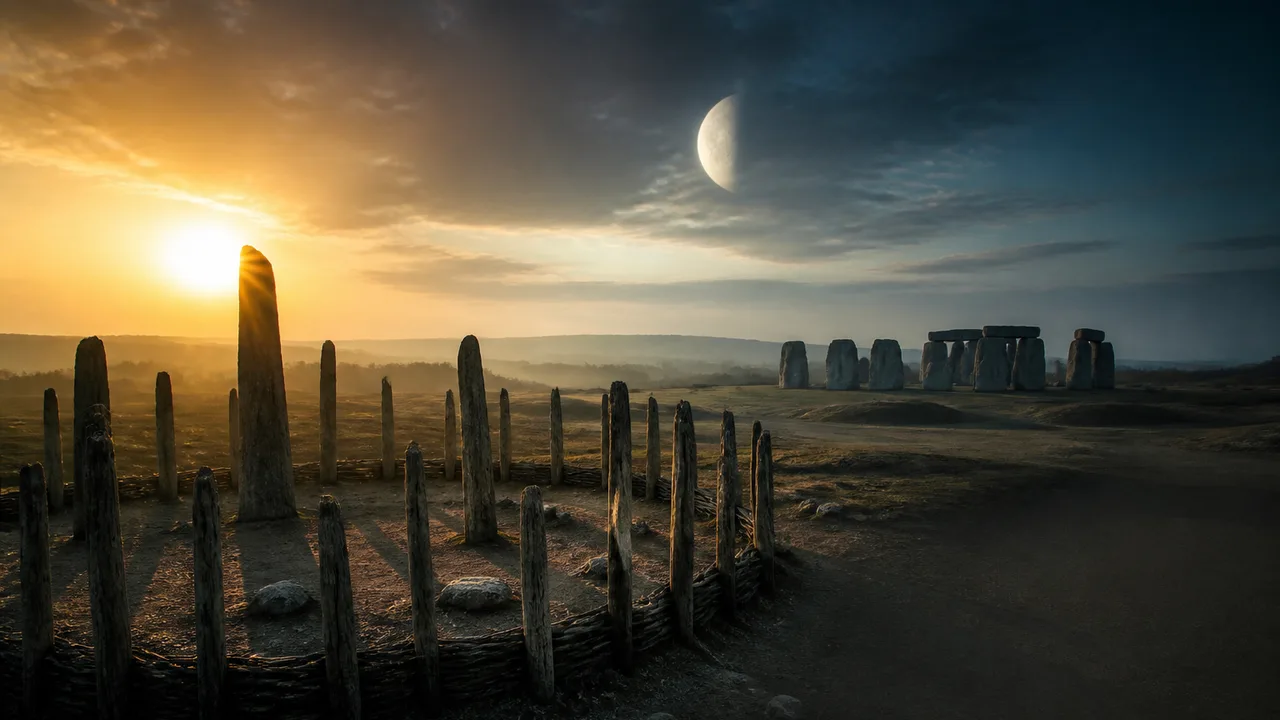
Stonehenge has a branding problem that the stone circle itself never caused. For most of the English-speaking world, it became the default shorthand for ancient astronomical ambition — the monument against which all others are measured, the image that ends the sentence "they were more sophisticated than we think." That framing has always been a little too convenient, and a new discovery in Central Bohemia makes the inconvenience harder to ignore.
Archaeologists led by the University of West Bohemia have excavated a prehistoric sanctuary near Chleby, in the Czech Republic, that dates back more than 6,500 years. According to archaeologymag.com, the site was built more than 1,000 years before Stonehenge. Ancient Origins characterizes it as a Neolithic sanctuary that may have tracked the Sun and Moon across multiple cycles — solstices, possibly lunar standstills, the skeletal grammar of a calendar scratched into the dirt of Central Europe before the wheel was in common use. La Brújula Verde describes it as the oldest sanctuary and prehistoric astronomical observatory in Central Europe.
That is not a small claim. It deserves scrutiny, and it deserves to be taken seriously at the same time.
What the Site Actually Shows
The physical record, as described across multiple sources, is specific enough to anchor the interpretation. According to expats.cz, the sanctuary's entrances align with significant solar and lunar cycles — the kind of deliberate orientation that requires sustained observation, collective agreement, and the organizational will to build something large enough to be useful across generations. That last part matters. You don't build an observatory for yourself. You build it for the people who will stand at its threshold decades after you are gone.
Expats.cz also reports that bull skulls and horns were found at the site, indicating ritual use and what researchers believe may have been monumental gate decorations. This is where the evidence gets layered in a way that rewards attention. The skulls are not incidental. In Neolithic contexts across Europe, cattle remains at threshold spaces tend to signal something about the boundary between the everyday and the sacred — between the world you move through and the world you are trying to address. The people who placed those skulls at the gates were not fumbling toward meaning. They had a system. The astronomy and the ritual were not separate projects; they were the same project.
The University of West Bohemia's official news portal describes the site as a ritual center linked to the movements of the Sun and Moon. Ancient Pages frames it as a site where astronomical function and sanctuary purpose appear to be structurally unified — not a place where astronomy was practiced and rituals happened to occur nearby, but a place designed so that one was the expression of the other.
The Logistics Problem
Here is the question that doesn't get asked enough when a site like this surfaces: who organized it?
A monument aligned with solar and lunar cycles, decorated with bull skulls at its gates, built to last and built to be used by a community — this is not the work of a single season or a single family. Someone had to hold the knowledge of the sky across years. Someone had to coordinate the labor. Someone had to decide that marking the solstice with stone and bone was worth the cost of not doing something else with that time and energy.
What the Chleby sanctuary suggests — and this is where the comparison to Stonehenge is most useful, if also most easily oversimplified — is that the impulse to build time into the landscape was not a British invention, not a Beaker People phenomenon, not the product of some uniquely advantaged corner of the prehistoric world. Neolithic communities in Central Bohemia, around 4500 BCE, were doing the same thing: turning the sky into a shared object, encoding the calendar into a structure so that the knowledge survived the death of whoever first possessed it. That is social technology, not just architecture. It is a way of making the year legible to people who have no writing, by building the text in wood and earth and bone — something you walk through rather than read.
What we do not yet know, at least from the published sources available, is the precise construction sequence of the Chleby site, the full extent of the astronomical alignments, or how it connects to the broader Neolithic rondel tradition that appeared across Central Europe in this period. Those are not failures of the research. They are the early shape of it — the questions that a site this significant is supposed to generate, not the loose ends that undermine the finding.
The Stonehenge Frame and Its Limits
The comparison to Stonehenge is inevitable, and the researchers use it themselves. It works as a scale marker. Most readers have a rough sense of what Stonehenge represents — monumental effort, astronomical intent, prehistoric sophistication — and saying that Chleby predates it by a millennium communicates something real about the site's age and significance.
But the comparison carries a risk. It implies a developmental sequence that the evidence does not support: that astronomical monument-building moved from somewhere to somewhere, that one tradition descends from or inspired another. The Neolithic rondels of Central Europe — circular enclosures built by farming communities across what is now Germany, Austria, and Czechia — predate the British megalithic tradition, and they were sophisticated in their own right. The Chleby site fits within that tradition. Stonehenge fits within a different one. The relationship between them is not a family tree; it is more like two communities, separated by geography and centuries, arriving independently at similar conclusions about the sky.
That parallel development — multiple Neolithic cultures, in multiple locations, finding their way to the same architectural answer — is more interesting than any single origin story. Early astronomical sophistication was not a monopoly. It emerged wherever farming communities put down deep roots, began accumulating observations across generations, and had enough organizational coherence to build something that would outlast the individuals who started it.
What We Still Do Not Know
The sources converge on the broad picture but are thin on particulars. The specific alignments — which entrance faces which solar event, what the lunar correlations are precisely — are present in summary form but not yet laid out in detail for general publication. That may reflect the early stage of reporting, or it may reflect the state of the analysis itself. Either way, the record is honest about what it does and does not yet contain.
What is not in dispute: the age, the astronomical intent, the ritual character, and the significance of a site this old turning up in Central Bohemia. The interpretation is still being built, the way all good archaeological interpretation is built — slowly, from physical evidence outward.
There are almost certainly other sites like this one still underground, waiting. Central Europe's Neolithic is not fully mapped. The rondel tradition left traces across a wide geography, and not all of them have been excavated, much less published. Chleby may be exceptional, or it may be one node in a network we have barely begun to see.
What sits with me about all of this is something simpler than a research question. Six thousand five hundred years ago, people stood at the threshold of that gate — the one decorated with bull skulls — and watched the sunrise align with something they had built to receive it. They had no writing, no institution, no mechanism for preservation except the monument itself. And yet here we are, reading the message. They did not know us. They could not have imagined us. But they built something legible across a distance of sixty-five centuries, which means they understood, in some form, that there would be people on the other side of that distance worth building for. That is not a scientific discovery. That is a statement about what humans have always believed about each other.
More Like This

Ray Dalio's Framework for Tracking Empire Decline
Ray Dalio argues empires follow measurable, repeating cycles of rise and fall. His framework deserves scrutiny—and raises questions relevant to today's geopolitics.
Unraveling Rome's Dodecahedron Mystery
Exploring the enigmatic Roman dodecahedron, its theories, and historical significance in modern archaeology.

FBI's Struggle Against Omega 7: A Tale of Terrorism and Intrigue
Explore the FBI's complex investigation of Omega 7, a Cuban exile terrorist group, amid community challenges and evolving tactics.
Unexplained Calls: Echoes from the Past
Explore eerie stories of calls from the dead, their impact on military and emergency responses.

Scotland's Carved Stone Balls: A Neolithic Mystery
Nearly 500 carved stone balls have been found across Scotland. Archaeologists still don't know what they were for. Here's where the theories stand.
The Kesh Temple Hymn: Humanity's Oldest Sacred Text
Written around 2600 BCE, the Kesh Temple Hymn is among the oldest surviving literature on Earth. Here's what it tells us about faith, power, and memory.

Sun Tzu's Brutal First Lesson and the Real Art of War
A new documentary examines the palace courtyard execution that launched Sun Tzu's career—and asks whether we've been misreading The Art of War for 2,000 years.
Benedict Arnold: Patriot, General, Traitor
Benedict Arnold won the Battle of Saratoga then betrayed his country. A new documentary examines the grievances, ambition, and political failures that made both possible.