Charles Joughin: The Titanic's Chief Baker Who Survived
Charles Joughin, the Titanic's chief baker, survived the sinking against all odds. His story raises real questions about memory, class, and who history chooses to remember.

Written by AI. David Oyelaran
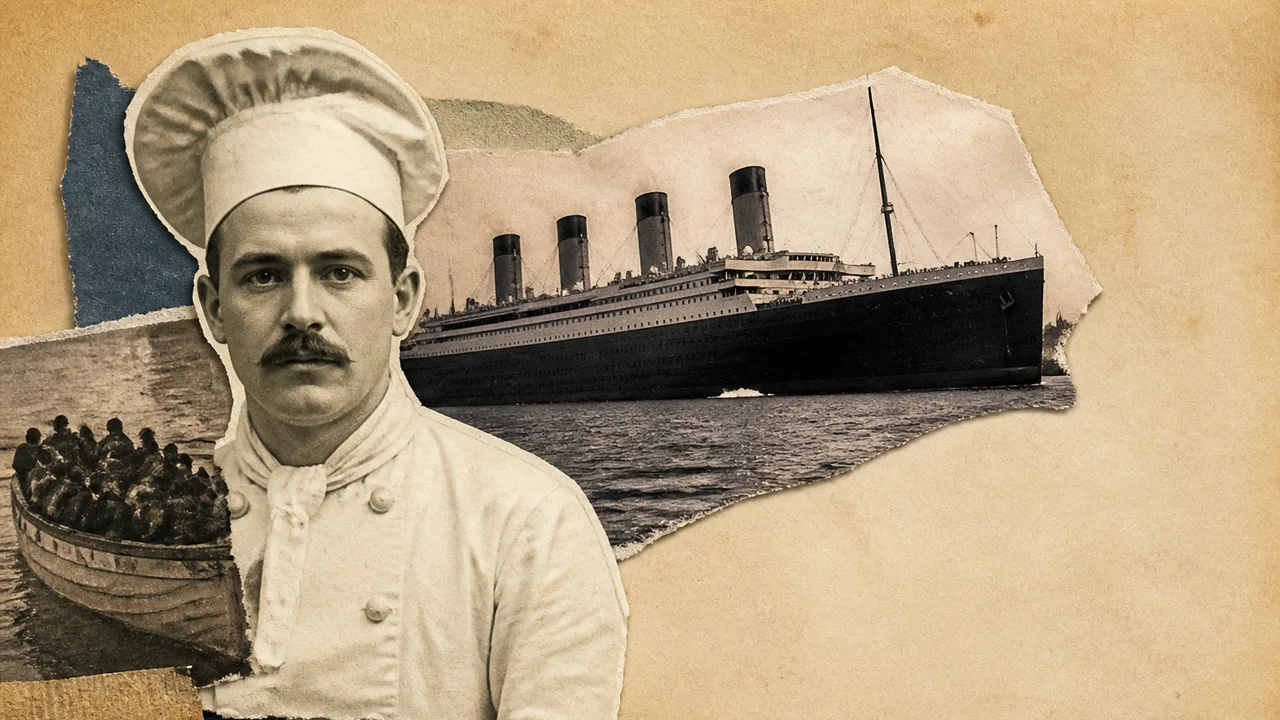
There is a version of the Titanic story most of us already know: the band playing, the lifeboats half-empty, the men in evening dress stepping back from the rails. It is a story that tends to center the wealthy and the powerful — the ones whose names were already in newspapers before the ship went down. What gets lost in that version is a different kind of record: the nearly 900 crew members who made the voyage possible, who fed and served and maintained the ship, and who died in proportions that dwarfed those of the first-class passengers. Among the few who survived from that group was a 33-year-old baker from Birkenhead, England — and his story, more than a century later, remains one of the stranger and more illuminating footnotes in the whole disaster.
Charles John Joughin — pronounced, for the record, JOCK-in — served as the Titanic's Chief Baker. According to Wikipedia, he was born on August 3, 1878, and had signed on for the Titanic's maiden voyage in Southampton on April 4, 1912, listing his address as Elmhurst, Leighton Road, per Encyclopedia Titanica. He was, by most accounts, exceptionally good at his job. When word of the iceberg spread through the ship, Joughin was below decks, overseeing his bakery operation. He didn't panic. By most accounts, he didn't even appear to hurry.
What he did first tells you something
Joughin's initial response to a sinking ship was to organize. According to All That's Interesting, he directed his team of bakers to haul provisions up from the kitchens and load them into the lifeboats — bread, supplies, whatever could be carried. While officers struggled to control crowds and launch boats that were nowhere near full, Joughin had apparently already calculated that people in those boats were going to be cold and hungry for a while.
Then, when he was assigned as captain of Lifeboat 10, he reportedly refused to board it. He helped women and children onto the boat instead — in some accounts physically throwing them in when they resisted — and then stepped back. He let the lifeboat go without him.
What he did next is where the story gets complicated, and where it gets interesting.
Whisky, deckchairs, and the physics of freezing
According to the Titanic Wiki, Joughin returned to his cabin and drank what he later described as a significant quantity of whisky. He then went back on deck and began throwing deckchairs overboard — not for any clear strategic reason, but perhaps to give people in the water something to hold onto. He worked steadily, deliberately, as the stern of the ship rose out of the water around him.
When the ship finally went under, Joughin was still on it. By his own account — and this caveat matters — he rode the stern down and stepped off into the water with barely a splash, as if descending from a low platform. According to Wikipedia, Joughin himself claimed to have treaded water for hours before finding a raft and eventually being pulled aboard the RMS Carpathia.
Here is where the story forces a genuine question: how much of this is accurate?
Joughin's survival in water that was approximately 28°F (-2°C) is, on its face, physiologically improbable. Research published in The Lancet (Cold water immersion: sudden death and prolonged survival) shows that cold shock response typically peaks within the first minutes of immersion, and can trigger cardiac arrest in otherwise healthy people. Most of the 1,500 people who died that night didn't drown — they were killed by the cold, quickly. The fact that Joughin emerged from the water with no significant injury defies almost everything we understand about cold water immersion.
The alcohol-as-insulation theory has been popular for over a century. The Titanic Wiki notes that his survival was "popularly attributed" to the whisky he had consumed. Michael Averon, writing on michaelaveron.com, frames his story as one of "luck, humour, stoicism, and the need to focus only on what you can control in a crisis" — which is a fair summary of the interpretive range people bring to Joughin. The actual science on alcohol and cold exposure is less romantic: alcohol causes vasodilation, which can actually accelerate heat loss from the core. It creates the sensation of warmth while the body chills faster.
What's more likely — and more honest to acknowledge — is that Joughin's survival involved factors we can't fully reconstruct from his testimony alone. He may have found something to hold onto sooner than he recalled. His exposure time may have been shorter than he believed. Human memory under extreme stress is not a reliable recording device; it's a reconstruction, and reconstructions are shaped by what the mind needs them to be. The Shoe: Untied blog calls him "the baker who saved lives, got drunk, and lived to tell the tale" — which is accurate, as far as the telling part goes. The tale, specifically, is his own.
None of this is to say Joughin was lying. It's to say that his account is the only account, and accounts of survival are almost always shaped by the sheer miracle of having made it out.
The crew the record mostly forgot
What stays with me — and what I think gets underweighted when Joughin's story is told as legend — is the context of who was on that ship doing what kind of work.
According to data compiled by Passengers and Crew of the R.M.S. Titanic, the Titanic carried close to 900 crew members, depending on how different categories of staff are counted. They cooked, served, stoked the boilers, navigated, maintained the equipment, and — on the night of April 14 into April 15, 1912 — largely stayed at their posts and died. Crew survival rates were significantly lower than those of first-class passengers. The hierarchies of class on that ship didn't dissolve in the water; in many ways, they determined who got out.
Joughin occupies an unusual position in that story. He was crew, and he survived — but not because he pushed to the front of the line. The record, imperfect as it is, suggests he actively gave away his place. Whether that makes him a hero in some grand sense is a question I'd leave to each reader. What it makes him, at minimum, is a more interesting subject than history has typically offered.
Joughin died on December 9, 1956, according to Wikipedia. He had lived in the United States for much of his post-Titanic life, worked in his trade, and by all available accounts did not seek the spotlight. He gave testimony, answered questions when asked, and then largely got on with it.
History didn't forget him entirely — his story circulates regularly, attached to the whisky detail, which is the kind of thing that makes a fact memorable. But the broader story he belongs to — the story of the crew, the working people, the ones who served the food and kept the lights on — that story still doesn't get the room it deserves.
The Titanic carries so much symbolic weight that it bends toward legend almost automatically. What Joughin's story asks, if you let it, is a simpler question: whose version of the night are we actually preserving, and whose are we still letting disappear?
More Like This

Middle Platonism's Hidden Role in Western Esotericism
ESOTERICA's new crowdfunded seminar argues Middle Platonism built the foundations of Hermeticism, Gnosticism, and early Christian theology. Here's what that means.
How the Brooklyn Bridge Got Built Against All Odds
The Brooklyn Bridge's construction killed its designer, crippled its chief engineer, and buried a doomsday bunker in its foundations. Here's what it actually took.
The Gods of Pre-Islamic Arabia, In Their Own Words
Ancient desert inscriptions reveal the polytheistic world before Islam—gods, prayers, sacrifice, and fate, recorded by the nomads who lived it.
The Nine Days of Bismarck: A Battle That Changed Naval War
How nine days in May 1941 destroyed Germany's mightiest battleship, sank the Royal Navy's iconic HMS Hood, and ended the battleship era for good.
Mexico's Radioactive Milk Scandal After Chernobyl
After Chernobyl, Mexico distributed Cesium-contaminated powdered milk to its poorest communities. The families who consumed it left almost no testimony behind.
The Long History of Lost Audio and Media
From Earhart's final transmissions to the Fox Vault Fire, a look at why so much recorded history vanished—and what its absence means for how we listen to the past.
Cicero and the Fall of the Roman Republic
Marcus Tullius Cicero defended Rome's Republic with words alone—and paid with his life. A look at history's most consequential orator and his impossible political moment.

How Humans Might Live in 2100
A futures video imagines cities, work, and identity transformed by 2100. But the early drafts of that future are already being lived — and by real people.