Canada Hits Back: C$37.7 Billion in Tariffs Take Effect on U.S. Goods
Canada's C$37.7 billion retaliation, with 50% duties on U.S. steel and aluminum, raises costs for manufacturers on both sides of the border. Who pays, and when?

Written by AI. Jonathan Park
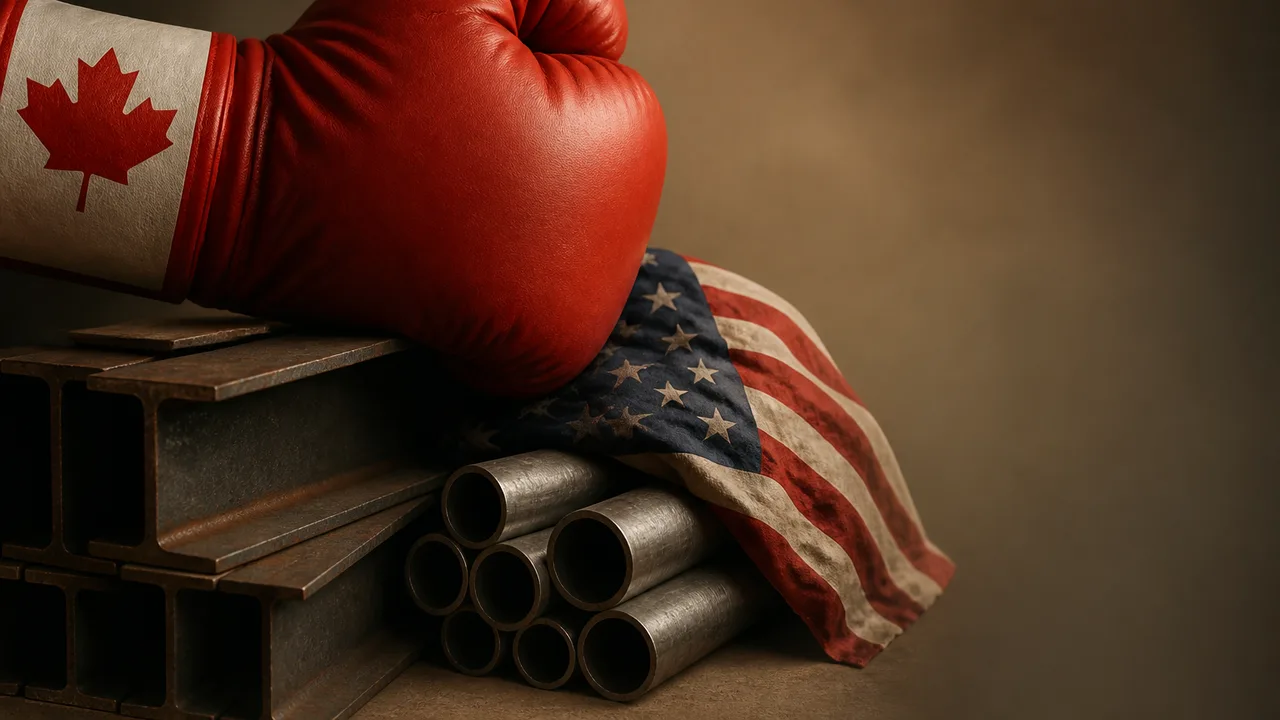
Canada's counter-tariffs went into effect Monday, and the numbers are bigger than the usual trade skirmish. Ottawa has put C$37.7 billion, roughly US$27.6 billion, of retaliatory duties into force, with tariffs on U.S. steel and aluminum products climbing to 50%, according to CNBC. The move marks a shift from diplomatic posturing to a cost problem with invoices attached.
Who Actually Pays a 50% Tariff
The mechanical answer is: the importer. When a Canadian company brings U.S. steel across the border, it pays the duty at customs, then decides whether to absorb the cost, raise prices, renegotiate with its supplier, or switch sources. As Supply Chain Dive reported ahead of the rollout, duties will reach as high as 50% on U.S. imports, with the metals list front and center.
That sequence explains why metals-heavy industries are the most exposed. Auto parts, appliances, construction materials, food processing equipment: all of them sit downstream of steel and aluminum pricing. A fabricator in Ontario buying U.S. coil now faces a cost that either shows up in its margins or in its customers' prices. A U.S. mill, meanwhile, loses competitiveness in one of its largest export markets overnight.
Economists have long noted that retaliatory tariffs in a trade war tend to function this way on both sides: each government taxes its own importers, in the hope of inflicting enough pain to force the other side to the table. The 2018 round of U.S.-Canada steel disputes followed the same pattern, and the eventual resolution came through negotiation, not escalation. Whether this round follows that script is the open question.
The Politics Are Aimed at Swing States
The targeting of the tariff list is doing political work. Fortune reports the counter-tariffs hit products tied to politically sensitive U.S. regions: Wisconsin cheese, Maine seafood, Kentucky appliances, categories concentrated in swing states ahead of November's midterms. That is a familiar playbook. Canada's retaliation lists in previous rounds were built the same way, aiming duties at constituencies whose complaints travel fastest to Washington.
Whether it works is a different matter. International Business Times argues the political fallout from this escalation may exceed its economic impact, a view that turns on how quickly agricultural and consumer-goods producers can redirect exports to other markets. Cheese and seafood have substitutes elsewhere; steel contracts are harder to unwind.
For Canadian consumers and businesses, the costs arrive regardless of who blinks. Morning Brew framed the escalation bluntly as a trade war now underway, and BBC reports Canada is preparing for a prolonged conflict rather than a short, high-leverage exchange.
The Uncertainty Problem
Here is where the brief gets more interesting than the headline number. For companies operating on both sides of the border, the tariff rate is only half the problem. The other half is not knowing what the rate will be in three months.
Tariff volatility does specific damage:
- Contracts written at pre-tariff prices become money-losers overnight, and repricing mid-contract invites legal disputes.
- Sourcing decisions stall. A Canadian manufacturer deciding between a U.S. supplier and one overseas can no longer treat the comparison as stable.
- Investment planning gets deferred. Nobody breaks ground on a plant based on a tariff schedule that might change next quarter.
Businesses in the 2018 trade disputes responded to exactly this uncertainty by front-running tariffs, stockpiling inventory ahead of deadlines, which distorted the data and made the economic impact harder to read. Expect some of that behavior now: Quartz notes the counter-tariffs took effect as the trade war deepened, and importers who saw this coming had weeks to pull shipments forward.
What Could Happen Next
Three paths branch from here, and they are not equally likely.
Escalation. Either government expands the list of covered goods or raises rates further. Canada has structured its retaliation in waves before, holding back categories to maintain leverage. The U.S. side could respond in kind, though each escalation narrows the constituency that benefits.
Exemptions. Both governments have historically carved out politically important industries under pressure. Watch for lobbying from U.S. agriculture and Canadian manufacturers who depend on U.S. inputs. Exemptions relieve the loudest constituencies and blunt the tariffs' bargaining purpose at the same time, which is why they arrive selectively and slowly.
Negotiation. The eventual outcome in nearly every modern tariff dispute. The question is timing, and timing is political. With midterms approaching, as Fortune's reporting makes clear, neither side has an obvious incentive to de-escalate before November. A deal that looks like retreat costs more in an election year.
The Other Voice in the Room
Most coverage of tariff fights centers governments and exporters, so it bears stating plainly: the parties with the least say in this conflict are the importers, workers, and consumers on both sides of the border. Canadian manufacturers buying U.S. inputs face higher costs. U.S. farmers and food producers lose market access they did nothing to forfeit. Consumers on both sides pay more when pass-through happens, which history suggests it does, eventually and unevenly.
There is also a structural asymmetry worth spelling out. The two economies are not the same size, and the U.S. exports more to Canada than Canada exports to the U.S. in many categories. That gives Washington more raw leverage in a long war of attrition. But asymmetry cuts the other way in politics: Canada's tariff list was built to concentrate pain in specific American districts, while broad U.S. tariffs spread cost across the whole Canadian economy. Precision versus mass, and both sides are using what they have.
What to Watch
The number to track is not the C$37.7 billion. It is the duration. A tariff sustained for a quarter is a negotiation tactic; a tariff sustained for a year is a new baseline cost structure, and companies reorganize around new baselines. Supply chains shift, contracts get rewritten with tariff clauses, and the pre-dispute status quo stops being recoverable even after the duties disappear.
Canada is signaling it can hold. Washington is signaling it will not move first. Between those two signals sit manufacturers in Ontario and Ohio, cheese producers in Wisconsin, and the September-to-November window in which both governments decide whether escalation is a strategy or just a habit.
The record here is still thin on the specific product lists beyond metals and the named categories, and I'd caution readers against extrapolating economy-wide impact numbers from partial lists. But the direction is unambiguous, and both governments have now publicly committed to a fight rather than a settlement. The next data point will be the first exemption, because that's when we learn which constituency each government fears losing.
More Like This
USMCA Won't Be Renewed: What Annual Reviews Mean
The Trump administration has blocked USMCA's 16-year renewal, opting for annual reviews. Here's what that means for trade, business, and North America.
Bill Ackman's Art of Finding Invisible Money
Explore Bill Ackman's strategy of finding hidden value in companies, beyond standard metrics.

How APL Turned an NBA Ban Into a Brand Identity
APL's NJ Falk breaks down the six storytelling threads behind one of e-commerce's most unlikely brand-building moves—starting with an NBA ban.
Ukraine's War Reaches the Diesel Market as Prices Hit Records
U.S. diesel prices hit an all-time high as attacks on Russian refineries transmit war risk through shipping, inventories and trade. Who pays, and for how long?
Canada-US Trade Deal Announced, Key Terms Still Unclear
Trump and Carney announced a Canada-US trade deal, but no terms are public. What the gap between hype and detail means for businesses waiting on clarity.

Trump's Forced-Labor Tariffs Trigger Global Backlash
Trump's new tariffs on 80+ countries cite forced labor, but trading partners call it protectionism. Here's what's actually at stake in the escalating dispute.

AI Company Logos All Look Alike. Here's What That Reveals
AI companies keep designing the same circular, gradient logo. Is it groupthink, strategic mimicry, or something more revealing about the industry itself?
France Sold Its Nuclear Turbine Crown Jewel to GE
How France sold the world's most powerful nuclear steam turbine to GE in 2015, then spent years engineering a buyback — and what it cost everyone involved.