A Bronze Leg Recasts Rome’s Short-Lived Scottish Frontier
A bronze leg from a Scottish bog may have belonged to an emperor’s statue. Its intact edge, the Antonine Wall and buried altars reveal a frontier in retreat.

Written by AI. Helen Papadopoulos
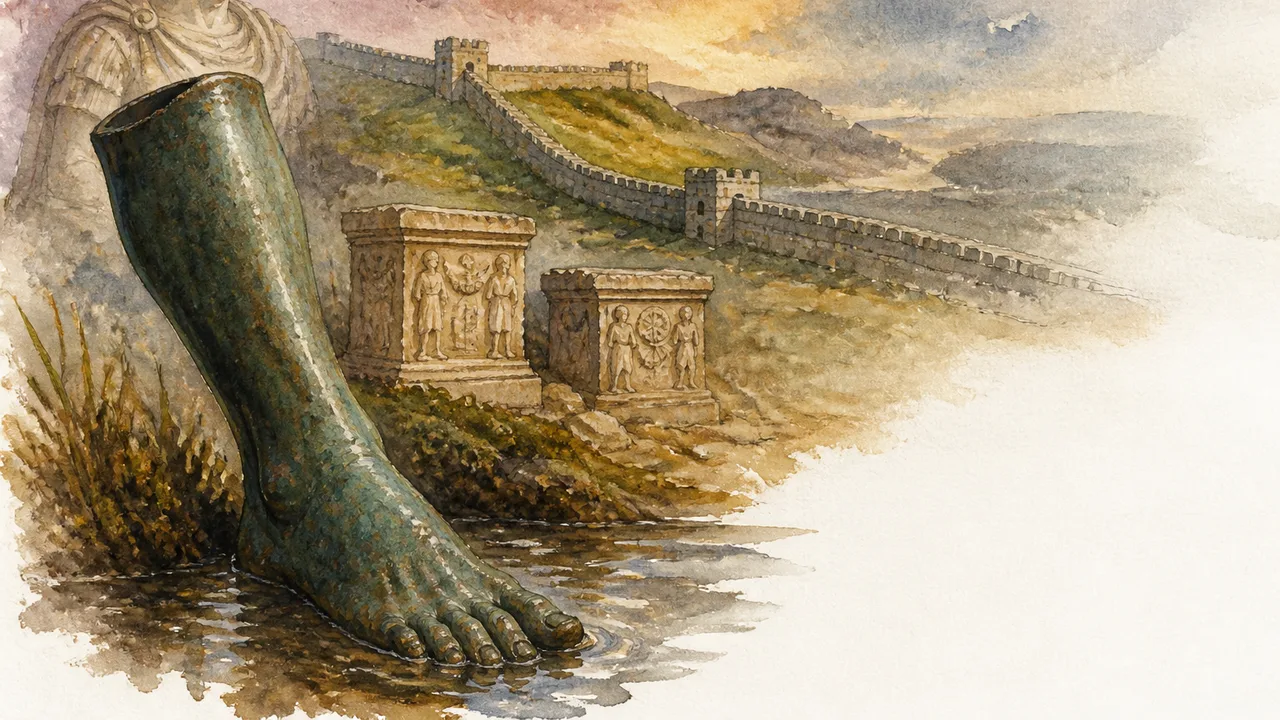
A gilded bronze leg found in a Scottish bog in 1820 has become the centerpiece of a new interpretation of Rome’s short-lived conquest north of Hadrian’s Wall. Curators at National Museums Scotland propose that the boot-clad limb belonged to an enormous statue of Emperor Antoninus Pius on horseback, erected in southern Scotland and later taken apart as Roman forces withdrew. The leg is real; the horse, rider and circumstances of their removal remain a reconstruction.
The Milsington leg came from a bog near Hawick, in the Scottish Borders. It dates to the 140s CE and is larger than life-size. From November 14, the National Museum of Scotland plans to display it against a full-scale silhouette of the proposed horse and rider. A silhouette is an unusually honest choice for an object whose missing parts include almost everything above the boot.
For generations, the leg invited a different reconstruction: raiders from north of Hadrian’s Wall had hacked it from a statue farther south and carried it home as loot. Some suggested York as its starting point. The assumption had an intellectual history as well as a geographical one. In 1932, the scholar James Curle argued that a monument of this scale could scarcely have stood north of Hadrian’s Wall, as the Guardian recounts. Put another way, an emperor could lose a leg in Scotland, but apparently could not have put his foot down there in the first place.
The curators’ examination challenges the hacking part of that story directly. The leg’s upper edge has no cut marks and remains as cast. Around the knee, an ungilded area and raised pieces of metal suggest that the leg joined folds of a tunic or cloak. The museum contrasts this intact piece with the small, irregular fragments left when statues were chopped up for scrap or attacked after a battle. A violent severing becomes a poor explanation for this particular surface.
That observation takes the argument some distance, but it cannot walk the whole route. An intact edge does not identify the person who separated the leg from the larger sculpture. The date and the comparable imperial statues found at frontier forts make a monument erected in Scotland plausible. Antoninus’s campaign makes him a plausible subject. Neither proposition emerges from an inscription on this leg, and the reason it ended up in the bog remains uncertain. The curators suggest dismantling during Roman withdrawal in the 160s or 180s CE; the physical join alone cannot date that act.
A Wall that Moved the Frontier North
Rome’s Scottish campaign explains why the proposed statue would have belonged in the region at all. Roman armies had campaigned in what is now Scotland in the first century CE. Hadrian subsequently consolidated a frontier in northern England, where construction of his wall began in 122. His successor Antoninus Pius pushed north again. The Antonine Wall, begun in 142, ran across central Scotland roughly 100 miles north of Hadrian’s Wall. Built largely of turf, it was abandoned after about twenty years; Hadrian’s Wall remained a frontier for much longer.
The familiar stone wall in England can make Rome’s northern boundary look settled and final. The shorter-lived turf wall records a decision to extend control and a later decision to give up that line. If the bronze leg came from a monument in southern Scotland, it would belong to the expansive part of that sequence. If Roman troops then dismantled the statue, the same object would also belong to the retreat. Archaeology has an inconvenient habit of keeping both chapters when empires would prefer a single triumphant inscription.
An emperor on horseback would have been a forceful way to announce authority in newly conquered territory. The museum points to other bronze imperial statues, including equestrian ones, from frontier forts. It also notes that Antoninus commemorated his Scottish victories with the title Imperator, a military honor marking victory. Those details strengthen the proposed identification: a campaign, a victorious emperor and a known form of frontier display fit together. They still leave room between a convincing identification and a recovered nameplate.
The curators looked to the surviving equestrian statue of Antoninus’s successor, Marcus Aurelius, as a model for the missing figure. That comparison helps a visitor imagine the scale and form of an imperial rider. It cannot supply the lost statue’s pose, horse or exact setting. The silhouette in Edinburgh asks viewers to make that mental leap while leaving the surviving bronze in plain sight.
What Else Was Put Away?
At Inveresk, near Edinburgh, a more securely documented act of burial offers a useful comparison. Two locally carved sandstone altars dedicated to Mithras and Sol were found beneath a cricket pavilion in 2010. Made in the 140s for a temple associated with the Roman military, they lay on their sides, apparently deliberately buried in antiquity. Roman forces left Inveresk within 25 years of establishing their presence there.
The altars show that Roman objects in this frontier landscape could be put away deliberately as military occupation ended. They do not turn every buried object into evidence of the same procedure: the altars were found together in their archaeological setting, while the Milsington leg was recovered from a bog in 1820. The comparison supports the possibility of careful Roman decommissioning without identifying who carried the bronze limb to its final resting place.
Inveresk also supplies people missing from the imagined portrait of an emperor. Finds there include women’s and children’s leather shoes from a settlement outside the fort, described in the account of the site. Roman soldiers were only part of the frontier’s population. Local communities encountered the military bases and the political changes that came with them; Roman displays of power addressed people who had not asked to be conquered. The Inveresk altars and the Milsington leg preserve the occupying culture’s objects, while those shoes bring some of the lives lived around its installations into view.
That wider picture resists an old habit of treating Hadrian’s Wall as a tidy dividing line between civilization and its supposed opposite. The Roman occupation extended north of it, and the communities Rome encountered had histories and material cultures of their own. Even the older looting explanation rested partly on a judgment about where an imperial monument could have stood. The new proposal asks us to test that judgment against the object and the changing frontier, rather than let an inherited map decide the answer.
The leg’s intact edge gives the curators good reason to reconsider a hacked-off trophy. The Antonine campaign gives their proposed Scottish statue a setting; Inveresk shows that deliberate burial accompanied withdrawal nearby. Together, they make the museum’s reconstruction persuasive enough to examine closely, while its missing horse and rider remain missing. Rome could build a wall, honor a victory and leave. The bronze boot has outlasted all three decisions.
More Like This
Denmark's Largest Viking Silver Hoard Found in a Garden
A homeowner in Rebild, Denmark unearthed around 700 Viking silver objects dating to the 10th century, the largest such hoard ever found in the country.
Arminius and the Betrayal That Broke Rome's Empire
How a Germanic prince trained by Rome destroyed three legions in the Teutoburg Forest in 9 AD — and fixed the Rhine as Europe's dividing line forever.
Cavalry Armor Surfaces in Palace Moat During Film Research Dig
Actors rehearsing a treasure-hunt film at Pielaszkowice Palace uncovered 19th-century cavalry armor in the moat. What the find can and cannot tell us.
Roman Temple at Kapersburg Reveals a Working Frontier
At Kapersburg, a Roman temple beside workshops and a fort offers a sharper view of worship, labor and later reuse along the empire's former German frontier.
How Rome Built, Used and Unmade Scotland's Antonine Wall
Archaeology at the Antonine Wall reveals an ordered Roman withdrawal, complicating the familiar story of a frontier built, defeated and swiftly abandoned.
South Carolina's 1860 Secession and the Civil War
On December 20, 1860, South Carolina voted unanimously to leave the Union. The document it produced tells us exactly why—if we bother to read it.
The Eighth Book of Moses and Ancient Magic's Complexity
The Eighth Book of Moses is a 42-day ritual from the Greek Magical Papyri blending Egyptian, Jewish, and Hermetic traditions to reveal a supreme divine name.