How Rome Built, Used and Unmade Scotland's Antonine Wall
Archaeology at the Antonine Wall reveals an ordered Roman withdrawal, complicating the familiar story of a frontier built, defeated and swiftly abandoned.

Written by AI. Helen Papadopoulos
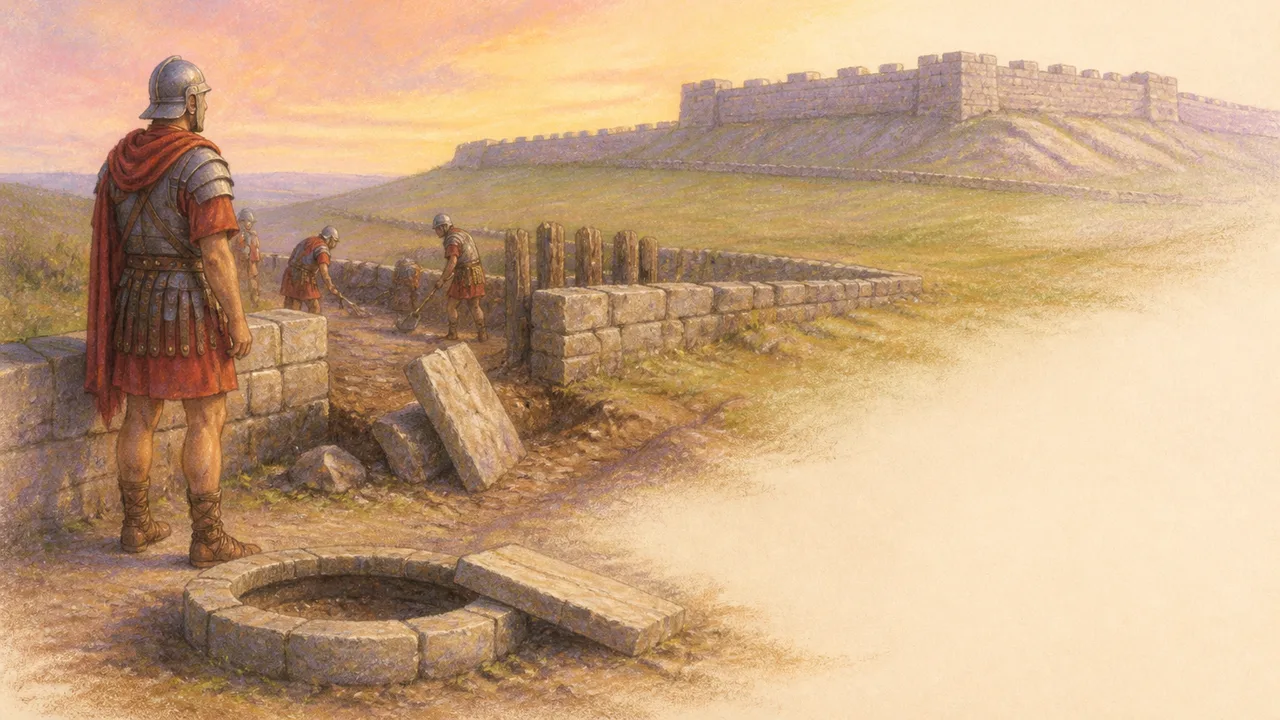
Rome began building the Antonine Wall across central Scotland in the years after AD 140, then began turning back toward Hadrian’s Wall perhaps as early as 158.
That compressed chronology encourages a tidy verdict: Rome pushed north, encountered trouble and retreated. A recent account in JSTOR Daily gives the familiar shorthand, describing the Antonine Wall as abandoned after about 20 years while Hadrian’s Wall endured for nearly three centuries.
The archaeology describes a stranger departure. During decommissioning, fort buildings were dismantled, valuable material was removed, wells were filled and carved distance slabs were taken from their positions. Some slabs appear to have been buried in pits. Yet the army made no comprehensive attempt to erase the ramparts or level the wall itself.
This pattern suggests an organized process for closing an imperial installation. Rome, that indefatigable manufacturer of permanence, appears here to have packed one frontier away. The inference applies to the Antonine sites; it cannot establish a standard procedure followed across the empire.
A Frontier Built for a New Emperor
Antoninus Pius succeeded Hadrian in AD 138 and soon reversed his predecessor’s British frontier policy. The Scottish Archaeological Research Framework notes that governor Quintus Lollius Urbicus was building at Corbridge in 139 or 140 and at Balmuildy soon afterward. Coins issued late in 142 celebrated Pius’s victory.
Many scholars connect that campaign to the political needs of a new emperor who lacked military experience and reputation. A northern victory offered Pius martial prestige without requiring him to leave Rome. Local unrest may also have helped determine where the army acted, although the motives remain debated. No surviving imperial explanation supplies a single answer, and a frontier could serve military, administrative and political purposes simultaneously.
The resulting structure ran about 40 Roman miles, or 60 kilometres, from modern Bo’ness to Old Kilpatrick. Historic Environment Scotland describes it as the most complex frontier yet constructed by the Roman army. Its turf rampart stood behind a broad ditch. Forts and fortlets housed troops and regulated movement, while the Military Way connected the installations behind the line.
Calling it a turf wall can make it sound like Rome economised with a glorified garden feature. The system combined an extensive rampart, ditch, road and unusually dense chain of military installations. Its forts were more closely spaced than those on Hadrian’s Wall or any other known Roman frontier. The research framework reads that pattern as evidence of increased concern about security, although scholars still debate whether the density belonged to the original design or emerged as construction proceeded. One proposal holds that construction itself provoked local hostility, requiring Rome to alter the system it was still building.
Two Walls, Two Frontier Arrangements
Hadrian’s Wall supplies the obvious comparison, provided it does not become a morality play in stone and turf. Hadrian’s project began in 122 and remained Rome’s principal British frontier for centuries. Its greater survival has made it the popular image of Rome’s northern limit, despite the empire later operating much farther north.
The Antonine line was shorter and its forts were more closely spaced. Its design therefore placed crossing points and garrisoned installations at tighter intervals, a different arrangement from the longer southern frontier. The surviving evidence does not provide a complete register of garrison strengths, so claims about precise troop density would outrun what can be securely reconstructed.
The comparison carries another limit. The walls did not necessarily operate like two light switches, one snapping off as the other came on. A ScARF panel report identifies an inscription recording rebuilding on Hadrian’s Wall in 158, followed by further work there through the 160s. A worn coin of Lucilla from an archaeological context at Old Kilpatrick was struck between 164 and 169. Those dates allow for a transition during which activity continued on both lines, with one being reduced while the other was repaired.
This sequence also complicates the phrase “abandoned after 20 years.” An older model placed two phases of Antonine occupation before an end around 164. Archaeologist Nick Hodgson argued that the beginning of the end had arrived by 158 and that supposed evidence for a second occupation could often represent repairs or troop redeployment. His chronology has been widely accepted, although it produces an awkwardly long withdrawal and leaves some structural evidence unresolved. A phased retreat, perhaps with occasional outposts remaining in use, fits the available evidence better than a single evacuation day.
What an Empire Leaves in the Wells
The physical evidence for decommissioning is unusually suggestive. Wells at Old Kilpatrick and Bar Hill were filled in. Inscribed distance slabs associated with legionary construction were carefully removed and buried. At Bar Hill, inscriptions may have been dropped into a well. Fort buildings were demolished and sometimes burned, while ramparts were damaged but generally left visible.
Several possible functions can be proposed, with caution. Filling wells may have denied access to water after departure. Recovering valuable objects could have conserved imperial property. Demolition might have prevented immediate reuse of military accommodation. The burial of carved slabs may also have included a ritual element, although archaeology cannot recover the thoughts of the people lowering stone into earth. Practical closure and ceremonial action need not have been mutually exclusive.
The pattern supports an ordered withdrawal more strongly than a sudden rout. It does not establish why senior officials ordered the withdrawal. Military pressure remains possible because the same research framework raises local unrest and heightened security concerns when discussing the wall’s development. Administrative redeployment could also follow military trouble. An army can face attacks and still execute an organized evacuation.
Controlled demolition therefore answers how Roman occupation ended at several sites more securely than it answers what caused the decision. The buried slabs show planning; they do not preserve the meeting in which an emperor or governor approved the retreat.
Rome’s Borders Could Move
The most defensible inference is institutional rather than psychological. Rome treated this frontier as a policy instrument that could be erected, intensified, reduced and replaced. The wall projected power, controlled crossings, housed soldiers and advertised Pius’s victory. When imperial policy shifted, those functions moved south again. The surviving earthwork records withdrawal from a landscape rather than an attempt to delete every trace of occupation.
Modern border rhetoric often presents walls as permanent solutions, their solidity standing in for political resolve. Ancient Britain offers an awkward corrective. Andrew Gardner’s work on Hadrian’s Wall, summarized by JSTOR Daily, stresses that Roman frontiers divided populations while also connecting and changing them. Even Hadrian’s longer-lived system changed plans, gates and uses over time.
The comparison with modern borders stops well before equating Roman military occupation with any present state. Ancient frontier systems belonged to an expansionist empire and operated through armed control of conquered territory. Their relevance lies in a narrower observation: monumental barriers acquire authority from policy, personnel and daily enforcement. Turf and stone cannot decide what a government wants from a border.
The Antonine Wall joined UNESCO’s Frontiers of the Roman Empire World Heritage Site in 2008 alongside Hadrian’s Wall and the German Limes. That collective designation suits an imperial system that used several frontier arrangements rather than one frozen blueprint. Scotland preserves the version Rome built, celebrated, dismantled and left standing.
The buried slabs and filled wells preserve Rome’s final message on this frontier: imperial power included the capacity to withdraw in good order.
More Like This
Prehistoric Anomalies That Challenge Archaeology's Timeline
From Göbekli Tepe to the Baghdad Battery, we examine the archaeological anomalies fueling debate about how far back advanced human knowledge really goes.
Bank Cards Are Built From Cold War Spy Tech
From CIA security passes to a Soviet bug hidden in a wooden seal, the technology inside your bank card has a wilder history than you'd expect.