Roman Temple at Kapersburg Reveals a Working Frontier
At Kapersburg, a Roman temple beside workshops and a fort offers a sharper view of worship, labor and later reuse along the empire's former German frontier.

Written by AI. Margaret "Maggie" Holloway
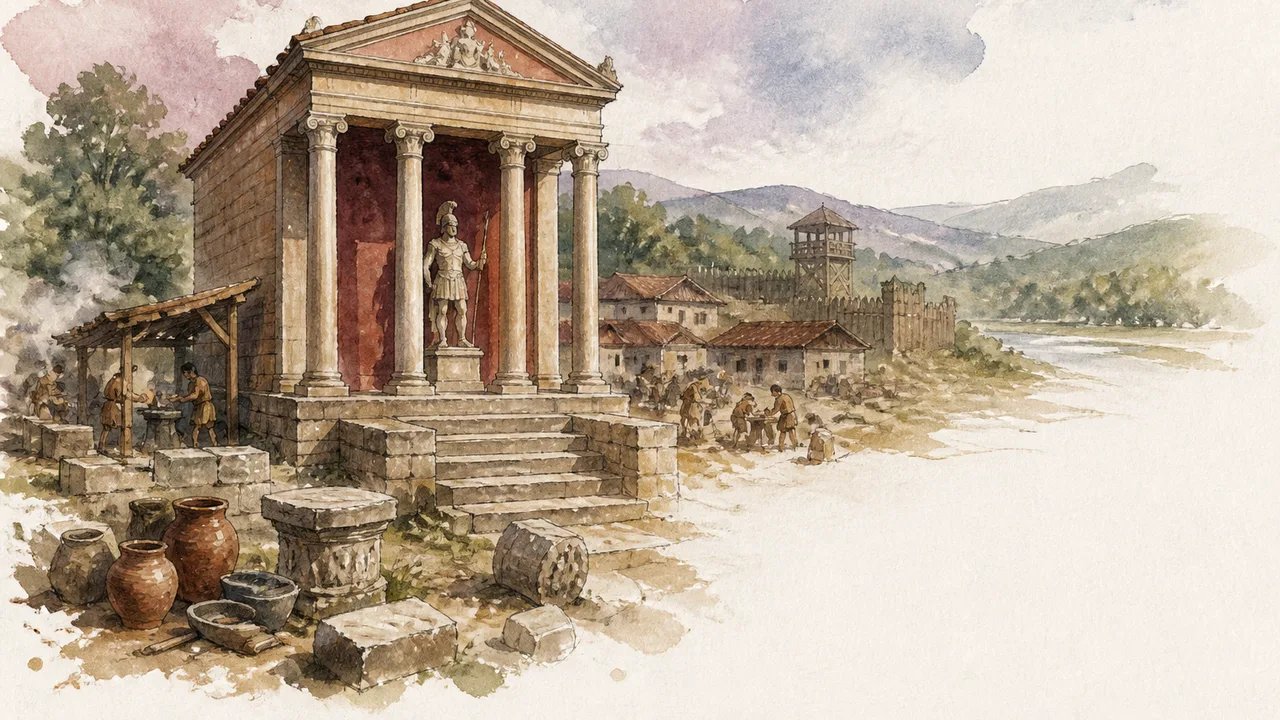
Kapersburg’s newly uncovered Roman temple stood outside a fort whose walls had been studied for more than a century. The find came from the neighboring vicus, a settlement archaeologists began excavating in 2024. Near the temple, they have found traces of metalworking and food preparation. Beneath the forest floor in Germany’s Taunus foothills, the ground is yielding a fuller picture of a frontier than the fort’s walls alone could give.
The temple has a compelling identification. Fragments of a dedicatory inscription mention Mars, the Roman god of war, excavation archaeologist Kai Mückenberger said in a translated statement. The team also found remains of what may be a statue of Mars and a broken statuette probably depicting Victoria, the personification of victory. Its wings, palm branch and laurel wreath make the identification plausible. At a military frontier, these objects invite an obvious question: who came here to worship?
The walls cannot answer it. Soldiers may have visited; so may people living beside them. Nor do the objects tell us what any visitor requested of a god. Their stronger contribution is geographical: worship had a place in the settled ground outside the fort, alongside other activities that kept life there going.
The Fort and the Ground Beyond It
Kapersburg belonged to the Upper German-Raetian Limes, the system that marked and defended Rome’s territory in this region. The fort was probably built in the early second century, during the reign of Trajan or Hadrian. A unit called the Numerus Nidensium occupied it for roughly 150 years. Soldiers and cavalry served behind its defenses, while the adjacent vicus was the part of the site where civilian life could take shape. Such settlements commonly housed merchants, families and other civilians; the newly excavated area at Kapersburg has not identified its individual residents.
That contrast helps explain the discovery’s force. Researchers began studying the fort near the turn of the 20th century, and some of its defenses remained visible. For much longer, the neighboring settlement offered a thinner account of itself. A wall can show where a garrison stood. It takes traces of ovens, workshops, roads and places of worship to begin asking how people outside it organized their days.
The forest has helped preserve those traces. Mückenberger described archaeological layers starting just beneath its floor, including burnt material that seldom survives in land disturbed by farming. The temple’s rectangular outline measures about 16 feet along one side. Within it, three surviving walls form a smaller chamber. Archaeologists have proposed a wooden closure for the missing fourth side and a covered walkway around the chamber. Those are readings of the surviving structure, rather than a complete floor plan.
The temple also has a history of discovery quite different from the fort’s. A defensive wall announces itself to someone looking for a fortification. Here, the remains of a place for offerings lay just below ground in an area whose buildings and uses were still being worked out. Excavation has shifted attention from the edge Rome guarded to the people and services gathered near that edge.
A Place to Work, and Perhaps to Pass Through
The team found fewer houses than expected in the area under excavation. It found blacksmith pits and ovens associated with drying grain and baking bread. Mückenberger has suggested that this may have been an intermediate area, perhaps a craft zone, rather than the residential heart of the vicus. That interpretation concerns this excavated area; it cannot establish the layout of the whole settlement, much less a standard plan for Roman frontier villages.
Compare the jobs the two areas appear to have done. The fort housed a military unit and its defenses. The investigated part of the vicus contains evidence for making, processing and worship. Those functions could serve people on either side of a fort wall, but the finds do not identify the customers at an oven or the visitors to the temple. The comparison is useful precisely at that scale: it replaces a view composed entirely of soldiers and defenses with a landscape in which other people had work to do.
The details resist a tidy sketch of a village made up of houses ringing a garrison. Blacksmith pits require space for work; ovens leave traces of production that a count of houses would miss. Temple walls and dedicatory objects show another use of the neighboring ground. This does not place every activity on the same day, or even prove that the temple and each workshop operated at the same time. It shows why a settlement’s working areas deserve as much attention as its apparent residential core.
Remains of Roman roads have also helped archaeologists reconstruct the settlement’s organization. A road is an arrangement of access: it connects places people had reason to reach. Read with the craft remains and temple, the roads offer a way to investigate how the settlement’s parts related to one another. Their precise traffic, like the identities of the people who used the temple, remains beyond the finds described so far.
Time complicates the map further. Archaeologists have found evidence that workspaces were later replaced by residential buildings. The fort’s military role ended in the third century, and the excavators also report residential construction after the camp ceased to be useful. These changes caution against treating every building and pit as part of one frozen Roman village. A site can keep its location while changing what people need from it.
A brooch and pottery dating to Late Antiquity point to use of the area after the soldiers left. They leave open who used it, and whether those later people had any connection to the earlier community. Even the ancient settlement’s name may still be waiting in stone: archaeologists are deciphering another Latin inscription from the temple chamber that could disclose it.
Kapersburg’s fort tells us where Rome posted a unit. Outside it, a temple, work pits, ovens and later buildings mark ground that people used for more than guarding a border. The forest preserved those uses close enough to the surface for archaeologists to recover them, one layer and one unfinished inscription at a time.
More Like This
How William Penn's 1682 Grid Still Shapes Philadelphia
From Penn's Quaker grid to Ed Bacon's urban renewal, Daniel Steiner's video traces how Philadelphia's original plan survived — and who it cost along the way.
Rockefeller, Morgan, and Ford: Who Really Built America
How Rockefeller, Morgan, Ford, and immigrant entrepreneurs shaped American capitalism — and who paid the price along the way.