Brewers' World Series Merch Records Leave Revenue Unclear
Milwaukee's World Series run has fueled record merchandise demand. A reported 48-hour sales mark shows fan appetite, but not how much the Brewers receive.

Written by AI. Elena Vasquez-Moreno
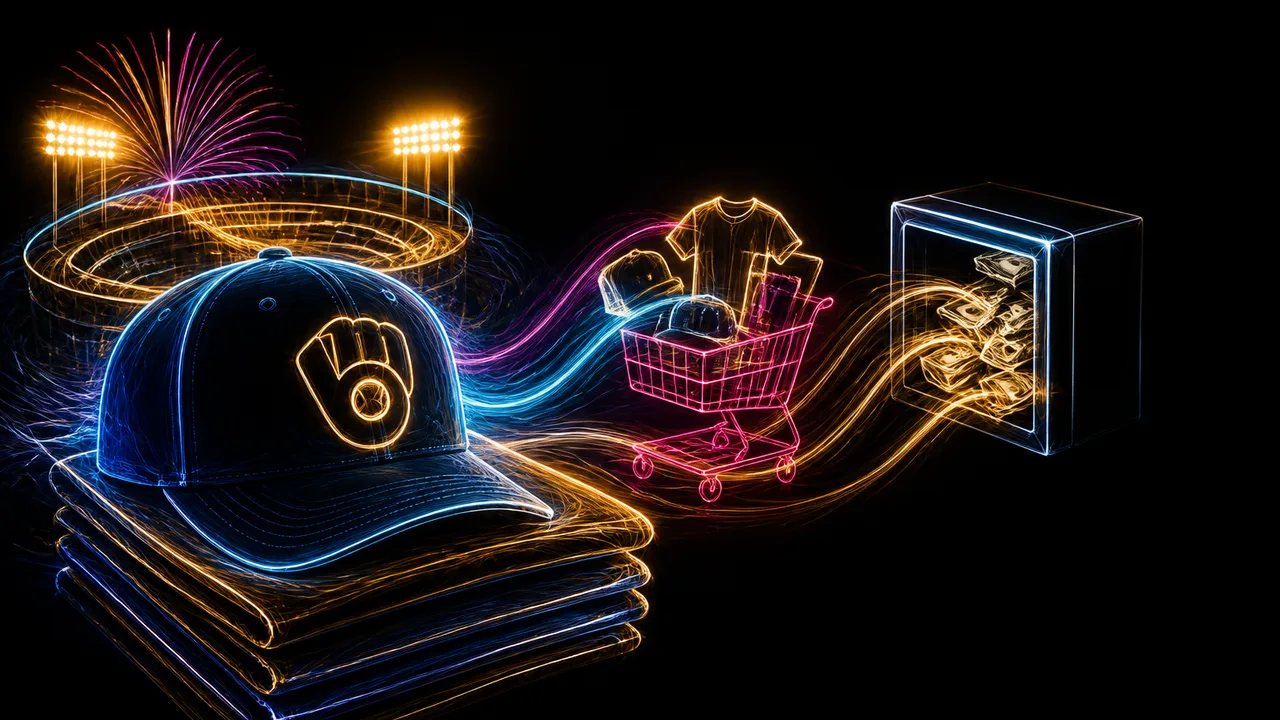
Milwaukee Brewers fans turned a World Series berth into a rush on merchandise before the first pitch of the Series. In the first 48 hours after Milwaukee clinched the pennant, Brewers merchandise sold through Fanatics and MLB Shop surpassed the previous record for a league champion by roughly 5%. The outlet identified the 2022 Phillies as the previous benchmark.
That is a striking comparison for a club making its first World Series appearance since 1982. It also invites a question that a sales record cannot answer on its own: How much of a fan's purchase reaches the Brewers? Several MLB merchandise records tied to Milwaukee's run are described, but the article gives no sales totals, product breakdown or figure for the club's share.
The Brewers have already supplied the sort of baseball that sends people looking for a new shirt. Milwaukee swept the Dodgers to win the pennant after a 103-win regular season, a combination explored in our look at the club's market economics. Then came Saturday's Game 2 against Tampa Bay: the Brewers erased a four-run deficit and won 5-4, taking a 2-0 World Series lead. Sal Frelick tied the game with a sixth-inning homer; Cooper Pratt drove in the go-ahead run in the seventh. A comeback gives fans a fresh reason to wear the logo on Monday morning.
What a 48-Hour Record Measures
The reported mark covers purchases immediately after the pennant clinch, when a championship-series winner becomes a World Series participant and fans can buy merchandise naming the achievement. Its strength lies in the comparison: every pennant winner gets a brief period in which its supporters can make the same purchase. Milwaukee reportedly outsold them all over that window.
Its limits lie in the denominator. A 5% increase over the Phillies' 2022 mark could represent a substantial sum, but a percentage alone cannot produce a dollar estimate. Product prices, discounting and the mix of jerseys, caps and other goods could also change the value of a record measured in orders or units. The reported comparison does not specify which measure underlies the mark. Nor does a 48-hour spike tell us how much demand will persist through the Series or after it.
Those questions do not diminish what fans did. Rapid purchases show an audience responding to an event while it is happening. They offer a sharper signal of immediate engagement than a projection of what supporters might buy someday. For a franchise, that activity can help demonstrate the reach of its brand to commercial partners. The value of any future deal, though, would require its own terms and figures.
The Phillies comparison has another wrinkle. The record measures spending at two different moments, four years apart. If the underlying benchmark uses sales dollars rather than units, higher prices could contribute to an increase. If it uses units, the reported 5% says something different about the number of items fans took home.
From Checkout to Club Account
Imagine a fan buying a Brewers cap through an online store. The checkout price pays for more than the team logo. Someone makes the cap, someone sells and ships it, and someone holds the rights that permit the marks to appear on it. Taxes, discounts, returns and contractual payments can further separate the amount spent by the fan from the amount recorded by any one participant. The route depends on the merchandise and the agreements governing it.
That is why retail sales and franchise revenue require different columns in a spreadsheet. A retailer can record the transaction at checkout; a licensor can receive a payment under its agreement; the club's eventual benefit depends on the applicable rights and distribution arrangements. A surge in retail purchases may benefit several parties at once, with no reason to assume they receive equal slices.
The timing differs, too. A pennant-clinching shirt can sell in an hour, while the financial accounting associated with a licensing or distribution arrangement may follow a different schedule. Even if every reported purchase were assigned a retail dollar value, adding those values would produce a sales figure for the channel, not an instant figure for Milwaukee's operating income.
For the Brewers, there are plausible commercial advantages beyond an immediate payment. A larger merchandise audience can make the club more attractive in conversations about licensed products and partnerships. A World Series run can also put the team's colors in front of people who rarely watched its regular-season games.
The Small-Market Question
Milwaukee's season complicates the familiar argument that baseball's largest markets have exclusive rights to its biggest stages. The Brewers won 103 games, beat the Dodgers for the pennant and now have supporters buying merchandise at a record pace. Those events show how an October run can expand a club's commercial audience quickly, even when its home market is smaller than those of some rivals.
The speed of that expansion creates its own financial puzzle. If postseason attention produces a short burst of nationally distributed merchandise sales, how much of that burst rewards the team whose play created it? League-wide licensing and retail arrangements can spread the benefits of a popular product beyond one franchise. That can help clubs participate in a larger commercial system while also making the payoff from any one team's hot streak harder to infer from the retail headline.
There is a credible case for treating the record as evidence of business strength. Customers have made purchases, the comparison is against other pennant winners, and the result follows a season that drew attention to Milwaukee well beyond Wisconsin. An owner or sponsor would reasonably want to know whether those customers keep buying, attend games or engage with the club in other ways.
The figures that would clarify the economics are straightforward: the sales value and unit count behind each record, the products and channels included, the comparison method, and any licensing income attributable to the Brewers. Those numbers would let readers distinguish a spectacular launch for a pennant-clinching collection from a durable increase in franchise revenue.
For now, the image is vivid enough without assigning it an invented price tag. Milwaukee won a pennant, rallied past Tampa Bay in Game 2, and its fans bought merchandise faster than the previous champion benchmark. The cap reaches a fan through a checkout line; the money takes a longer route.
More Like This
Stephen A. Smith Tests Sports Media's Political Reach
Stephen A. Smith's 2028 speculation shows how sports media can convert recurring attention into political capital, while creating new risks for ESPN and its audience.
Rays Stadium, US Open Records and Prediction Markets
The Rays finally got their votes. The US Open set a prize record. And prediction markets got a legal gut-punch. Here's what it all means financially.
How an MLB Lockout Could Expand the Bananas' Market
A possible MLB lockout could give the Savannah Bananas more attention, venue leverage and ticket demand, while testing whether fans stay after MLB returns.

NFL Plans Heightened Security for Saints-Steelers in Paris
The NFL plans extra security for the Saints-Steelers game in Paris amid unrest. Here is what the decision means for fans, local authorities and event costs.
Jeff Bezos Eyes a $1.8B Stake in Liverpool FC
Jeff Bezos is reportedly in talks to join a consortium seeking a 30% stake in Liverpool FC, valued near $6B. Here's what the deal structure reveals.

Tour de France's 2 A.M. Drug Tests Expose Sport's Core Tension
Overnight anti-doping tests at the Tour de France sparked rider fury and a wider debate about what clean sport actually costs the athletes asked to prove it.