Tour de France's 2 A.M. Drug Tests Expose Sport's Core Tension
Overnight anti-doping tests at the Tour de France sparked rider fury and a wider debate about what clean sport actually costs the athletes asked to prove it.

Written by AI. Elena Vasquez-Moreno
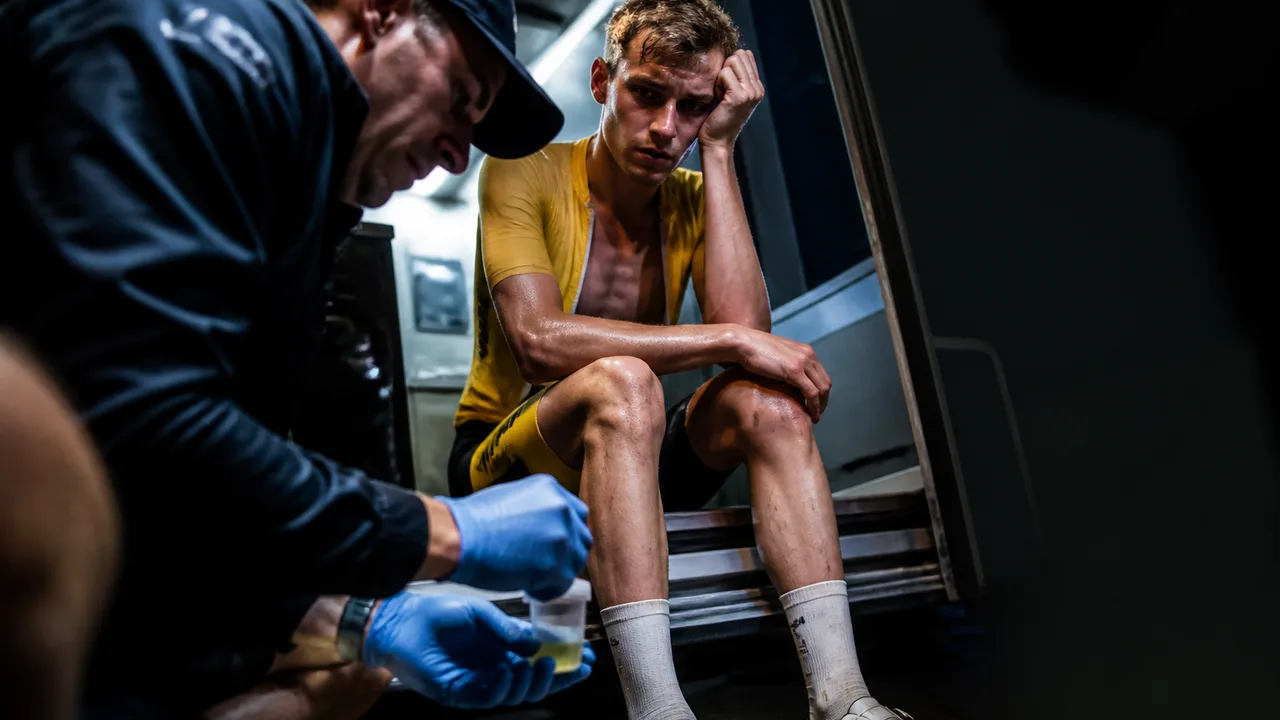
Sometime in the deep dark of a French hotel corridor, a knock arrived that nobody had requested. Two in the morning. The riders on the other side of the door had, in some cases, already logged six or seven hours in the saddle that day and had a mountain stage waiting for them the following morning. The International Testing Agency — the ITA, the independent body that handles anti-doping controls on behalf of the World Anti-Doping Agency — had questions.
That scenario, confirmed across multiple reports from this year's Tour de France, has ignited a fight that cuts right to the operating contradiction at the heart of professional cycling: the sport needs clean athletes, and the sport needs to be seen catching dirty ones, and those two imperatives are not always the same thing.
What Actually Happened
According to Front Office Sports and Yahoo Sports, the overnight testing operation first drew attention when it touched the race's two most prominent riders — defending champion Tadej Pogačar and perennial rival Jonas Vingegaard. By the following Monday, the crackdown had expanded: at least six more teams were subject to the same surprise controls.
Velo/Outside put the timing in useful context. Surprise hotel tests are not unusual at the Tour — but the customary hour is closer to 6 a.m., early enough to be inconvenient, late enough to have let riders sleep. Testing at 2 a.m., ahead of a crucial mountain stage, is a different instrument entirely. The backlash from within the peloton was, per Velo, "strong."
The ITA didn't exactly dispute that characterization. Cyclingnews reported the agency's public statement acknowledging that "night-time testing may be disruptive to riders' rest and recovery" — which is, in the language of institutional self-defense, about as close to a concession as you're going to get from a regulatory body. The defense that followed was predictable but not without logic: effective testing, the ITA argued, requires the element of surprise. Test at a predictable hour, and the hour becomes a data point that sophisticated dopers can engineer around.
The Strategic Case for Midnight Knocks
That argument deserves to be taken seriously before it's critiqued.
The history of doping in professional cycling is, in the bluntest terms, a history of athletes and their support staff being smarter than the testers. EPO, blood transfusions, microdosing — the pharmaceutical creativity that characterized the 1990s and early 2000s was partly a function of athletes knowing the detection windows. The biological passport program introduced in 2008 changed the dynamic considerably, shifting the focus from metabolite detection to longitudinal tracking of blood values. But the underlying logic — that dopers will exploit every known constraint in the testing system — remains structurally sound.
If regulators always test at 6 a.m., then any substance that clears in four hours becomes, in practice, safe to use at 2 a.m. The ITA knows this. Its decision to vary the testing window, while disruptive, reflects a genuine operational concern, not theater.
Defector's dispatch from Évian-les-Bains captured the ambient tension well: "After several years of lurking in the shadows, the specter of doping once again looms over the Tour de France. Though nobody has tested positive — or no positive test results have been made public — the biggest story at the race is whether the riders are racing clean." That's a remarkable sentence. The biggest story at the world's most watched bike race isn't who's winning. It's whether the winning is real.
The Cost That Falls on the Athletes
Here's where the argument gets genuinely complicated. The ITA's operational logic is defensible. The question is who bears the cost of executing it.
At the Tour de France, riders typically sleep 8 to 9 hours to facilitate recovery from what sports scientists describe as some of the most sustained physiological stress in professional athletics. A 2 a.m. wake-up doesn't just cost an hour of sleep — it fragments the sleep architecture that makes recovery possible at all. REM cycles disrupted mid-sequence don't simply pick up where they left off. The rider who answers a knock at 2 a.m. on the eve of an Alpe d'Huez stage is not the same physiological creature as one who slept through.
Teams and riders pushing back on this aren't being precious. They're describing a real competitive consequence that falls exclusively on the tested. And the tested, here, are the athletes who are complying — the ones who filed their whereabouts accurately, who answered the door, who submitted to the controls. The ones gaming the system, if any exist, have presumably already made their accommodations.
This is the operational irony of aggressive out-of-competition testing: in the absence of a positive result, the visible, immediate cost lands on clean athletes. The deterrent effect on potential cheats is real but invisible. The sleep debt is tangible.
Vaughters and the Credibility Trade-off
Jonathan Vaughters — longtime team director at EF Education-EasyPost and a figure who has spoken with unusual candor about cycling's doping history — offered the clearest articulation of the pro-testing position. According to Velo/Outside, Vaughters acknowledged that the late-night tests were far from ideal but argued the trade-off was worth it: "I don't like that they lost sleep, but I would rather lose sleep than lose credibility."
That's not a throwaway line. Vaughters is effectively arguing that the credibility of the sport — its commercial value, its claim on public attention, its ability to attract investment and broadcast deals — depends on testing that the public perceives as rigorous. Sleep is renewable. Credibility, once lost, is a longer rebuild.
He's also, it should be noted, a team director whose competitive interests are not entirely separable from his stated principles. A director confident in his own roster's cleanliness has less to lose from aggressive testing than one who isn't. That doesn't make him wrong. It does make the position worth examining.
What the Silence Around Positive Tests Tells Us
Defector's observation — that no positive results have been made public — cuts in more than one direction. It could mean the expanded testing found nothing, which is the best-case read: the peloton is cleaner than its predecessors, the biological passport is working, and the midnight theater was ultimately just theater.
It could also mean the testing found something that remains under the legally required confidentiality period before announcement. Anti-doping procedures allow for provisional suspension before public disclosure, meaning a positive result from this Tour could surface weeks or months later without appearing in any current dispatch.
Or — and this is the read that cycling's most skeptical observers would reach for — it means the athletes being tested are sophisticated enough that no single test, regardless of timing, is going to catch them. The midnight knock may be a genuinely effective deterrent, or it may be a visible display of rigor that somewhat outpaces its actual detection capability. The data to distinguish between those possibilities isn't public.
The Structural Question Nobody Wants to Answer
What's actually being negotiated here isn't the 2 a.m. policy. It's the terms under which elite athletes surrender portions of their privacy, their sleep, and their physical recovery in exchange for the right to compete. The whereabouts system — under which riders in the registered testing pool must log their location for one hour each day, 365 days a year — already represents a substantial imposition that most working adults would find extraordinary. The overnight hotel test is the whereabouts system arriving in person, without the scheduling convenience.
The athletes and teams demanding reform are not, as far as the available record shows, asking for an end to testing. They're asking for a conversation about the design of a system that currently allocates all the friction to the compliant.
That's a reasonable ask. Whether cycling's governing bodies and anti-doping agencies are structured to hear it — given that the ITA's institutional purpose is precisely to resist pressure from the very organizations it tests — is a separate and more uncomfortable question.
The next test, whenever it comes, will knock at whatever hour serves the program. The riders will answer. That much is settled. What isn't settled is whether the sport has thought carefully enough about what it's asking them to prove, and what it costs them to prove it.
More Like This
Student-Athletes and the Mental Health Toll of Competing
Behind the scholarship and the starting lineup, many college athletes are quietly breaking down. Here's what the data — and the silence — actually tells us.
Dodger Stadium's 4th of July Fan Experience Reviewed
A Dodgers fan vlog captures rock climbing, a $22 burger, commemorative coins, and a Yamamoto gem against the Padres on Independence Day.

IOC Lifts Russia Ban, Opening Path to LA28
The IOC has provisionally reinstated the Russian Olympic Committee ahead of LA28, deferring final participation decisions to individual sports federations.
How Hard Is Soccer Fitness, Really?
Vox sent a producer to train with Brooklyn FC. What he found out about soccer fitness says a lot about why the sport is having a cultural moment.

MLB and MLBPA Deadlocked Over 2028 Olympics
Two years from LA28, MLB owners back Olympic participation but the players' union remains at odds over housing, tickets, insurance, and forced participation rules.
Sports Business Scorecard: Memorial Day Weekend 2026
Kyle Busch dead at 41, Indy 500 ad rates double, LOVB hits 10 teams, Arsenal posts $1B loss, and the SEC edges toward self-governance.

Stadium Food Prices and the Captive Fan Economy
How exclusive concession contracts, private stadium operations, and public subsidies created a system where fans pay 249% more for a hot dog.
MLS Bets on a Post-World Cup Surge
MLS commissioner Don Garber says the World Cup was always the plan. Now comes the harder part: turning a soccer moment into a soccer market.