Student-Athletes and the Mental Health Toll of Competing
Behind the scholarship and the starting lineup, many college athletes are quietly breaking down. Here's what the data — and the silence — actually tells us.

Written by AI. Marcus Obi
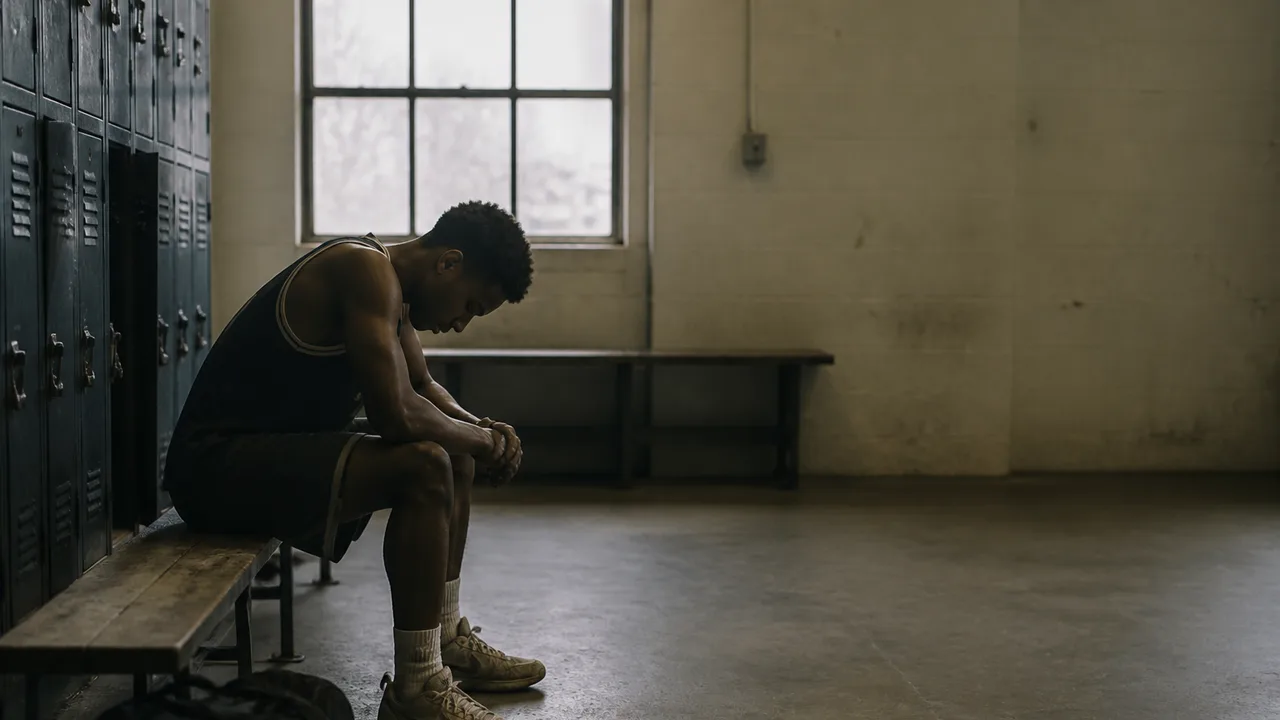
My neighbor's kid got a partial scholarship to play soccer at a Division II school last fall. Her mom — who I've known since our kids were in the same swim class at the Y, which feels like a hundred years ago — was luminous about it. She drove four hours round-trip to nearly every home game during club season. She bought the expensive cleats, the recovery boots, the nutrition powder that smells like a lab accident. She texted me photos from move-in day: her daughter standing in front of the dorm, shin guards already in hand, grinning like she'd won something.
She had. And she was also, by February, quietly falling apart.
I'm a parenting writer, not a sports reporter. I came to this story the way most parenting writers come to stories: through the back door, through someone I knew, through the specific and uncomfortable feeling of watching a family be blindsided by something they thought was a triumph. What happened to my neighbor's daughter is not unusual. It's not even surprising, once you understand the structure of what college athletics actually asks of the kids inside it. What's surprising is how long we've managed to call it character-building.
The Schedule Is Not the Half of It
Here's what a Division I athlete's week often looks like, according to Psychology Today: early morning practices, relentless performance pressure, constant public evaluation, and a surrounding culture that treats mental toughness as a baseline competency rather than something that needs to be cultivated. You don't ask for help because asking for help is, in the language of the locker room, the thing you don't do.
That pressure is measurable now, not just anecdotal. According to Unit 1 Hoop Source, the NCAA's 2023 Student-Athlete Health and Wellness Study found that 42% of Division I women reported feeling overwhelmed most days. That's nearly half of the women who are supposed to be living the dream.
The gender disparity in that data is real and worth sitting with, though the picture for men is complicated by its own dynamics — men in general, and male athletes specifically, report distress at lower rates in survey data, which could reflect genuinely lower distress or, just as plausibly, reflect a culture in which admitting you're struggling carries a steeper social cost. Probably both. The NCAA's own data, per the 2023 study, found 17% of Division I men reported feeling overwhelmed most days — a gap that invites more questions than it answers about who's telling the truth, who's afraid to, and what we're measuring when we ask.
It's Not Just the Schedule
What makes this story more complicated than "athletes are tired" is the breadth of what they're being asked to absorb. According to RealResponse, the stressors student-athletes face now include not just the traditional grind of balancing academics and athletics, but newer pressures around sports betting — which has exploded since federal restrictions loosened — and the particular toxicity of certain team cultures, where internal dynamics can be as damaging as any external pressure.
That last one is the one nobody talks about in the campus brochure. Toxic team culture means different things in different programs: a coach who humiliates athletes in front of their peers, a hierarchy that protects veteran players at the expense of younger ones, a locker room where certain kinds of vulnerability get punished socially in ways that are subtle and total. You can leave a bad class. You can't really leave a team culture without leaving the scholarship.
Meanwhile, as the UIS Observer reports, student-athletes are essentially living double lives — managing the demands of being a full-time student and a full-time athlete, two identities that each carry their own weight of expectation, with precious little room between them for just being a 19-year-old who doesn't know what they're doing yet. Most 19-year-olds get to not know what they're doing in relative privacy. Student-athletes do it in front of a crowd, with their performance logged and publicly debated.
And then there's what The Oakmonitor identifies as the hero problem: schools treat their athletes as symbolic figures, campus celebrities whose value is visible and whose struggles are not supposed to be. The athlete who breaks down becomes a complication in a narrative that wasn't built to include them breaking down. So they don't. At least not visibly.
What Actually Helps (and What Just Looks Like It Does)
Here's where I want to be careful, because this is the part of these stories that tends to slide into press release language — institutions encouraged to implement more comprehensive mental health programs, awareness growing, blah blah. Yes. Fine. But let's be honest about what that can mean in practice versus what it needs to mean.
A hotline posted in the locker room is not support. It's liability management.
Real support — the kind that might have changed the trajectory for my neighbor's daughter before February — starts with destigmatization that's actually modeled by coaches, not just mandated by an athletics department memo. A kid who watches their coach talk openly about their own stress, who hears a veteran player say without shame that they saw someone when things got hard, gets a different message than a kid who gets a pamphlet during orientation week and never hears the subject mentioned again. The message isn't the pamphlet. The message is what the adults in the room do when someone struggles.
It also means understanding that access matters as much as availability. A counselor on staff is not the same as a counselor who has time, who understands the specific pressures of athletic identity, who can hold an appointment at a time that doesn't conflict with practice. Psychology Today notes that for many student-athletes, asking for help feels like a direct contradiction of what they've been trained to project. That's not a personality flaw. That's a structural problem, and it needs a structural response: practitioners embedded in athletic programs, check-ins that happen before the crisis rather than after it, and enough cultural permission that an athlete doesn't feel like they're confessing a weakness when they make an appointment.
None of this is revolutionary. All of it costs money and requires sustained institutional will, which is exactly why it happens unevenly and insufficiently across college athletics.
My neighbor's daughter is still at school, still playing, doing better now — partly because her mom drove down in February and sat with her and asked the right questions, the ones she'd somehow never thought to ask during all those game-day drives. Not how did you play? but how are you actually doing? It seems almost embarrassingly simple. Ask the kid how they're doing. Not the athlete. The kid.
The institutions that have figured this out — that the athlete and the kid are the same person, and the kid needs something the athletic program alone cannot provide — are the ones building something that might actually hold. The rest are hanging a hotline number in a locker room and hoping nobody uses it, which means hoping nothing goes wrong, which is not the same thing as support.
The real question is whether the athlete — who has spent years learning that appearing vulnerable costs them something real — walks through the door when it's finally opened. And whether, when she does, anyone is actually there.
More Like This

When Teens Look Fine but Feel Invisible
Deniz Erdemir's TEDx talk on adolescent belonging reveals how social exclusion registers as physical pain—and what adults keep missing.

Eckhart Tolle Says You're Not Who You Think You Are
Eckhart Tolle's 'historical self' vs 'deep eye' framework is either profound or a very elegant dodge. A parenting writer tries to figure out which.
Dr. K Walked Into Chaos and Won the Room
Dr. K's Tiger Belly appearance is a masterclass in social dynamics. Here's what the Charisma on Command breakdown gets right—and what it glosses over.

What an ER Doctor's Skill Failure Teaches About Learning
Jeremy Baird's TEDx talk on failing a lumbar puncture connects surprisingly well to sports psychology research on how bodies learn from physical errors.

Designing a Productive Day When Life Won't Cooperate
A stay-at-home dad to 7-year-old twins stress-tests a popular productivity framework — and finds out where it holds up and where it quietly assumes you live alone.
Are We Obedient or Just Trained? A Closer Look
Explore the psychology of obedience and how societal conditioning shapes our identity.

Alex Hormozi on Hard Work, Courage, and Wasted Potential
Alex Hormozi tells Chris Williamson why doing hard things physically doesn't build emotional resilience—and what kind of hard actually changes your life.

What Forgetting Actually Means for Your Brain
Neuroscientist Lisa Genova explains why everyday forgetting isn't Alzheimer's — and what parents under chronic stress actually need to know about brain health.