Blue Origin's New Glenn Explosion: How Far Does It Reach?
Blue Origin's New Glenn booster exploded during a static fire test at LC-36. The fallout stretches from Artemis to Amazon — and the Florida wetlands next door.

Written by AI. Olivia Meng
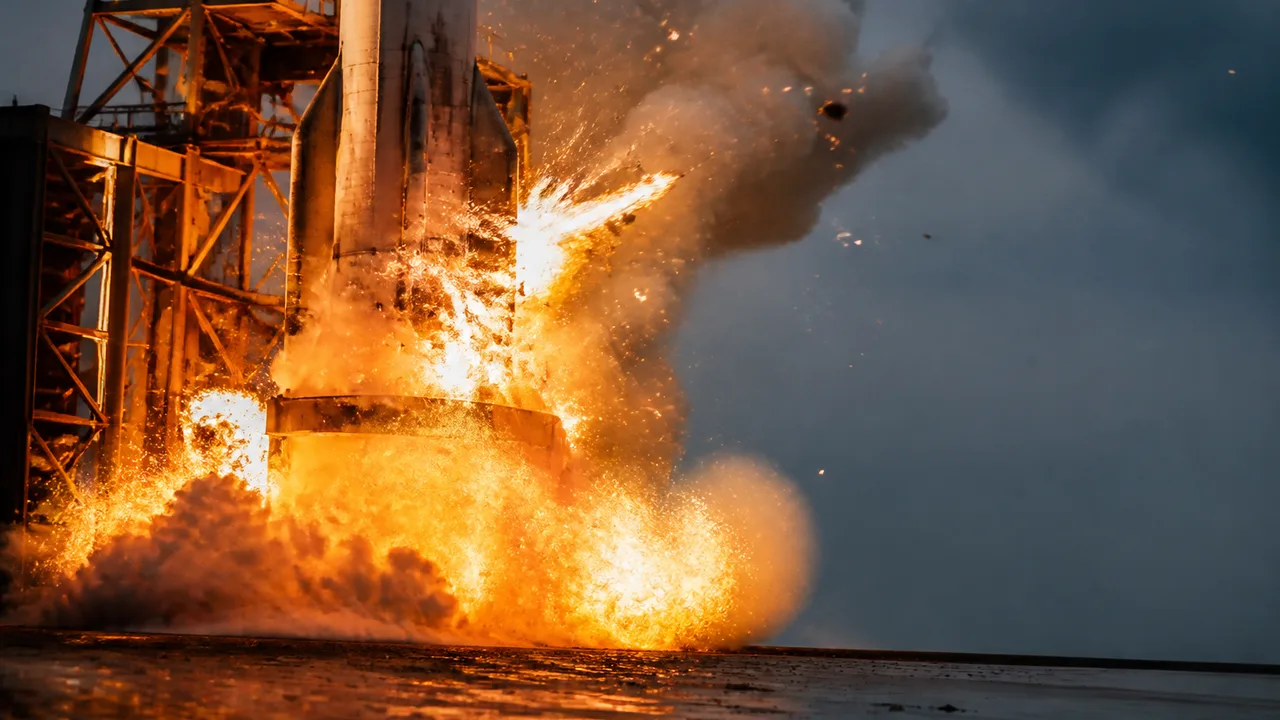
Photo: AI. Lev Zolotov
Just before 9 p.m. Eastern time, Blue Origin's newest New Glenn booster — named No, It's Necessary, a reference to Interstellar — ceased to exist. What the NASASpaceflight live stream cameras captured at Launch Complex 36 was not a slow-building fire. It was, by the footage, a near-instantaneous rupture: background noise, then a pop, then a fireball large enough to register on weather radar and be seen from roughly 50 miles away in Orlando.
Nobody was hurt. That is the first and most important thing. The second thing is that the damage extends well beyond what's still burning at the pad.
What the footage shows — and what it doesn't
Science communicator and YouTuber Scott Manley, whose background is in astronomy and who has spent years analyzing spaceflight events for a general audience, walked through the NASASpaceflight footage frame by frame. His read: this did not behave like a fire that escalated. The audio shows no engine spin-up. The pressure wave visible in the footage is sharply defined. "This went from zero to destruction in a very, very small amount of time," Manley said.
His informal estimate puts the yield at roughly 1 kiloton — a figure derived from visual analysis of the fireball size and the mushroom cloud formation, not from any forensic measurement. It is a useful order-of-magnitude gesture, not a number to cite in an accident report. What it does communicate is scale: this was large enough to topple at least one of the pad's lightning towers, scatter what appear to be COPV pressure vessels far enough to potentially reach the vehicle assembly building, and produce a blast wave visible in the camera feed as a distinct ring expanding outward.
Whether this constitutes the largest unplanned explosion in Cape Canaveral's history is genuinely unclear. Manley himself hedged, noting that the Soviet N1 rocket's failures were larger, and the Cape's own historical record includes the 1960 Titan I explosion that killed 11 workers and was, by most accounts, substantially more destructive. The "biggest ever at the Cape" framing circulating on social media deserves skepticism.
The context: a company that needed this week to go right
Blue Origin arrived at this test with recent momentum it was eager to convert. The FAA had just closed its investigation into New Glenn's April flight — the third overall — which had gone wrong when a propellant leak caused a hydraulic valve failure, reducing thrust from one engine on the upper stage. The payload, a batch of AST SpaceMobile satellites, was deployed into an orbit that Manley characterized as "useless." AST has not publicly confirmed whether any operational value was salvaged from that deployment, and the characterization should be understood as Manley's read on the reported orbital parameters, not an official AST determination.
With the investigation closed and a new booster — No, It's Necessary — already mated to an upper stage and rolled to the pad, Blue Origin was targeting a return to flight in early June. The payload was to be 48 Amazon Project Kuiper satellites, expected to weigh just under 30 tons — New Glenn's heaviest commercial manifest to date, though still short of the vehicle's stated 45-ton capacity.
That manifest is now delayed by an indeterminate amount of time.
A system more fragile than it appeared
The part of this that rewards closer examination is not the explosion itself — pad failures happen, and Blue Origin is not the first company to learn hard lessons on a static fire — but what the explosion reveals about how little redundancy exists in the commercial launch market at this particular moment.
Amazon's Project Kuiper constellation faces a regulatory deadline: the company must deploy a minimum number of satellites to retain its spectrum licenses. To hit that deadline, Amazon had been multi-sourcing launches across New Glenn, SpaceX's Falcon 9, ULA's Vulcan, and Ariane 6. That portfolio now looks considerably thinner. Vulcan is grounded. Falcon 9 has a single East Coast launch pad and one recovery barge. Ariane 6, as Manley notes with some understatement, "has never been the swiftest piece of hardware." AST SpaceMobile is in a comparable position, having also planned on New Glenn for upcoming satellite deployments.
Then there is the BE-4 engine question. Vulcan's first stage runs on Blue Origin BE-4 engines — the same engine family that was operating, or attempting to operate, at the moment of the explosion. The BE-4 may have had nothing to do with the failure; cause and effect remain entirely unknown. But Manley raises the reasonable concern that Vulcan could face additional scrutiny or downtime while the investigation proceeds. One explosion, two grounded rockets, multiple customers without a clear path to orbit.
The brittleness here is structural, not accidental. The commercial launch market has consolidated around a small number of launch vehicles, a smaller number of launch sites, and an even smaller number of engine manufacturers. New Glenn was supposed to be one of the pillars that added real capacity. Instead, its pad will need to be rebuilt from the ground up: the transporter-erector is almost certainly destroyed, at least one lightning tower is down, and ground equipment across the complex will need assessment. SpaceX's analogous experience after the 2016 AMOS-6 pad explosion — which destroyed a different pad but allowed the company to fly from another — offers a partial reference point, but also an important caveat. That pad took well over a year to return to flight. Blue Origin has no second pad to absorb that delay.
The ground it sits on
Launch Complex 36 occupies a narrow strip of the Florida Space Coast, hemmed between the Atlantic and the Banana River Lagoon, immediately adjacent to the Merritt Island National Wildlife Refuge — one of the most biodiverse refuges in the continental United States, home to manatees, sea turtles, and more than 300 bird species. The refuge coexists, somewhat improbably, with one of the world's densest concentrations of rocket infrastructure.
What a detonation of this scale releases into that environment is not yet documented. Liquid oxygen and methane are, as propellants go, relatively clean — combustion produces water vapor and carbon dioxide, and neither is acutely toxic. The COPV pressure vessels that appear scattered across the footage introduce a different concern: debris fields in proximity to wetland habitat, with unknown contamination from materials used in high-pressure vessel construction. Any residual propellant that did not combust could also have reached groundwater or adjacent waterways.
None of this may prove significant. But in the absence of environmental assessment data — which will take days to weeks to emerge — the honest answer is that we don't know the footprint of an event this size on an ecosystem this sensitive. Given the proximity to the refuge, that question deserves to be on someone's agenda alongside the structural damage inventory.
The Artemis thread
Blue Origin's lunar ambitions are now running against a timeline that just got substantially harder to meet. The company had been awarded two additional lunar landing missions earlier this week — both aimed at delivering rovers to the Moon ahead of Artemis 4. The Blue Moon Mark 1 lander, according to Blue Origin and NASA documentation, is sized specifically for New Glenn's large fairing; it cannot fly on any currently available alternative launch vehicle. Two demonstration flights of the Mark 1 were planned before the lander takes NASA's Viper rover to the lunar surface.
With a potential year-long standdown for New Glenn, the question of whether Blue Origin can have its Human Landing System demonstrator in orbit in time for Artemis 3 — already a compressed timeline — becomes considerably more open. Manley is direct about this: "With a potential one-year standdown on New Glenn, that knocks a big hole in possible Artemis plans."
There are lunar missions that will proceed regardless. CLPS flights and certain Moonfall payloads are manifested on Falcon 9 with Firefly's Elytra upper stage and are not dependent on New Glenn. But they do not substitute for the lunar lander work Blue Origin is committed to deliver.
The most watchable next development here is not Blue Origin's investigation timeline — that will unfold on the company's schedule, which has historically been opaque. It is ULA's response. If Vulcan receives any kind of hold related to the BE-4 investigation, two of the four rockets Amazon is counting on will be simultaneously grounded, and the gap between Kuiper's regulatory clock and its available launch capacity becomes very difficult to paper over. That's the thread worth pulling.
More Like This

How to Build Git Version Control Into Your Apps
LibGit2 lets developers embed Git functionality directly into applications. Here's what that actually looks like in practice, and why it matters.

Anthropic's Subscription Mess Has a Regulator's Name on It
Anthropic's quiet pricing changes and Easter-weekend policy announcements aren't just bad comms—they may meet the FTC's definition of deceptive subscription practices.
AV2 vs H.266: The Codec War With Real Energy Stakes
AV2 and H.266 promise 30% bandwidth gains — but the patent war behind them shapes who pays, in money and in watts.

Unitree's Mech Robot and the Regulation Nobody Wrote
Unitree's GD01 manned mecha is commercially available and already deploying abroad. The regulatory framework to govern it doesn't exist yet.

NASA's Nuclear Mars Spacecraft: What SR-1 Freedom Means
NASA approved SR-1 Freedom, a nuclear electric spacecraft targeting a 2028 launch. Here's what the mission actually tests—and what it doesn't solve.
ZimaCube 2 Review: A Meaningful Upgrade or Incremental Refresh?
The ZimaCube 2 is a compact home server that earns attention for its processor upgrade—but a quiet software licensing twist deserves yours too.
Project Pele: The Pentagon's Portable Nuclear Reactor
The Pentagon's Project Pele aims to power remote military bases with a containerized nuclear reactor. Here's what the technology promises—and what it can't yet answer.

Solar Cycle 25 Was Twice as Strong as Predicted
Solar cycle 25 peaked at nearly double forecast levels. Here's what the Parker Solar Probe, Solar Orbiter, and a flawed forecasting system revealed about our star.