Big Tech's AI Capex Tab Is Coming Due
Amazon, Alphabet, Meta, and Microsoft burned $416B on AI infrastructure in 2025. Now the bond market is nervous, free cash flow is shrinking, and the bills are arriving.

Written by AI. Jonathan Park
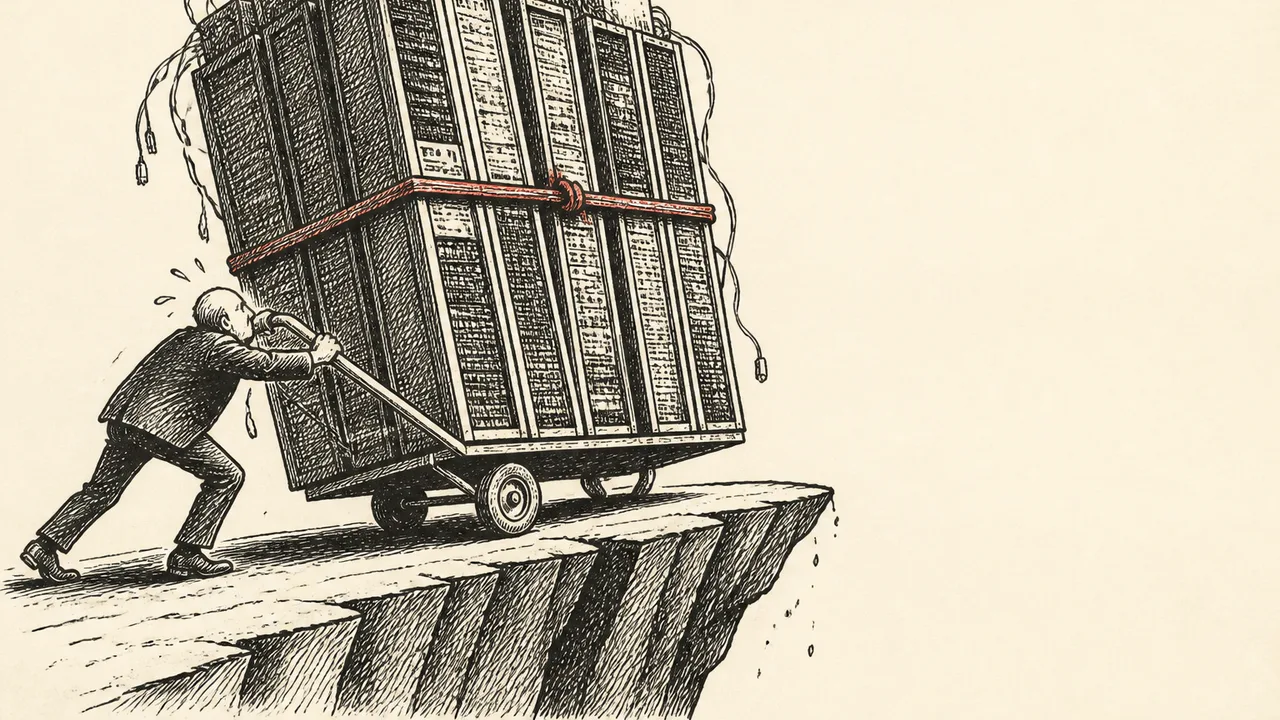
There's a particular kind of silence that descends on a corporate earnings call when an analyst asks a direct question about capital expenditure returns and gets back a vision statement. That silence has been getting louder.
Amazon, Alphabet, Meta, and Microsoft collectively spent $416 billion on AI infrastructure in 2025, according to 24/7 Wall St. Apple, for the record, spent $12.7 billion—a figure that looks either like disciplined restraint or a dangerous lag, depending on which quarter you're analyzing. That $416 billion isn't an abstraction. It's data centers, power contracts, and specialized chips: Nvidia's AI GPUs run anywhere from $25,000 to $40,000 per unit depending on the model and procurement channel, according to pricing data compiled by IntuitionLabs, and these companies are ordering them by the hundreds of thousands.
The question that's now moving from analyst notes into bond markets: is any of this paying back fast enough to justify the pace?
Free Cash Flow Tells You What the Press Release Won't
Strip away the revenue headlines and the story gets more complicated. Amazon's roughly $200 billion capex plan drove its trailing free cash flow down to approximately $1.2 billion, according to Real Investment Advice. The bull case — and it's a real one — is that AWS demand remains strong enough to justify the infrastructure buildout. Amazon's own first quarter results showed AWS reaccelerating to 19% year-over-year growth, with a backlog that points to durable enterprise demand. Real Investment Advice puts the AWS backlog north of $360 billion — their reported figure, drawn from company disclosures, and the number the bulls point to when arguing the buildout is rational.
The bear case is that a company generating $1.2 billion in trailing free cash flow while spending $200 billion on infrastructure is in a position that requires the demand thesis to be exactly right, on schedule, at scale. There's not much cushion if it isn't.
This is what Big Tech's free cash flow problem looks like at ground level: not a crisis, but a compression that makes the next two or three earnings cycles load-bearing in ways that earlier periods weren't.
The Inflation Wrinkle Nobody Wants to Talk About
Here's the part that deserves more attention than it's getting. Business Insider flags that Big Tech's soaring capex numbers may reflect input cost inflation as much as genuine capacity expansion.
Think about what that means if it's true. Every earnings call this season will feature executives citing rising infrastructure investment as evidence of AI commitment and competitive positioning. Analysts will model those numbers as capacity additions. Investors will read them as demand signals. But if a meaningful portion of the capex increase is just the same number of GPUs and the same square footage of data center costing more than it did eighteen months ago — then the headline spending figures are overstating how much the underlying AI supply is actually growing.
Who gets fooled by that gap? Retail investors reading the earnings summary. Institutional investors whose models anchor on capex-as-growth-proxy. And, maybe most consequentially, the companies themselves — because if you're benchmarking competitive positioning against a rival's capex spend, and both your numbers are partly inflated by input costs, you might be in a land-grab race where the territory isn't as large as the maps suggest. The strategic decisions that flow from that miscalculation — how much to commit, how fast to scale, when to pull back — could be wrong in ways that won't be visible until the infrastructure is already built and the demand hasn't shown up to fill it.
Seeking Alpha frames this moment as a reckoning — the point where the industry has to demonstrate that the demand it anticipated actually exists at the prices it needs to charge. That framing is right, but it undersells the stakes. The reckoning isn't just financial. It's epistemological: companies that can't distinguish capacity growth from cost inflation in their own capex numbers are flying partly blind.
CNBC reports that bond market anxiety is specifically growing around AI capex budgets — and bond markets tend to be less patient with a good story than equity markets are. Debt investors want to know when the cash comes back and whether it's enough to service the obligations. The off-balance-sheet AI debt picture makes that calculation even harder: if Alphabet, Microsoft, Amazon, Meta, and Oracle are collectively carrying $1.65 trillion in off-balance-sheet AI commitments — more than their reported debt combined, per Nikkei's analysis — then the bond market's anxiety starts to look less like nervousness and more like pattern recognition.
The CFO Problem Nobody's Solving
Zoom out from the hyperscalers and the picture gets messier in a different way.
Enterprise AI adoption has created a billing crisis that most companies weren't prepared for. The shift to usage-based pricing — where you pay per token, per API call, per model inference — has made AI costs structurally unpredictable in a way that per-seat software licenses never were. The Register surveyed 2,145 senior leaders across 20 countries and found that 29 percent of them struggle to understand their own operating costs as they scale AI deployments.
Nearly a third of senior executives don't know what their AI is costing them. That's not a planning problem — it's a governance failure sitting quietly inside most corporate AI strategies right now. A CFO who can't tell their board whether AI is a $2 million line item or a $20 million one isn't in control of their technology budget; they're along for the ride and hoping the invoice isn't worse than the forecast.
The deeper issue is organizational. Most companies built their budget processes around predictable software costs. AI usage-based pricing breaks that model. The CFO who signs off on an AI rollout in Q1 gets handed an operational bill in Q3 that their finance team didn't model and their procurement team didn't negotiate. When the bill arrives and the ROI question gets asked out loud in a budget meeting, "we're investing in the future" is not a number.
Chase's analysis of enterprise AI adoption identifies a pattern emerging among companies navigating this: the ones getting a handle on costs are moving away from broad-based AI deployment toward targeted use cases where the return is measurable and the spend is bounded. That's not retreat — it's the difference between running AI on every workflow because you can and running it on the workflows where it actually changes the economics. The companies that survive this capex cycle intact will be the ones that figured out the latter before the bills from the former ate their margin.
Chase also notes something worth watching: as corporate AI costs rise, the marginal performance gap between U.S. AI models and Chinese competitors is narrowing in ways that may affect enterprise purchasing decisions. If the cost delta between a premium U.S. model and a cheaper alternative shrinks faster than the capability gap does, procurement math changes — and with it, the demand assumptions that underpin Big Tech's infrastructure buildout.
The diverging market reactions Meta and Microsoft have already faced on their AI investments are a preview of what happens when Wall Street starts grading on execution rather than intention. The story of the next few quarters isn't who spent the most. It's who can show the invoice and point to what they bought.
More Like This

USMCA Won't Be Renewed: What Annual Reviews Mean
The Trump administration has blocked USMCA's 16-year renewal, opting for annual reviews. Here's what that means for trade, business, and North America.

Enterprises Make AI Talk Like Cavemen to Cut Token Costs
Companies including Nvidia and GitHub are using a 'Caveman' plugin to slash AI output tokens by up to 75%. Here's what that actually tells us about enterprise AI economics.
Bill Ackman's Art of Finding Invisible Money
Explore Bill Ackman's strategy of finding hidden value in companies, beyond standard metrics.

How APL Turned an NBA Ban Into a Brand Identity
APL's NJ Falk breaks down the six storytelling threads behind one of e-commerce's most unlikely brand-building moves—starting with an NBA ban.
AI Investments: Bold Moves and Uncertain Outcomes
Meta and Microsoft face diverging market reactions to AI investments, revealing deeper industry tensions.

Wall Street's SaaS Panic: Is the Software Boom Actually Over?
Software stocks are cratering as AI raises existential questions about SaaS business models. But is this panic justified, or just markets grappling with uncertainty?

Big Tech's $1.65 Trillion Off-Balance-Sheet AI Debt
Nikkei finds Alphabet, Microsoft, Amazon, Meta, and Oracle carry $1.65T in off-balance-sheet AI debt—more than their actual reported debt combined.

Eminent Domain Is Being Used to Build Data Centers
Power companies in Georgia and Pennsylvania are using eminent domain to seize private land for AI data center infrastructure. Here's what that actually means.