What BepiColombo Is Finding at Mercury Before Orbit
BepiColombo's flybys have produced surprising data on Mercury's geology, magnetosphere, and polar ice. Here is what the evidence actually shows, and what remains a model.

Written by AI. Amelia Nwofor
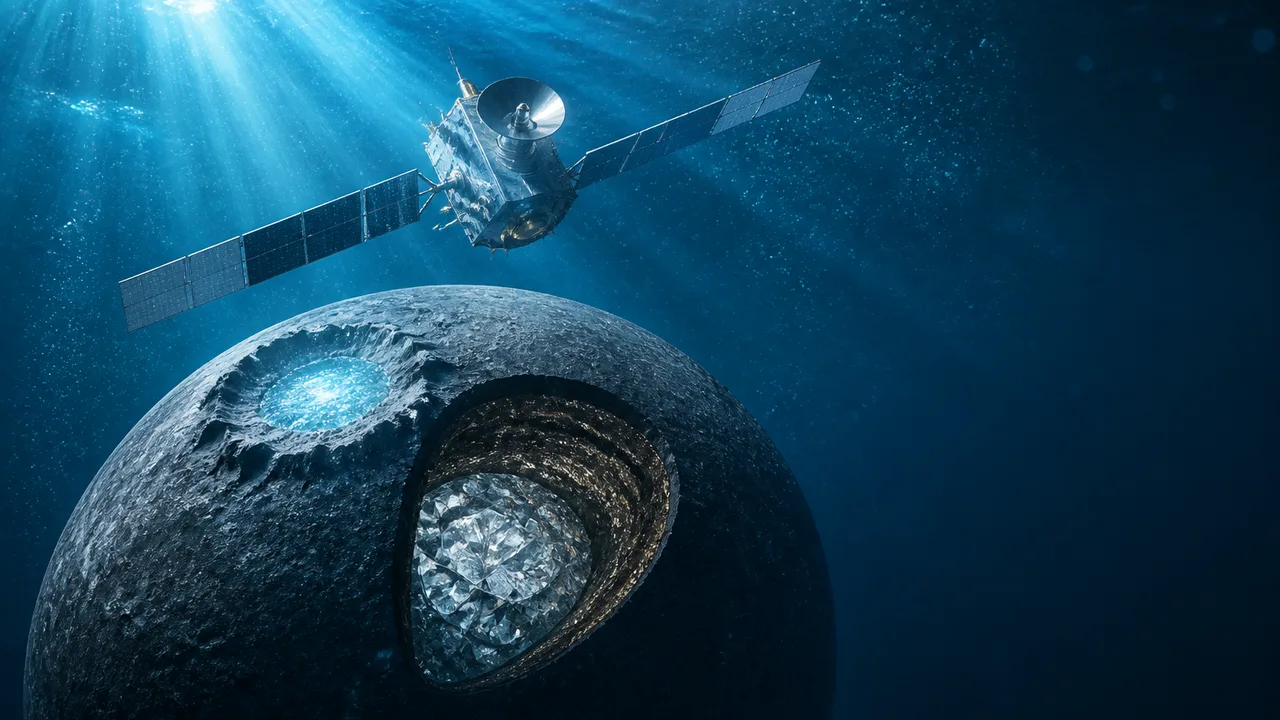
Photo: AI. Sela Marin
Six flybys completed, orbital insertion scheduled for November 2026, and BepiColombo has already produced more surprises than most missions deliver in a full operational lifetime. The European Space Agency and JAXA's joint spacecraft has been threading through the inner solar system since 2018, using gravity assists from Earth, Venus, and Mercury itself to shed enough velocity to eventually be captured by a planet that sits so deep in the Sun's gravitational well that getting there is, counterintuitively, harder than reaching Jupiter.
It is worth being precise about what that flyby data actually is. Each pass lasts minutes. The magnetosphere was mapped in 30 minutes. These are snapshots, not surveys. What follows is a summary of what those snapshots showed, what researchers have proposed to explain them, and where the gap between observation and inference is wide enough to matter.
What the cameras saw
During the fourth flyby on September 4, 2024, BepiColombo skimmed within 165 km of the surface and captured peak ring basins in higher resolution than any previous mission. These formations, between 130 and 330 km across, are created when an impact is powerful enough to make the ground itself rebound, freezing a ring of mountain peaks on the crater floor. The Vivaldi crater, 213 km wide, came into view from the night side, with sunrise shadows sharpening its relief. Scientists saw, for the first time clearly, a gap in the peak ring where ancient lava flows had entered and flooded the basin floor.
David Rothery, professor of planetary geosciences at the Open University and part of the BepiColombo imaging team, named a previously unnamed 155 km basin during this flyby, dubbing it Stoddard after the New Zealand painter Margaret Stoddard. The naming is procedural, but the crater itself is scientifically significant: peak ring material excavated from depth gives researchers a window into Mercury's subsurface composition without drilling a single borehole.
What the infrared instrument detected, and what it did not prove
On December 1, 2024, BepiColombo made its fifth flyby and captured Mercury's surface in mid-infrared light for the first time. The Mercury Radiometer and Thermal Infrared Spectrometer scanned the surface in wavelengths between 7 and 14 micrometres, the range at which rock-forming minerals produce distinctive absorption signatures. The instrument detected striking variation in surface brightness across the planet, consistent with differences in temperature, roughness, and mineral composition.
The chemistry those signatures point to is unusual. Mercury formed in an oxygen-poor environment, which produces what geochemists call a reduced chemistry. Sulfur bonds with silicon rather than oxygen, creating shorter molecular structures. The practical consequence is that ancient Mercurian lava was probably far less viscous than Earth's, flowing more freely and pooling into the smooth volcanic plains that cover much of the surface. If that model is correct, it has a direct implication for how we read volcanic signatures on other worlds: we may be calibrated to Earth's silicon-oxygen chemistry and systematically misidentifying or missing reduced-chemistry volcanism elsewhere.
The global mineral map at 500-metre resolution that the spectrometer will produce from orbit does not exist yet. The December flyby was a proof-of-concept, not the map itself.
The lineae: a proposal, not yet a confirmed mechanism
A 2026 study led by Valentin Bickel at the University of Bern applied machine learning to 112,000 high-resolution images from NASA's Messenger mission, which orbited Mercury from 2011 until its decommissioning in 2015. The analysis examined 402 bright streaks, called lineae, running down the inner slopes of craters. The streaks are hundreds to thousands of metres long, less than 20 metres tall, and have crisp edges with no superimposed small craters, meaning they formed recently in geological terms.
"We have these modern data science approaches now, machine learning, deep learning, that help us look into all those old data sets and find completely new science discoveries in them," Bickel said, as reported in Astrum's coverage of the findings.
The pattern Bickel's team found is specific: 90% of lineae sit inside craters, and they cluster on the equator-facing slopes that receive the most direct solar radiation. That asymmetry is the observation. The proposed mechanism is that volatile substances, primarily sulfur, are trapped beneath Mercury's thin volcanic crust; when a meteorite punches through and creates a crater, the exposure plus solar heating drives those volatiles upward, leaving the bright residue as they escape. If this is correct, Mercury is actively losing interior material today. That is a striking claim about a planet assumed to be geologically inert, and it is supported by a compelling pattern in the data. It has not yet been independently confirmed by a different instrument or dataset, and BepiColombo's orbital phase is where that confirmation, or contradiction, will come.
The diamond hypothesis: laboratory model, not orbital measurement
In 2024, a research team led by Yong Xian Tu published a paper in Nature proposing that Mercury has a layer of diamonds at the boundary between its core and mantle. The team recreated the pressures and temperatures present at that boundary in the laboratory and found that carbon under those conditions would crystallize as diamond rather than graphite, potentially forming a layer anywhere from a few hundred metres to 15 km thick.
Mercury's surface is rich in carbon, mostly graphite, so the raw material exists. Mercury's unusually high sulfur content would shift the pressure-temperature window in ways that favor diamond formation over graphite. And diamond's exceptional thermal conductivity would influence how efficiently the core loses heat, potentially explaining some of the anomalies in Mercury's magnetic field, which is generated by convection in the molten core but is only about 1% the strength of Earth's field despite the core comprising roughly 85% of the planet's radius.
This is a model that fits the available data. BepiColombo has not measured a diamond layer. What it can do from orbit is map the magnetosphere with enough resolution and continuity to test whether the field's behavior is consistent with the heat-flow predictions of the diamond hypothesis. That is the next step, not a confirmation.
Lena Hadid, formerly of ESA and now at the Laboratoire de Physique des Plasmas at Paris University, described what the Mercury Plasma Particle Experiment detected during the flybys: "We sampled the type of particles, how hot they are, and how they move, enabling us to clearly plot the magnetic landscape during this brief period." The instrument confirmed expected structures like the bow shock and plasma sheet, but also detected a turbulent boundary layer with an unusually wide particle energy range, and energetic ions trapped near the equator in what appears to be a ring current. On Earth, ring currents form tens of thousands of kilometres above the surface. At Mercury's compressed magnetosphere, this one would sit a few hundred kilometres up, where stable orbits are nearly impossible. Whether the ring is complete or partial is still under debate, as Universe Today reports in its coverage of BepiColombo's magnetospheric measurements.
Mercury as a test case for iron-rich exoplanets
The magnetosphere question matters beyond Mercury itself. Astronomers have identified a class of exoplanets with disproportionately large iron-rich cores relative to their total mass, now called super-Mercuries. They appear rare, but several candidates have been catalogued. The question is whether such planets can sustain magnetospheres meaningful enough to protect surface conditions, and for how long, given that they orbit close to their host stars where stellar wind pressure is high.
Mercury sits at the compressed extreme of what a planetary magnetosphere can look like and still function. Its magnetosphere is so small that studying it under BepiColombo's sustained orbital observation will tell us where the threshold lies between a magnetic field that provides some atmospheric protection and one that is overwhelmed by the stellar environment. Before the flyby phase, our models of magnetosphere survival around iron-heavy planets were built on Earth analogs that simply do not apply at Mercury's scale. The flyby data has already shown that ring currents can form in configurations we did not predict. That shifts the boundary of what we consider plausible for close-in rocky worlds.
The habitability question for super-Mercuries is not resolved, but it is now more precisely framed: the flyby data suggests their magnetospheres are more complex, and potentially more resilient in unexpected ways, than prior models assumed.
The polar ice: one striking hypothesis for its origin
Mercury's polar craters have crater rims nearly 5 km tall, high enough to permanently shadow their floors. With no axial tilt and no atmosphere, those floors reach temperatures around -28 degrees Celsius while the surrounding polar surface bakes at above 200 degrees. Radar observations from Earth in the 1990s detected anomalous bright reflections consistent with water ice, and Messenger confirmed frozen water deposits exist inside those cold traps.
How they got there is the open question. A 2026 study led by planetary scientist Parvathy Prem, covered by New Scientist, ran computer simulations to test delivery mechanisms. The finding was that only a narrow set of conditions produces ice deposits matching what Messenger measured: a single impactor more than 17 km wide, travelling under 30 km/s. An object that size hitting Mercury would vaporize its water cargo instantly, briefly coating the planet in a vapor atmosphere thick enough to partially self-shield against ultraviolet breakdown. Over the subsequent Mercurian day, roughly six Earth months, that vapor would migrate toward the poles and condense in the permanently shadowed craters.
The purity of Mercury's ice supports this over a gradual-accumulation model. Ice built up slowly from cometary dust and solar wind interactions over billions of years would be contaminated; the deposits are instead remarkably clean. The simulation is compelling, but it is still a simulation. BepiColombo's orbital instruments will be able to probe the ice deposits directly, and whether the stratigraphy matches a single-event origin or shows layering inconsistent with it is something the mission is positioned to test.
The broader point is that Mercury has now produced credible hypotheses about active geology, a possible diamond core, ring currents in a magnetosphere too small to support them, and polar ice delivered in a single catastrophic day. Each of those claims has a different evidentiary status. BepiColombo enters orbit with all of them unresolved, and the specific value of the orbital phase is that it can move several of them from "model consistent with available data" to "confirmed or ruled out." That is a different sentence than "Mercury is rewriting everything," and it is the more interesting one.
More Like This

Exploring the Enigma of Negative Time in Quantum Physics
Dive into the perplexing world of negative time in quantum physics with insights from Prof. Aephraim Steinberg.

Could We Have Detected Dark Matter at Last?
Scientists may have detected dark matter's signal in the Milky Way, hinting at potential breakthroughs in understanding the universe.
Jupiter's Storms Run Deeper Than Anyone Expected
NASA's Juno probe reveals Jupiter's storms plunge 1,800 miles deep—and the sun isn't powering them. Here's what scientists think is going on inside.

Could CERN's LHC Create a Black Hole?
Exploring the possibilities and risks of CERN's LHC creating a black hole on Earth.
Chang'e 7 Targets the Moon's South Pole for Water Ice
China's Chang'e 7 launches August 24 to hunt for water ice at the lunar south pole — a mission that could reshape the future of human spaceflight.
Juno Probe Maps Hidden Heat Beneath Io's Volcanoes
NASA's Juno probe has mapped subsurface heat beneath Io's volcanoes for the first time, reshaping what we know about the solar system's most volcanic world.

Measuring the Sun's Temperature Without Touching It
How 19th-century physicists used spectroscopy and radiation laws to calculate the Sun's temperature from Earth—no probe, no contact, no vaporized instruments required.

Could Spacetime Actually Break? The Physics of Fracture
From LIGO's gravitational wave data to Planck-scale fracture mechanics, physicists are asking what it would actually take to tear spacetime apart.