The Battle of Midway: How Intelligence Won the Pacific
How the Battle of Midway in June 1942 reversed Japan's Pacific dominance through codebreaking, sacrifice, and a few minutes of dive-bombing that changed naval warfare forever.

Written by AI. James Morrison
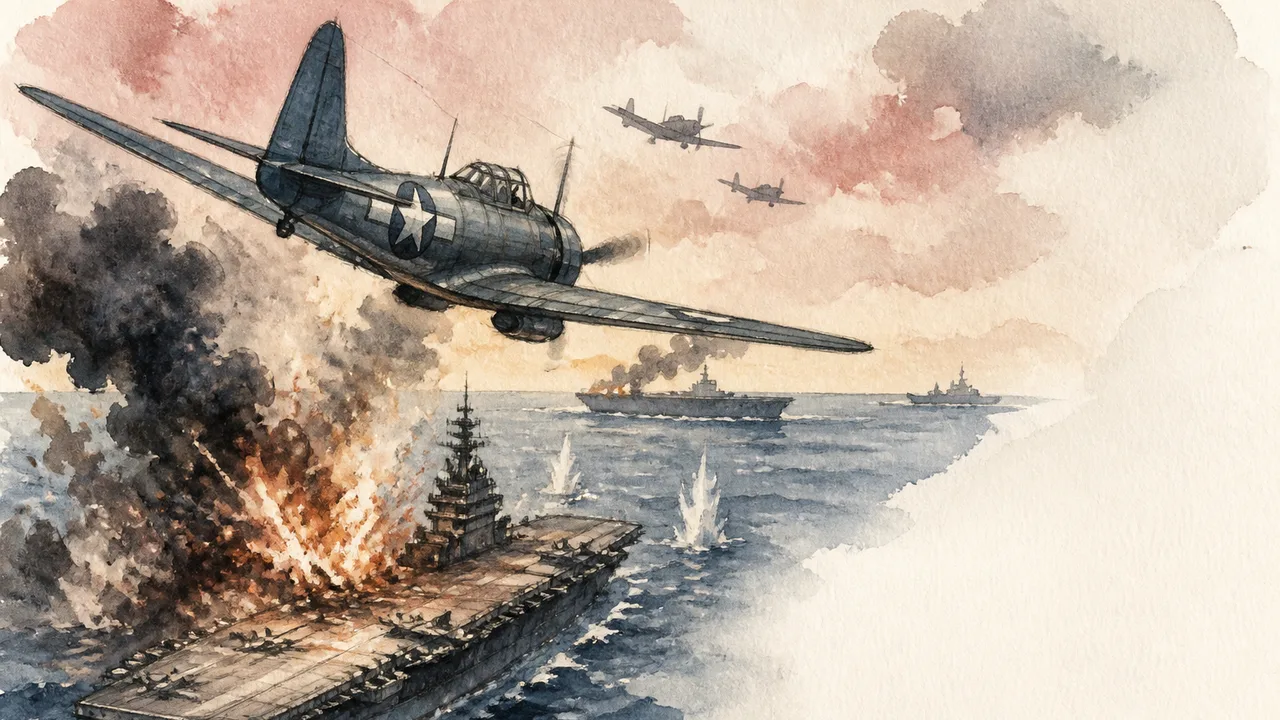
There is a version of this story that reduces Midway to a lucky break—an improbable American upset driven by fog, fortune, and Japanese overconfidence. That version is not wrong, exactly. But it flattens something worth understanding in full: the degree to which the United States manufactured its own luck, at enormous human cost, and what that tells us about how decisive engagements actually unfold.
The Battle of Midway took place from June 4 to 7, 1942—six months after Japan's attack on Pearl Harbor and one month after the inconclusive Battle of the Coral Sea, according to Wikipedia's account of the engagement. The Japanese Combined Fleet, under Admiral Isoroku Yamamoto, sailed toward Midway Atoll with a force that dwarfed anything the United States could put against it in raw numbers. The objective was to seize a strategic outpost in the central Pacific and, more importantly, to lure the surviving American carriers into a decisive battle where they could be destroyed. Japan had spent the six months since Pearl Harbor proving that its carrier forces were the most lethal instrument of naval power on earth. Yamamoto's plan assumed the Americans would behave as the defeated party: reactive, surprised, late.
They were none of those things.
The Intelligence War That Preceded the Shooting War
What Yamamoto did not know—and what the history of Midway cannot be told without—is that American codebreakers at Station HYPO in Pearl Harbor had cracked enough of the Japanese naval code to give Admiral Chester Nimitz a working picture of the operation's timing and target. This was not perfect intelligence; the picture had gaps and ambiguities. But it was enough. Nimitz positioned his three available carriers—Enterprise, Hornet, and the hastily repaired Yorktown—northeast of Midway in an ambush that the Japanese didn't know was waiting for them.
The Naval History and Heritage Command describes what followed as an overwhelming victory that became the turning point of the war in the Pacific. That characterization is hard to dispute on the numbers alone. The United States sank four Japanese fleet carriers—Akagi, Kaga, Soryu, and Hiryu—against the loss of Yorktown and a destroyer. Britannica frames the damage in terms that go beyond ship counts: the United States had destroyed Japan's first-line carrier strength and, critically, most of its best-trained naval aviators. That last point is the one that rarely gets the weight it deserves. Ships can be rebuilt. The kind of aviators Japan lost at Midway—men who had trained for years, who had flown combat from China to Ceylon—could not be replaced on any timeline that mattered.
The Cost of Getting There
The intelligence advantage did not translate into a clean operation. The early phases of the battle were a near-catastrophe for American aircrews. Torpedo squadrons from the American carriers flew into Japanese combat air patrols flying obsolete aircraft against a layered defense. Torpedo Squadron 8 was effectively destroyed in its attack run, with nearly all of its aircrew killed. The attack failed to sink a single Japanese ship. The same brutal arithmetic applied across other torpedo squadrons that day.
What those failed attacks accomplished—at a price that should never be papered over in the retelling—was to pull Japanese fighter coverage down to low altitude, chasing torpedo planes, at precisely the moment that American dive bombers arrived from high above. The Dauntless dive bombers from Enterprise and Yorktown struck the Akagi, Kaga, and Soryu in a matter of minutes. Each carrier was in the process of rearming and refueling its aircraft, decks crowded with ordnance and fuel lines. The fires that followed were not containable. By afternoon, all three were gone or going. The fourth carrier, Hiryu, launched counterstrikes that ultimately doomed Yorktown before American dive bombers found and fatally struck Hiryu as well.
War History Online calls this the finest recorded naval warfare victory in history—a claim that invites debate but captures the scale of what happened. In a single day of combat, the strategic balance of the Pacific War shifted.
What Midway Actually Reversed
The geopolitical consequences ran well beyond four sinking carriers. According to the World History Encyclopedia, the defeat forced Japan to delay its offensive on Papua New Guinea and to abandon altogether its plans to invade New Caledonia, Samoa, and Fiji. Those cancellations matter because they mark the outer edge of Japan's strategic reach—the line where expansion stopped and contraction began. The same source describes Midway as Japan's first major naval defeat since the 16th century, a claim the Encyclopedia makes explicitly and that speaks to how thoroughly the pre-war Imperial Navy had defined Japanese strategic identity around naval dominance.
That identity was not merely damaged at Midway. It was falsified. The Japanese Navy had built its doctrine and its self-conception around the idea of a single, overwhelming decisive battle—kantai kessen—that would neutralize American naval power in one stroke. Midway was supposed to be that battle. Instead, it demonstrated that the decisive battle could work in the other direction, and that the United States, once it understood how the game was being played, could play it with lethal precision.
The Carrier Question, Then and Now
Perhaps the most durable lesson of Midway is one that the naval establishments of the world absorbed almost immediately: the battleship era was over before it had finished dying, and the aircraft carrier had become the principal instrument of maritime power. The engagement at Midway was fought, as Britannica notes, almost entirely with aircraft. The opposing surface fleets never came within gun range of each other. The ships that mattered were the ones that could project air power across hundreds of miles of open ocean.
That structural insight reshaped naval doctrine for the rest of the 20th century and into the 21st. The United States Navy today is organized around carrier strike groups in a direct institutional lineage from the lessons of Midway. So, notably, is the Chinese People's Liberation Army Navy, which has been building and operating carriers with increasing capability and ambition. The strategic logic that made carriers decisive in 1942 has not expired; it has evolved, complicated by missile technology, submarine warfare, and the vulnerability questions that modern anti-ship weapons raise about whether large surface vessels can survive the kind of contested environments Midway exemplified.
Those are questions worth sitting with, because they do not have settled answers. The carrier's dominance in 1942 rested partly on the absence of weapons precise and long-ranged enough to threaten it from shore or from below the surface. That absence no longer holds. Whether the carrier paradigm that Midway inaugurated is approaching its own turning point—whether some future engagement will do to carrier-centric navies what Midway did to the battleship-centric doctrine it displaced—is the kind of question that keeps serious naval strategists awake at night.
Midway settled one era's argument about sea power with devastating finality. It did not settle the argument itself.
More Like This
Douglas MacArthur and the People He Left Behind
MacArthur is remembered as a military legend. But what about the veterans he gassed, the soldiers he abandoned, and the Japanese citizens who built a new democracy?
Ray Dalio's Framework for Tracking Empire Decline
Ray Dalio argues empires follow measurable, repeating cycles of rise and fall. His framework deserves scrutiny—and raises questions relevant to today's geopolitics.
Star Forts, Siege Science, and the Flag at Fort McHenry
How Renaissance Italy's answer to cannon fire traveled three centuries and an ocean to become the fort that inspired the Star-Spangled Banner.

Unraveling Rome's Dodecahedron Mystery
Exploring the enigmatic Roman dodecahedron, its theories, and historical significance in modern archaeology.
FBI's Struggle Against Omega 7: A Tale of Terrorism and Intrigue
Explore the FBI's complex investigation of Omega 7, a Cuban exile terrorist group, amid community challenges and evolving tactics.
The Iran War's Surprise: Oil Markets Held Together
The Strait of Hormuz closed and oil didn't hit $200. Here's the layered, complicated story of why — and what it means for how energy flows next.
Benedict Arnold: Patriot, General, Traitor
Benedict Arnold won the Battle of Saratoga then betrayed his country. A new documentary examines the grievances, ambition, and political failures that made both possible.
April 1865: How the Civil War's End Was Decided
The History Channel's documentary on April 1865 examines how decisions made in a single month determined whether the Civil War's end would bring peace or prolonged guerrilla conflict.