Battle of Belmont: Grant's First Combat Through an Eyewitness
At Belmont in 1861, Grant's troops attacked and withdrew. B. F. Sawyer's eyewitness account brings Civil War confusion into focus alongside the river campaign.

Written by AI. James Morrison
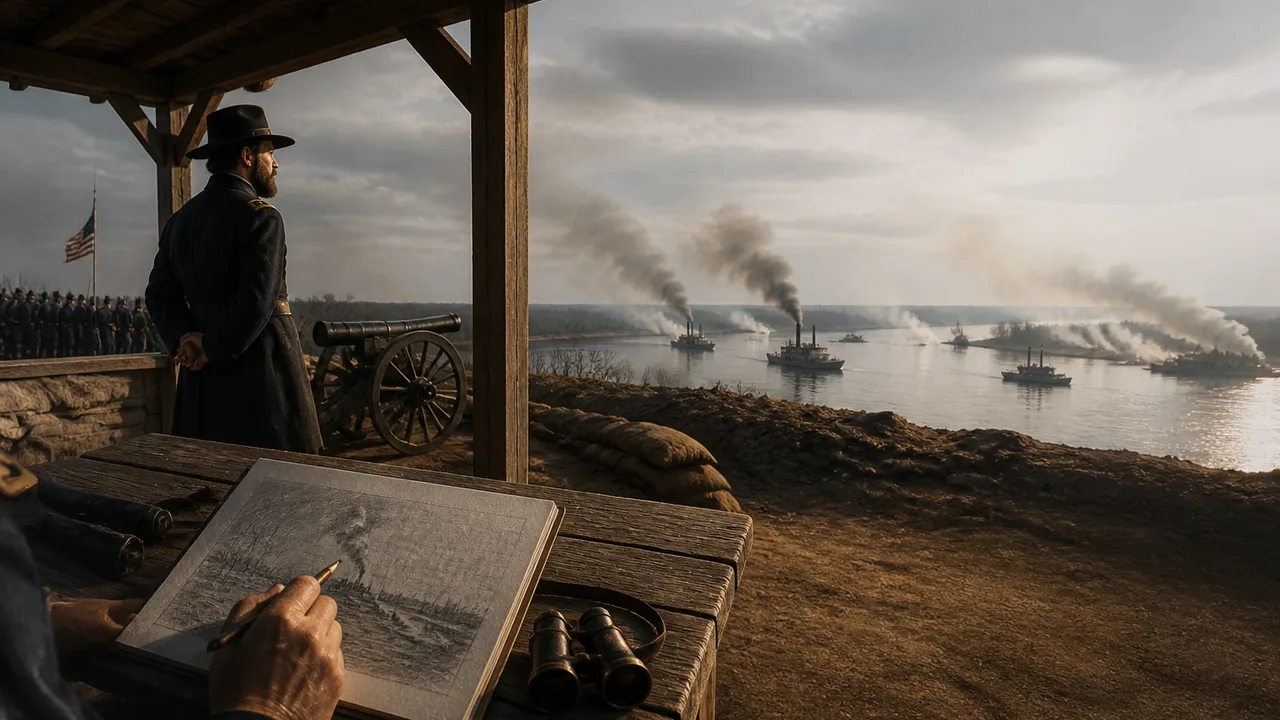
On November 7, 1861, Ulysses S. Grant led Union troops into combat at Belmont, Missouri, in his first battlefield command of the Civil War. His force attacked a Confederate position near the Mississippi River and then withdrew as the fight turned against it. Those two movements fit neatly into a campaign history. For the men trying to carry them out, the second was not simply the first in reverse.
A renewed focus on an eyewitness account by B. F. Sawyer gives the Battle of Belmont another scale. Grant could describe an operation by its objective and result. A participant had to make sense of it from wherever he stood, with other parts of the field beyond his sight. Sawyer’s value lies in that narrower view. His account belongs beside commanders’ reports and other testimony, where disagreements over sequence, perception and responsibility become part of the history rather than an inconvenience to edit out.
Belmont was an early test for inexperienced soldiers on both sides. It was also a fight over a river corridor whose importance reached far beyond a small Missouri landing. Understanding both scales helps explain why Grant attacked and why the experience of the attack could look so different from a headquarters account.
A Small Landing on a Strategic River
Belmont stood on the Missouri side of the Mississippi, opposite the Confederate position at Columbus, Kentucky. Belmont was a small steamboat landing, and Confederate forces wanted to control passage on the river, even contemplating a chain stretched across it to stop Union vessels moving south. A landing that might barely register on a civilian map could matter greatly to armies that needed to move troops and supplies.
Kentucky complicated the geography. Its political future was contested, with pro-Union and pro-Confederate factions seeking to determine the state’s allegiance. Columbus gave the Confederates a position from which to contest traffic on the Mississippi. Belmont offered Grant a target across the river in Missouri. The boundaries on the map did little to confine the military problem: what happened at one bank affected the choices available on the other.
Grant held the rank of brigadier general, a general officer’s grade below the senior commanders directing larger forces. Belmont was his first combat test as a Civil War commander, although he would later command Union armies on a far greater scale. That later career makes the engagement easy to read backward, as an opening chapter in an inevitable rise. On the morning of the fight, there was no such guarantee. Grant had to put an inexperienced force into action against Confederates who could respond to the attack.
The Union troops struck the Confederate position near Belmont. The course of the fighting then forced a withdrawal. Calling that sequence an attack followed by a retreat is accurate, but it leaves out the command problem inside it. Troops moving forward need to identify a target and keep enough order to act together. Troops pulling back under pressure must do that while changing direction, locating a route out and maintaining contact with whoever is directing them. At Belmont, withdrawal was part of the battle, not an administrative act after it.
The View Below the Command Level
Sawyer’s eyewitness account draws attention to a basic limit of battlefield perception: no participant could see the whole engagement unfold. A commander’s report can connect an order to a later movement. A witness closer to the action can help explain how that movement appeared to someone required to respond to it. Those views answer different questions.
Consider the moment an attack loses momentum. From above, a commander might describe a changed enemy position and order a withdrawal. On the ground, soldiers have to recognize that the direction of the fight has changed before they can follow the order. They may see nearby units moving without knowing what prompted them. That gap between decision and understanding is central to any reconstruction of Belmont’s confused course. It also helps explain why two truthful participants could later disagree about when the fighting turned.
An eyewitness can record disorder without explaining its full cause. A report from a senior officer can identify an intended maneuver without proving that every unit carried it out as intended. Placing Sawyer beside official accounts allows historians to test where an order, an observation and a remembered outcome align. Where they conflict, the useful question is precise: did the witnesses occupy different positions, learn of an event at different times or attach different meanings to what they saw?
Sawyer’s exact vantage and the date on which he wrote his account are not clear from the account’s renewed presentation, so his testimony alone cannot establish the timing or cause of a disputed movement. That limitation still leaves room for the experience he recorded. A witness need not possess the commander’s view to show how a commander’s plan met the field.
The same scrutiny belongs to Grant’s account. Military reports serve practical purposes. They explain actions to superiors, record results and assign significance to decisions. Participants’ recollections carry their own pressures, including allegiance, memory and knowledge of what happened afterward. Neither form should receive an automatic promotion to the status of final verdict. Their strongest use comes from reading them against each other and against the geography of the fight.
A Battle that Resists a Clean Verdict
Belmont invites competing judgments because Grant’s force attacked and then left the field. One can assess the initial assault, the subsequent Confederate response and the Union withdrawal separately. Compressing them into a single label of victory or defeat risks hiding the decisions that soldiers and commanders actually faced.
The Confederate position across the river also prevents the fight from becoming a self-contained contest at the landing. Belmont’s value came from its relationship to Columbus and the Mississippi. An account focused solely on the last troops to occupy the ground would miss why the armies fought there in the first place. An account focused solely on river strategy would miss what the changing situation demanded of the troops who had landed.
That tension is why Sawyer belongs in the history without replacing Grant. The first combat command of a future general in chief attracts attention to leadership: what Grant intended, how he responded and what he learned. Sawyer directs attention to the people whose understanding of those choices was necessarily incomplete as events unfolded. Their confusion was not a footnote to the operation. An army’s ability to act depends on how well orders survive the distance between headquarters and the men carrying them out.
Belmont did not decide control of the Mississippi or the course of the Civil War. It put inexperienced armies into a fight tied to both questions. Grant’s later prominence ensured that his first battle would be remembered. Sawyer’s account asks readers to keep another measure of that day alongside the general’s career: what an order looked like once it reached the ground.
More Like This
The KGB's Cyanide Newspaper Gun That Almost Worked
How a KGB poison weapon hidden in a rolled newspaper killed Ukrainian nationalist Stepan Bandera in 1957—and why one mistake unraveled the whole operation.

LIDAR Is Rewriting What We Know of Ancient Cities
Anthropologist Luke Caverns is planning the largest LIDAR scan ever done in the Amazon. What the technology finds may force a rewrite of ancient history.
Bodmin Moor's Bronze Age Village and Its Neolithic Cairn
Archaeologists confirm a Bronze Age village on Bodmin Moor—and find a 6,000-year-old cairn that may have outlasted the community that built it.
The Medici and the Borgia: Power, Banking, and Renaissance Italy
The Medici-Borgia rivalry was no simple feud. A look at how banking, papal power, marriage, and armies shaped Renaissance Italy's contested politics.
The Crusades: Two Centuries of Holy War Explained
From Pope Urban II's 1095 call to arms to the fall of Acre in 1291, the Crusades reshaped Christianity, Islam, and the medieval world permanently.
Gettysburg's Command Failures and What They Still Cost Us
Dr. Roy Casagranda's Gettysburg lecture reveals how four command archetypes from 1863 shaped the battle's outcome—and what they still tell us about military leadership today.