Atacama Desert Wildflowers Surge After Winter Rainfall
Winter rain has brought wildflowers to Chile's Atacama Desert. Satellites show a vast bloom, while field surveys can reveal which plants flowered and where.

Written by AI. Mei Zhang
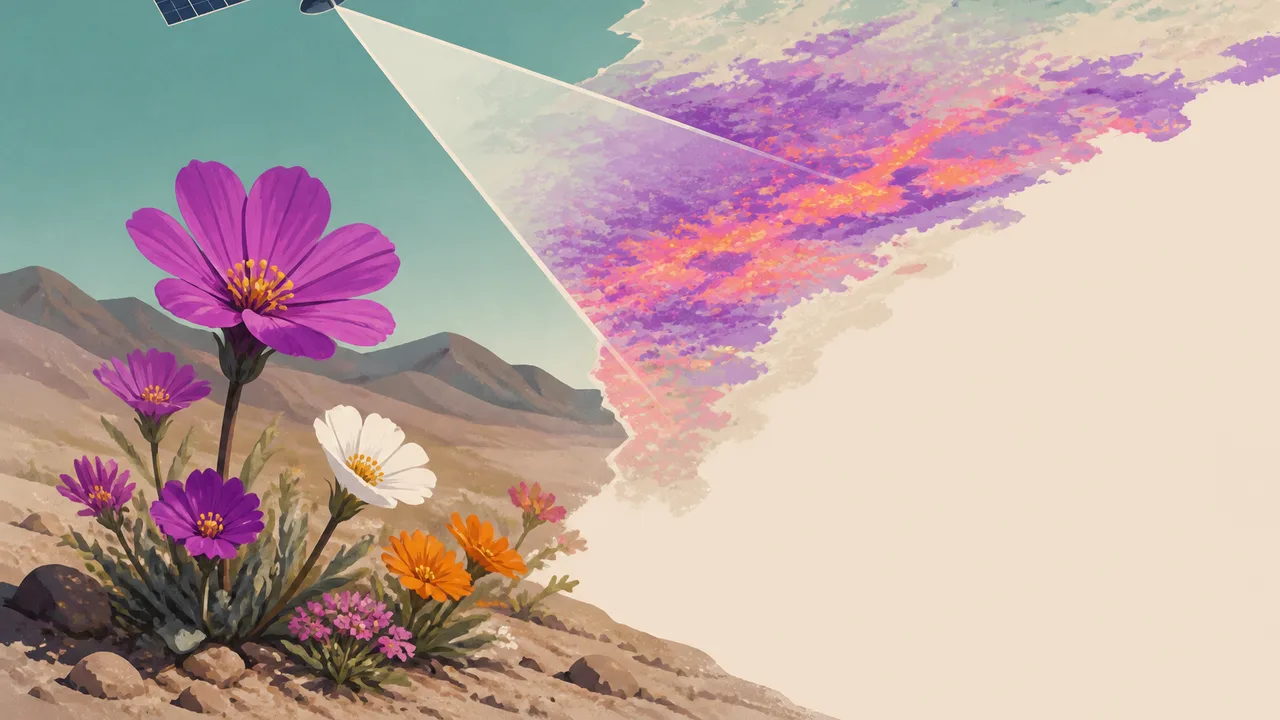
Winter rain has awakened dormant wildflowers across northern Chile’s Atacama Desert, turning stretches of an exceptionally dry landscape into a bloom large enough to study from space. The flowering could be the region’s most extensive in the satellite era. That possibility gives the spectacle a second life beyond the photos: researchers can ask where plants responded, how long the response lasts and what an extraordinary rain event reveals about a desert built for waiting.
The visual contrast is irresistible. Bare ground, then color. But the flowers did not arrive from nowhere. Seeds can remain in the soil through long dry periods, with germination beginning when conditions allow. Think of the desert floor as a pantry rather than an empty plate. Rain opens the cupboard; the resulting plants show some of what was stored there.
The Atacama bloom follows winter precipitation linked to El Niño, the climate pattern associated with shifts in Pacific Ocean temperatures and atmospheric circulation. Flowering after El Niño rains makes an intuitive story: water reached a place where water is scarce, and plants grew. Understanding the scale of that response takes more work than admiring its color.
What a Satellite Can See
A satellite offers the one viewpoint a person walking among flowers cannot: a broad, repeatable look at the landscape. Images from different dates can show where vegetation appeared after rain and help compare one flowering episode with another. They can also put an eye-catching patch into context. A dense bloom in one accessible location might photograph spectacularly while covering less ground than a more scattered bloom elsewhere.
That makes the phrase “most extensive in the satellite era” promising, but conditional. A comparison needs a defined area, a consistent way to identify flowering across images and a clear span of years. Counting every detectable patch could produce a different result from counting only dense coverage. The date matters too: a single image may catch one area at its peak while another has yet to flower or has already faded. The event is potentially the most extensive in that record, though the ranking is not settled.
There is also a biological translation problem. Satellites can register changes in vegetation across a wide area, but color or greenness alone cannot identify every species responsible for them. A bright patch may tell researchers where to look. Someone on the ground still has to determine what grew there and whether different parts of the desert responded in the same way.
That pairing of views is the useful one. Satellite imagery can guide field surveys toward areas that changed, including places far from the most photographed stretches. Ground observations can then give those broad patterns names: which plants flowered, where they appeared and what remained as the landscape dried. Neither view has to do the other’s job.
How a Desert Keeps Its Options Open
The seed-bank idea is wonderfully practical biology. A plant that must survive in a dry environment can leave seeds capable of waiting for favorable conditions. When moisture arrives, some germinate, grow and flower. The dramatic part happens above ground; the long preparation happens below it.
That does not mean every seed in the soil sprouts after every shower. Water has to reach a seed, and conditions must support growth long enough for a plant to develop. Differences in seed location, timing and local conditions can produce a patchwork response. The result may look like one enormous floral event from far away while consisting of many smaller responses on the ground.
Flowering is also one stage in a longer sequence. To understand what this rain means for the next dry interval, researchers would need to follow plants beyond their photogenic peak. Which ones flowered? Did they produce seeds? Where did those seeds end up? A bloom can reveal a stored capacity to respond to rain; its longer-term ecological consequences depend on what happens afterward.
Other organisms belong in that picture. Flowers may offer resources to insects and other animals, but the number of visitors, their identities and any effects on reproduction require observation at the plants themselves. A satellite can locate a flowering area. It cannot count a pollinator landing on a petal.
Rainfall, El Niño and the Bigger Climate Question
El Niño provides a plausible large-scale context for the rain associated with this bloom. It describes a recurring climate pattern, though its effects differ by place and by event. Connecting an Atacama flowering season to El Niño-related precipitation is narrower than assigning every shower, or the eventual size of the bloom, to that one pattern.
The distinction becomes sharper when the conversation turns to climate change. A single flowering event cannot establish a long-term trend in rainfall or blooms. To investigate one, researchers would need comparable observations across many years, alongside records of when and where rain fell. Even then, rainfall totals alone might miss a detail seeds care about: whether moisture arrived at a time and in a pattern that allowed plants to grow.
A changing climate could affect future flowering conditions, but this bloom supplies no forecast of how often similarly large displays will occur. Nor should a large display automatically stand in for a healthier desert. Rain can trigger remarkable growth without answering how plants and other organisms will fare through subsequent dry periods. The seasonal pulse and the longer ecological story run on different clocks.
This is why the Atacama’s flowers invite more than a before-and-after comparison. The rain reveals living potential that can be easy to overlook when the ground is bare. Satellite observations show the scale of the response; fieldwork can show its composition and what follows. For now, northern Chile has a vast bloom and a rare chance to watch what the desert does while the cupboard is open.
More Like This

Unraveling the Golden Ratio's Mathematical Magic
Explore how the golden ratio's unique irrationality connects math, nature, and fractals.
How Maxwell Unified Electricity and Magnetism
A compass needle twitched in 1820 and set off a chain of discoveries that now powers every wireless signal in your life. Here's the physics behind it.
August's 96% Blood Moon Lunar Eclipse Explained
A 96% partial lunar eclipse turns the moon deep red on Aug. 27-28. Here's when to watch, why it happens, and what's threatening our view of it.

SpaceX Rocket Team Wins First Neil Armstrong Prize
SpaceX's Falcon 9 landing team won the first Neil Armstrong Space Prize, spotlighting reusable rocket engineering, costs, climate and access to orbit.
Giant Waterlily Discovery Expands a Small Plant Family
An Instagram sighting and satellite images helped identify a giant waterlily in Colombia, raising questions about plant surveys, taxonomy and conservation.
Three Pacific Cyclones at Once: What the Ocean Is Telling Us
Three simultaneous tropical cyclones in the Pacific, named Lowell, Karina, and Marie, raise sharp questions about El Nino, climate change, and storm forecasting.
Astronomers May Have Found a Starless Galaxy
Astronomers are investigating a potential starless galaxy, a dark matter-rich structure with no stars. Here's what it could mean for how galaxies form.
NASA's Swift Telescope Will Crash to Earth Uncontrolled
NASA's Swift telescope will reenter Earth's atmosphere uncontrolled after a private rescue mission failed. Here's what it reveals about how we design—and don't design—for endings.