Antarctic Ozone Hole Ranks Seventh Largest in 2026
The 2026 Antarctic ozone hole ranked seventh largest by area, yet its depth was less extreme. Explore why one dramatic spring does not settle the recovery question.

Written by AI. Nadia Marchetti
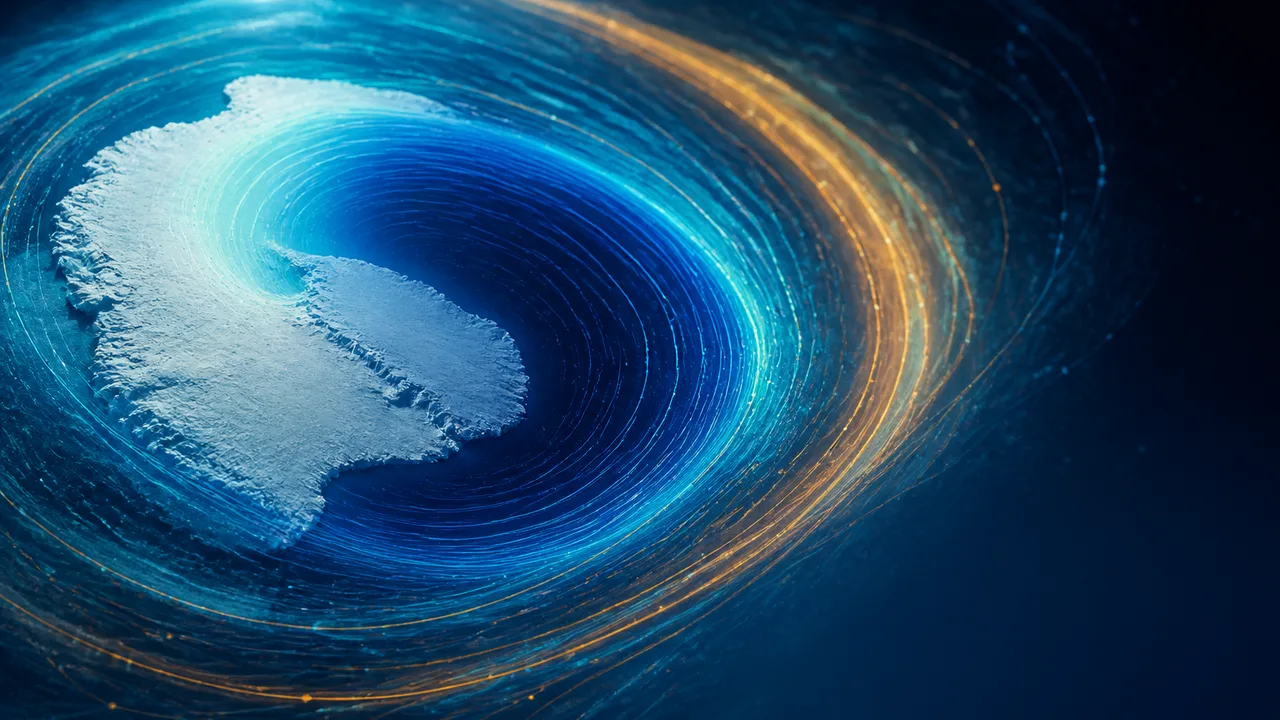
The Antarctic ozone hole reached its 2026 maximum as the seventh largest by area in a 48-year satellite monitoring record. That is an unusually high ranking for a problem the world has spent decades trying to solve. It also comes with a second observation: the depleted region was less deep than several other large ozone holes.
Area describes how far the ozone hole spreads. Depth describes how severely ozone is depleted within it. A season can rank near the top on one measure without setting a comparable mark on the other. The 2026 result asks readers to hold two facts at once: the affected region grew exceptionally wide, and its most depleted parts were less extreme than in some other big years.
This is where a dramatic annual ranking can lead us astray. Ozone recovery unfolds over decades; the Antarctic hole forms anew each spring under atmospheric conditions that change from year to year. A large season deserves scrutiny. It does not, by itself, date the end of a long-term recovery.
What the Seventh-Place Ranking Measures
Picture the ozone layer as a variable concentration of gas high in the atmosphere, rather than a solid covering with a tear in it. The phrase ozone hole refers to a region of severe thinning over Antarctica. Satellites can track how much ozone lies above different locations and map the area where concentrations fall below the level used to define the hole. A ranking by area compares the spread of that region with earlier seasons measured in the same monitoring record.
The seventh-place result concerns the hole's 2026 maximum, the point at which its area peaked. Peak area is useful precisely because it allows one conspicuous feature of different seasons to be compared. It leaves other questions for other measurements. How low did ozone levels fall within the region? How much of the depleted area was severely thinned? How long did the hole persist?
NASA's assessment that this year's hole was not as deep as several other large events gives the area ranking some necessary company. Think of two weather maps showing storms with similar footprints. The outline alone cannot tell you whether rain fell at the same intensity throughout both. Ozone depletion has its own physics, but the measurement problem is familiar: an outline does not describe every condition inside it.
The comparison with recent years also changes depending on the window chosen. The 2026 hole was the largest in a decade. That recent-years comparison and seventh place in the longer satellite record answer different questions. Neither describes the depth of the depletion.
Why the Hole Returns Each Antarctic Spring
The recurring seasonal cycle starts far from the image of a punctured shield. During the Antarctic winter, cold conditions and a circumpolar wind system help isolate air high above the continent. Chemistry in that cold environment prepares ozone-destroying substances for the return of sunlight. When spring light reaches the region, reactions involving chlorine and bromine can destroy ozone rapidly. As seasonal conditions change, the hole eventually contracts.
Those reactions explain why restrictions on ozone-depleting chemicals remain central to the recovery story. Chemicals used in products such as older refrigerants and aerosols released compounds that could ultimately contribute chlorine and bromine to the stratosphere. International controls under the Montreal Protocol reduced their production and use. Recovery takes time because the atmospheric effects of those chemicals do not disappear the moment a factory stops making them.
The chemistry also operates inside a moving atmosphere. Temperature, circulation and the persistence of conditions favorable to ozone loss can vary between Antarctic springs. Those variations help explain why the hole does not shrink neatly, year after year, like a circle being erased from a chalkboard. The seventh-place area ranking alone does not identify which conditions drove the breadth of the 2026 hole.
That leaves a scientific question more useful than a verdict based on one season: how do the measurements of area, depth and duration move over time? If researchers compare only the widest point each year, they risk overlooking changes in severity within the hole. If they look only at the lowest ozone readings, they miss how far depletion extended. Both views describe the same spring from different angles.
A Large Hole During a Long Recovery
The strongest case for concern about 2026 is straightforward. Seventh largest across 48 years is an exceptional area ranking. It shows that Antarctic spring can still produce extensive ozone depletion despite international controls. Anyone expecting a smooth, uninterrupted decline in the hole's size will find this season a poor fit for that expectation.
The strongest reason to avoid declaring the recovery reversed is equally concrete. A trend describes a pattern across many seasons, while seventh place describes one season's peak area. The depth comparison further complicates any attempt to assign the entire year a single position on a scale of severity. Recovery and a bad year can coexist when the underlying chemical burden changes slowly and seasonal conditions fluctuate.
This does not make the annual maximum a meaningless statistic. Repeated large seasons, especially if accompanied by greater depth or persistence, would demand closer examination in a long-running record. Likewise, a sequence of smaller, shallower holes would offer a fuller picture of progress than a single small footprint. The sensible unit of judgment is the pattern, built from consistent measurements, rather than whichever year's map looks most alarming.
NOAA and NASA have released measurements of the 2026 ozone hole. Continued satellite observations and atmospheric measurements can put this year's width and depth alongside earlier seasons. The work is repetitive by design. A long-term environmental policy succeeds or fails over stretches of time that make for awkward headlines, and monitoring has to last long enough to catch both improvement and the fluctuations that complicate it.
There is also a practical reason to preserve the distinction between a season and a trend. The ozone layer helps shield life on Earth from ultraviolet radiation. Treating one high ranking as proof that chemical controls failed would misread the timescale of the problem; treating the recovery trend as a reason to ignore an exceptionally wide hole would discard an important observation. Neither shortcut improves the measurement.
For now, 2026 belongs in the record with both of its descriptors intact: seventh largest by area, less deep than several other large events. Future Antarctic springs will show whether its broad footprint was an outlier in a recovering system or part of a pattern that needs a closer explanation.
More Like This
Neil Turok's Case for Quantum Gravity Without Strings
Neil Turok argues quadratic gravity—a 1970s idea—may solve quantum gravity without strings or extra dimensions. Here's what that claim actually rests on.

Statins May Cut Dementia Risk in Type 2 Diabetes
A major study finds early statin use after a type 2 diabetes diagnosis is linked to up to 15% lower dementia risk. Here's what the evidence actually shows.
America Wants Nuclear Cargo Ships by 2028: The Real Obstacles
A MARAD-Core Power agreement targets nuclear merchant ships laid down from 2028. The reactor is the easy part; lawyers, insurers and ports are not.
SpaceX Hits 600 Falcon 9 Booster Reuses
SpaceX reached 600 flight-proven Falcon 9 booster launches on July 13-14, 2026. Here's what that number actually means for spaceflight economics.
El Niño 2026 Could Be Among the Strongest on Record
NOAA gives a greater than 90% chance of a very strong El Niño by late 2026. Here is what the forecasts actually say, and what they do not.
Penguin Poop Is Shaping Antarctica's Climate
New research reveals penguin colonies release ammonia that seeds cloud formation over Antarctica—a feedback loop with real consequences for the continent's climate future.
Static Electricity Still Puzzles Scientists After Centuries
Static electricity has baffled scientists since ancient Greece. New research on carbon compounds and oxide surfaces may finally offer a clue to how tribocharging works.
The Physics of Sound: Ocean Acoustics and Musical Scales
A Royal Institution talk with Helen Czerski and Philip Ball asks whether underwater sound and the musical scale we use are governed by physics or cultural habit.