AI Data Centers Are Draining the Drought-Stricken West
Tech companies claim AI data centers use little water. Researchers say indirect consumption from power generation is 10 times higher — and communities are paying the price.

Written by AI. Olivia Meng
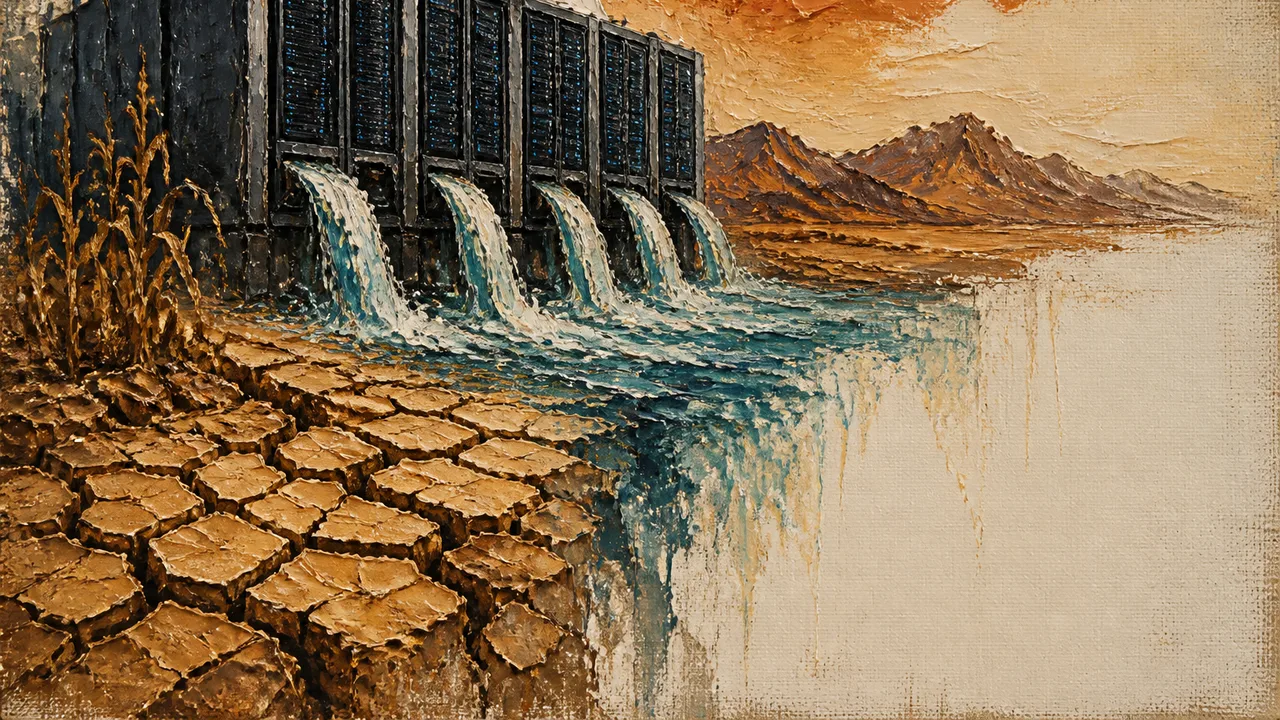
Photo: AI. Saskia Aaltonen
Roberto Roque grows pecans on land his family has farmed for three generations in southern New Mexico. He flood-irrigates, which looks exactly as inefficient as it sounds — water sheeting across flat fields in a region that gets roughly ten inches of rain a year. He knows the math on his operation. What he doesn't know is the math on the facility going up a few miles from his orchard: Project Jupiter, a 1,400-acre data center campus being developed by Oracle and OpenAI.
"If they consume the amount of water that people are saying that they're going to consume," Roque told More Perfect Union's investigators, "then what are we going to eat? Because agriculture is going to cease to exist."
That question deserves a straight answer. Getting one has proven remarkably difficult — and the difficulty is not accidental.
The accounting trick hiding the real number
When tech companies disclose water use, they report what happens inside the fence line: the water pumped through cooling towers, the water in the pipes. Oracle and OpenAI told the More Perfect Union team that Project Jupiter would require a one-time fill of roughly 11 million gallons to cool the campus's first four buildings. Meta, whose data center construction began in El Paso in late 2025, has described its facility as "a very low water user" with a closed-loop recycling system.
Both of those statements can be technically accurate and still be the wrong number to look at.
Alex Gorries Gao, who has published peer-reviewed research on data center resource consumption, explained the gap clearly: "The biggest part of the water footprint of a data center is not inside a data center itself. It's indirect water consumption due to the electricity that is generated for the data center. That's the part that these tech companies don't disclose. But if you're only talking about what's going on on site, you're really missing the lion's share of the impact."
His research found that, on average, the water consumed to generate the electricity powering data centers is ten times higher than the water used inside those facilities. That multiplier is why the on-site figures companies publicize — while not false — function as misdirection. Meta is actually the only major tech company that discloses its indirect water footprint at all; Gorries Gao found that in Meta's case, that indirect footprint is 24 times larger than its on-site consumption.
The sector-wide implications of that ratio are hard to sit with. Gorries Gao estimated that the total water consumption of AI systems may already be around 200 billion gallons annually — roughly twice the world's annual supply of bottled water. A recent UN report put the water footprint of data centers' electricity consumption in 2025 alone at approximately 1.2 trillion gallons, enough to fill around 2 million Olympic-size swimming pools.
These figures describe a resource draw that the public conversation about AI has almost entirely missed, because the companies shaping that conversation have chosen what to count.
El Paso: where the arithmetic gets local
About two-thirds of new data centers currently under construction are being built in drought-prone areas, according to More Perfect Union's reporting. The El Paso–southern New Mexico corridor illustrates why that statistic matters beyond the abstract.
El Paso sits in the Chihuahuan Desert. The Rio Grande that feeds the region's water system has been in long-term decline. Already in 2025, 20% of El Paso's total water use went to cooling power plants on the local grid — before Meta plugged in. According to More Perfect Union's investigation, Meta's facility at full buildout could account for up to 43% of El Paso Electric's peak load. That electrical demand cascades directly into water demand at the generation level, in a place where the grid already drinks a fifth of the city's water supply just to keep the lights on.
El Paso Water CEO John Balliew told the More Perfect Union team that the concerns are overblown. "Meta coming in is really a drop in the bucket," he said. "It adds 0.4% to the overall water consumption. So, it's not a big deal. We have plans in place. We have a sustainable supply of water."
That 0.4% figure, notably, measures direct water consumption — the same partial accounting the researchers have flagged as insufficient.
Community organizer and attorney Veronica Carbajal, who was born and raised in El Paso, put the tension plainly: "We've asked them time and again why they keep speaking out of both sides of their mouth. To large water users like Meta, they're saying, 'Don't worry, we have plenty of water.' And then to residents, they say, 'We have to raise the rates because we don't have water.'"
El Paso Water has imposed rate hikes on residents in recent years, including a double-digit increase in 2026. The More Perfect Union investigation found that, per El Paso Water's own CEO, residents would be subsidizing the infrastructure costs required to service large new industrial customers like Meta, because the impact fees the company pays cover only a fraction of the actual cost.
At a city council meeting documented by More Perfect Union, over 200 residents showed up to demand the city cancel its water deal with the company. According to that investigation, the council voted to keep the deal.
What public records actually reveal — when you can get them
Communities around the country have tried to use public records laws to find out what the tech industry won't volunteer. The experience has been instructive about who these disclosure systems are designed to protect.
In Oregon, Google successfully argued that its data center water use figures constituted a trade secret. A 13-month legal battle eventually produced the numbers: 1.5 million gallons per day, equal to roughly 40% of the host city's total consumption. In Virginia, a water deal for an Amazon data center came back heavily redacted. In Texas, state lawmakers surveyed 341 data centers about their water use; only 17% responded.
When voluntary disclosure fails and legal compulsion gets stonewalled, the inference is not that the companies have nothing to hide — it's that the system of accountability has no teeth.
The conflict-of-interest dimension compounds this. More Perfect Union's investigation identified local businessman Lane Gaddy as simultaneously sitting on the El Paso Water Board — which is providing water for Meta's $10 billion facility — and having sold water rights to Oracle's Project Jupiter from his own New Mexican sod farm. When asked to speak on the record, Gaddy told the More Perfect Union reporter he was under a non-disclosure agreement. Community organizer Carbajal characterized it directly: "When you sit on a board that deals directly with water, then you have a conflict."
The NDA, in this context, is doing a lot of work.
States are moving, but downstream from the problem
At least eight states have introduced bills requiring data centers to report their water use. New Mexico lawmakers are pushing for a moratorium on large projects like Project Jupiter until the state establishes criteria for evaluating their water and infrastructure impacts. These are not trivial efforts, and the people driving them deserve credit for forcing a conversation that the industry has actively tried to prevent.
But notice what mandatory reporting is and isn't: it's a floor, not a ceiling. Knowing how much water a data center system actually consumes — including the indirect draw from power generation — tells a community what it's agreeing to. It doesn't resolve the underlying tension between a water-intensive industry's preferred site selection and the physical reality of the watersheds it's choosing.
Jerry Pacheco, who leads the Border Industrial Association in the region, framed the economic logic with candor: "This is an industry that's moving by the minute. Companies have high stakes, billions and billions of dollars of getting there first with their data centers." He insisted the companies are being transparent about their water use. Gorries Gao's research suggests otherwise.
The distance between those two positions isn't really about data. It's about what a community's water supply is for — and who gets to decide.
Roberto Roque's pecans, Veronica Carbajal's neighborhood, the wells that have been drying up across the region: these are not arguments against economic development. They're arguments for knowing what you're trading away before the deal is signed. In a desert that already can't count on the Rocky Mountain snowpack it used to rely on, that seems like the minimum due diligence.
Whether the companies building the infrastructure for the AI economy believe they owe communities that minimum is, at this point, an answered question. The answer just isn't the one they give on record.
More Like This
Rethinking Cosmic Acceleration: A Local Illusion?
Exploring the debate on whether the universe's acceleration is a local phenomenon, challenging the concept of dark energy.

How the Asteroid Impact Ended the Dinosaur Era
Explore the catastrophic asteroid impact that ended the dinosaurs, its immediate aftermath, and the long-term environmental changes.

Subcritical Reactors: Nuclear Power's Safety Fix?
A new generation of subcritical reactors promises to make nuclear meltdowns physically impossible. But can they deliver on cost, scale, and timeline?

Eminent Domain Is Being Used to Build Data Centers
Power companies in Georgia and Pennsylvania are using eminent domain to seize private land for AI data center infrastructure. Here's what that actually means.
Intel's 30 Years in Costa Rica: What Happened
Intel is closing its Costa Rica assembly plant after nearly 30 years. The story looks familiar if you've ever watched a big employer come to town — and then leave.

Understanding the Real Risk of Brain-Eating Amoebas
Explore the facts and myths surrounding brain-eating amoebas. How real is the threat, and can climate change affect its spread?

Geothermal Energy's Promise and Its Real Barriers
Geothermal delivers 24/7 clean power with near-zero emissions. But drilling costs, financing gaps, and policy inertia stand between the technology and global scale.

How Air Pressure Works, From Barometers to Champagne
Neil deGrasse Tyson explains the physics of air pressure — and why understanding it matters beyond parlor tricks and party science.