AI Data Centers Are Pushing Up Memory Chip Prices
AI data centers are redirecting chip production away from consumer electronics, driving up prices for laptops, cameras, gaming consoles, and professional storage gear.

Written by AI. Dorothy "Dot" Williams
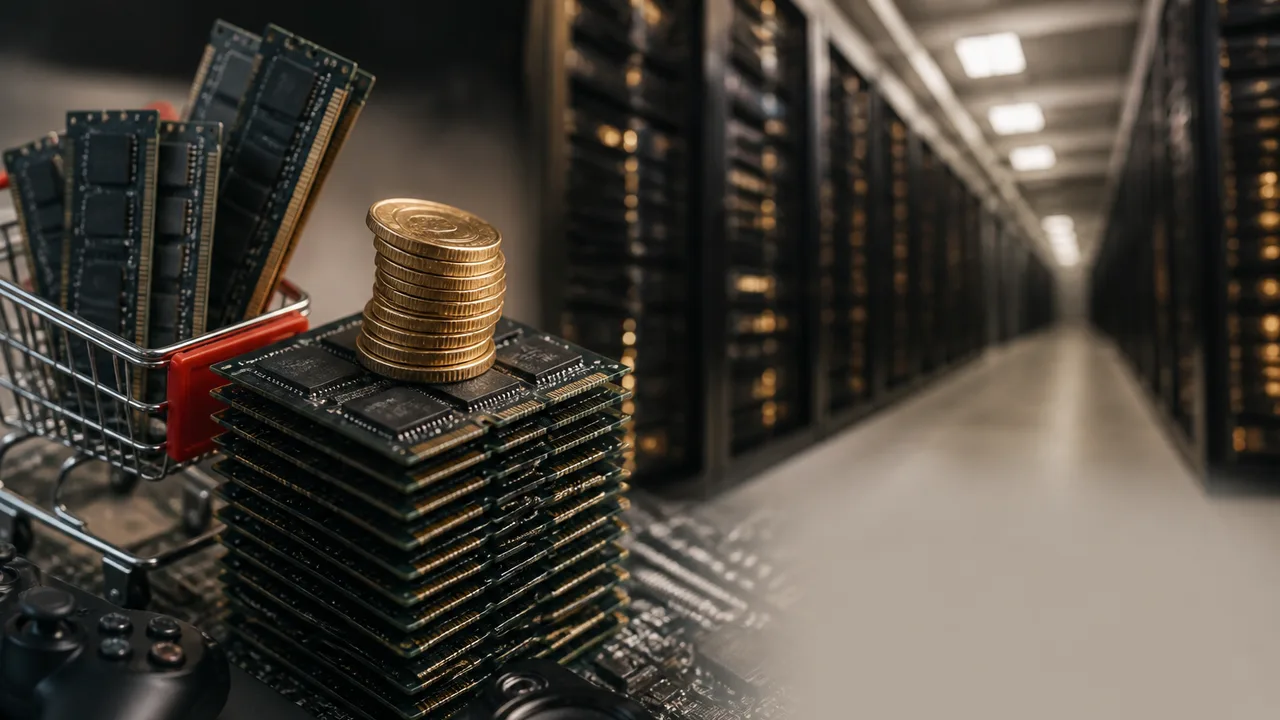
Photo: AI. Renzo Vargas
A MacBook Pro that cost $1,600 in 2025 cost $400 more by the following year. Xbox raised the price on a nearly six-year-old console. Lenovo, Dell, and HP followed with their own hikes. Apple, per Morning Brew, cited demand for memory and storage fueled by AI expansion. The companies all pointed at the same thing: the voracious appetite of AI data centers for memory chips.
The explanation is tidier than the reality. And that gap is worth sitting with.
The chip split that changes everything
Here is the part that tends to get lost in the headline version of this story: AI data centers do not actually use the same chips as your phone or laptop.
Consumer devices run on two types of memory. NAND handles long-term storage, the photos still on your phone after you power it off. DRAM handles short-term processing, fast but temporary. AI data centers run on something called High Bandwidth Memory, or HBM. It is essentially DRAM stacked vertically in a three-dimensional configuration, capable of moving data five to ten times faster than standard DRAM. The stacking makes it significantly more expensive to manufacture, and it requires far more production capacity per unit.
So the direct competition story, AI eating your laptop's chip supply, is not quite right. What is happening is more structural. The world's three dominant memory chipmakers, Micron, Samsung, and SK Hynix, together control more than 60% of global NAND production and nearly 90% of DRAM, according to Business Insider's reporting. All three have shifted meaningful portions of their fab capacity toward HBM to chase AI demand. That leaves less manufacturing throughput for NAND and DRAM. Less supply, same or growing demand: prices rise.
"If you're a memory chip company, obviously you're going to go to the best customers," one analyst explained in the Business Insider video, "and right now those are the AI companies."
That is not a conspiracy. That is a rational business decision. The question is what it costs everyone else.
Who's actually paying
Atlanta commercial photographer Alan Cooley laid it out in concrete terms. He spends $15,000 to $20,000 annually on storage. Seven drives he showed on camera cost over $6,000 to $7,000 total. When he bought them, he paid roughly $1,500 for the same set. One specific Samsung T7 drive he purchased in April 2025 for $285 was listed, by July 2026, at over $1,100, a price increase of more than 200 percent in roughly 15 months.
"These prices aren't tethered to new technology," Cooley said. "They've just gone up because some center in some place needs them more than I do."
That is the part that stings for working professionals. The drives did not get better. The technology did not advance. The price moved because the supply chain got redirected, and Cooley, along with every other professional who depends on storage for income, absorbed the consequence.
Jeff Hirsch, president of Photo Care, a New York camera store established in 1968, has watched this play out across his customer base. Memory cards and solid-state drives have roughly doubled in price since early 2026, he says. A 1 TB solid-state drive that was around $170 eight months ago now runs over $300. A filmmaker who bought memory cards at $500 per card the previous year paid $1,300 per card when they came back. Hirsch says his store's media sales by volume have dropped 30%.
"I don't want to say it's putting electronic media out of reach of some people," he said, "but it is coming close to that."
The International Business Times has tracked the same pressure across laptop and smartphone categories broadly. The professional photography sector is just one visible cut.
The gaming industry's particular bind
Gaming surfaces a structural contradiction that is hard to ignore. Xbox, a Microsoft property, raised the price of its 512 GB Series S from $400 to $500, and the 1 TB version from $450 to $600, citing memory and storage costs. The company has warned those costs are expected to double again by fall 2027.
Gaming YouTuber Luke Stephens put the trajectory in plain terms: "We have a 6-year-old console that is, for the top-tier variant, approaching a thousand dollars. So can you only imagine what the new one is going to cost?"
The contradiction is that Microsoft is simultaneously one of the largest investors in AI data center expansion, spending roughly $175 billion on AI infrastructure in 2026 alone, according to Business Insider's reporting. The company is not a passive victim of chip scarcity. It is an active driver of the demand that is redirecting production away from consumer chips. Its gaming division then takes the hit on the other side of that ledger.
Stephens sees the endgame clearly: consoles sold on payment plans, the way cell phones are, because outright purchase becomes unworkable for most buyers. That is a significant shift in how gaming has historically operated, and it is being driven not by any deliberate industry strategy but by a supply chain squeeze that nobody at the consumer end controls.
The lawsuit and the question it raises
Here is where the story gets genuinely murky. In June 2026, seventeen plaintiffs filed a class action antitrust lawsuit alleging that Micron, Samsung, and SK Hynix coordinated to limit memory supply and inflate prices. The precedent they are drawing on is not distant history. In the early 2000s, Samsung and Hynix pleaded guilty to conspiring to fix DRAM prices. Micron admitted participation but avoided prosecution by cooperating with federal investigators.
The current lawsuit is unproven, and courts set a high bar for demonstrating actual collusion versus companies making parallel rational decisions in a tight oligopoly. But the market structure makes the question legitimate. Three companies controlling nearly 90% of global DRAM production have significant pricing power regardless of intent. When AI demand creates a genuine reason to shift capacity, that power gets exercised, and it is difficult from the outside to distinguish rational reallocation from something more coordinated.
"When that type of demand hits an industry like this, there's a lot more control that these three or four companies exert over the industry," one analyst said in the Business Insider video. "Sometimes that's okay, but sometimes it's really, really damaging."
The boom-bust history of the memory chip industry adds another layer. For decades, memory prices moved in predictable cycles: demand surged, supply caught up, oversupply crashed prices, repeat. One analyst in the Business Insider video, who has covered the sector for two to three decades, noted that the cycle has historically reasserted itself even when conditions seemed permanently changed. "We might just make way too many memory chips in two years' time and then prices will come crashing down again," he said.
Whether AI demand breaks that pattern permanently is genuinely unsettled. Micron's CEO has argued the AI era has structurally changed the cycle. Skeptics point to the same historical record the analyst cited.
What actually changes prices
There are two paths to relief, neither of them fast.
Building new fabs costs between $15 billion and $20 billion per facility and takes three to five years from groundbreaking to production. The machinery alone, specialized lithography equipment, can run up to $400 million per unit, and a single fab requires rows of it. SK Hynix has accelerated its Yongin Semiconductor Cluster timeline, according to Business Insider, but that is a years-long process regardless.
The other path runs through politics. Community opposition to data center construction is growing: protests have taken place across dozens of states, and New York enacted a one-year moratorium on new data center construction in July 2026. If permitting and local resistance meaningfully slow data center buildout, demand for HBM chips eases, and chipmakers may find more reason to restore NAND and DRAM capacity.
That is a lot of moving parts, and none of them are on the timeline of a photographer who needs drives now or a gamer who was budgeting for a console this holiday season.
The underlying tension is not really about data centers versus consumers. It is about who gets to be the priority customer when a critical input is scarce and the companies controlling that input have every financial incentive to chase the biggest check. Right now, the biggest checks are in AI. Consumer electronics, professional storage, gaming hardware: those are second in line. The prices reflect exactly that.
Whether the cycle eventually corrects, or whether AI demand has genuinely rewritten the rules of this market, is the question that everyone from Alan Cooley's camera bag to Microsoft's board room is waiting to answer.
More Like This
Impressions Don't Pay the Bills. Mars's CMO Agrees.
Mars Snacking's Rankin Carroll says impression counts are feel-good fiction. What he's building instead has lessons for any business spending on ads.

Uganda Vanilla Could End the Price Chaos
Madagascar's vanilla monopoly has wrecked small business budgets for decades. Uganda's emerging industry might finally offer the stable supply chain Main Street needs.
Hugging Face Microduck Sells 10,000 Units in a Week
Hugging Face's $399 Microduck sold 10,000 units in its first week. Who's buying, what chip powers it, and what the open-source pitch actually means.

When Trending Foods Leave Producers Behind
Oxtail now costs $14/lb. Acai farmers earn 20 cents/lb. A look at who actually profits when food goes viral—and who gets left out.

What 21 Global Jobs Reveal About Work and Worth
From Louisiana shrimp docks to Everest base camp, Business Insider's job profiles reveal a pattern: the harder and more essential the work, the thinner the margin.

Google's €13 Billion Finland Bet: What It Buys and What It Risks
Google plans its largest European investment ever: €13 billion in Finnish AI data centers. What Finland gains, what it pays, and how to judge the deal.

Texas Is Becoming the Hub of Commercial Space
From SpaceX's Starbase to Firefly's moon landing, Texas has become the center of commercial space. Here's what's driving the shift—and what it costs.

Spain's Immigration Boom: Real Gains, Real Costs
Spain's mass immigration wave is propping up its pension system — but stagnant wages and a housing crisis reveal what the government isn't building alongside it.