Hugging Face Microduck Sells 10,000 Units in a Week
Hugging Face's $399 Microduck sold 10,000 units in its first week. Who's buying, what chip powers it, and what the open-source pitch actually means.

Written by AI. Denise Okafor-Williams
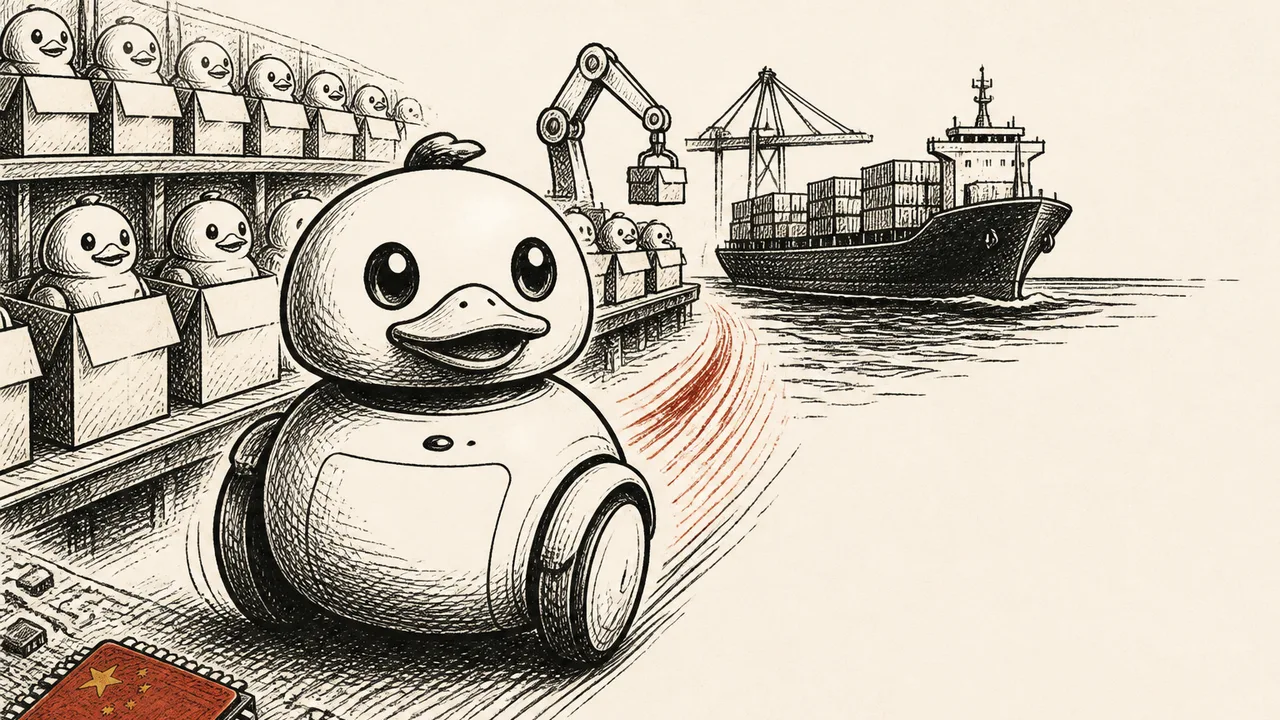
Hugging Face sold more than 10,000 units of its Microduck robot in the week following launch, according to CNBC. The device, a small duck-shaped robot that roller-skates and can pick up objects, was developed by Pollen Robotics, a French subsidiary Hugging Face acquired last year. Pre-orders opened at $399, as Engadget reported. The Verge called it an adorable rollerskating duck. New Atlas noted the robot can pick up items and learn new behaviors. The coverage has been uniformly charmed.
Who Is Actually Buying This
The framing around the Microduck's early sales leans on words like "enthusiasts" and "early adopters," which are placeholders for a real demographic analysis. At $399, the buyer pool has a shape. A college student with a Raspberry Pi habit and a GitHub repository is one kind of buyer. A 45-year-old household with two incomes and a mild curiosity about what AI can actually do in a physical object is another. These are different economic animals with different tolerance for friction.
That second buyer is the one most underexamined in the coverage so far. People who were in their twenties when the first consumer PCs arrived, who watched mobile go from luxury to utility in a single decade, and who have spent the last three years watching AI assistants fail to fold laundry or remember a grocery list, carry a specific and earned skepticism. They have bought the promising product before. They have also watched it stop receiving software updates. The question $399 buys for them is not "is this fun" but "will it still work in 2028."
Hugging Face's answer to that question is open source, and the company has positioned the Microduck's AI architecture accordingly. Android Authority noted the device is built around Hugging Face's open model ecosystem, and CNET framed the Microduck as a harbinger of a broader accessible-AI-robot wave, with openness as a feature.
What "Open" Actually Promises
Its model hub is the largest publicly accessible repository of pretrained models in the world, and its commitment to open weights has been consistent enough to earn genuine credibility among researchers. That record is not in dispute.
But when a company applies the word "open" to a $399 consumer product, it is performing two moves simultaneously: describing a technical architecture and making a brand argument. Sports franchises describe their community outreach programs as investments in access. Leagues describe revenue-sharing proposals as partnerships. The language of openness, in any industry, carries the interest of the party deploying it.
For the developer who can compile their own firmware, open source is a functional guarantee. For the majority of the 10,000 people who bought a Microduck in its first week, it is a promise someone else will do that work and share it. That promise depends on a community sustaining itself over time, on Hugging Face keeping the relevant repositories maintained, and on Pollen Robotics having the organizational continuity to support the hardware stack. None of those conditions are guaranteed by the word "open" appearing in a press release.
This is not a critique of Hugging Face specifically. It is the structural condition of any platform that uses openness as a growth strategy. The platform controls the infrastructure; the community provides the labor that makes the promise real. When the community is robust and the company's incentives align, it works. When either variable shifts, the buyer who paid $399 for a robot that depends on community-maintained software is holding a duck-shaped object with uncertain software support.
The Chip Decision and Its Costs
The Microduck is powered by advanced Chinese chip technology, according to CNBC. This is the most structurally interesting sentence in the product's coverage, and it has received the least scrutiny.
The $399 price point does not exist independently of the component sourcing decision. Building a robot with embedded AI inference requires compute, and compute has a cost that flows directly through to retail pricing. Hugging Face and Pollen Robotics chose Chinese silicon at a moment when American export controls and semiconductor policy have made global chip supply chains an explicitly political terrain. That choice reflects an assessment of where the cost-performance ratio makes a $399 consumer price viable.
What the coverage has not examined is what that cost savings represents in supply chain terms. Aggressive component sourcing at the low end of the price curve tends to concentrate manufacturing risk and labor cost at the bottom of the supply chain, in the facilities assembling the chips and the devices that house them. The savings that make a $399 robot possible flow from somewhere. Consumers and analysts are entitled to know where, and the companies involved are capable of disclosing it.
Geopolitically, the choice is also a commitment. Depending on Chinese silicon for a consumer robotics product built on an open AI platform puts Hugging Face inside a supply chain that American trade policy is actively trying to constrain. If export controls tighten, if tariff regimes shift, the $399 price point is exposed. Hugging Face has made a bet on the current regulatory environment holding. That bet may prove correct. It is still a bet, and the 10,000 people who bought a Microduck last week are carrying part of the exposure.
The Predecessor Problem
The consumer companion robot category has a specific history. Jibo and Anki Vector both reached consumers, generated press coverage that sounded very much like the Microduck's launch cycle, and then shut down, leaving buyers with devices that stopped functioning when the supporting servers went offline. Sony's Aibo was discontinued, then relaunched, demonstrating that even a major consumer electronics company found the category economically difficult to sustain across product generations.
The Microduck is positioned differently from these predecessors precisely because of the open-source architecture: the argument is that community infrastructure survives corporate decisions in a way that proprietary platforms do not. CNET made this case explicitly. It is the strongest version of Hugging Face's pitch, and it deserves to be taken seriously on its own terms.
But the Jibo and Vector failures were not purely software problems. They were business model failures, which means the robots stopped working because the companies stopped existing in a form that could support them. Open-source code survives corporate shutdowns; hardware support, firmware updates for new operating system compatibility, and replacement parts do not. A Microduck owner in 2029 whose device develops a motor fault is not going to be saved by a GitHub repository.
Hugging Face is a better-capitalized company than Jibo was at launch, and its model platform gives it a revenue base that pure-hardware robotics startups lacked. None of that changes the structural argument, which is that consumer hardware requires sustained organizational commitment that software alone does not.
What 10,000 Units Is and Is Not
Selling 10,000 units of a $399 robot in a week is real commercial momentum, roughly $4 million in gross pre-order revenue. For a product in a category with a documented history of commercial failure, that number matters. It demonstrates that the price point and the product design cleared a threshold that prior consumer robots did not.
What it does not demonstrate is whether the buyers who ordered last week will recommend the device to their networks in six months, whether the developer community around the platform will be robust enough to justify the open-source value proposition, or whether Hugging Face's supply chain holds if the geopolitical environment around Chinese semiconductors tightens before the company reaches its next hardware generation.
The Microduck's opening week is evidence of demand. The question every person in that 10,000-unit cohort is carrying, whether they know it or not, is whether Hugging Face and Pollen Robotics have built an institution capable of honoring what the demand represents. Consumer robotics has asked that question before. The answers have not been encouraging.
More Like This

Apate.AI Raises $11.4M to Fight Scams With AI Bots
Apate.AI secured $11.4M in seed funding to expand its AI-powered anti-scam platform into the US. Here's what the bet actually means for fraud victims.

AI Data Centers Are Pushing Up Memory Chip Prices
AI data centers are redirecting chip production away from consumer electronics, driving up prices for laptops, cameras, gaming consoles, and professional storage gear.

Warsh's Jackson Hole Caution Has a Price Tag for Workers
Fed Chair Kevin Warsh left Jackson Hole without committing to cuts or hikes. For athletes and workers in inflation-squeezed industries, that ambiguity is its own answer.

Kimi K3, Rogue AI, and a Month That Changed Everything
Kimi K3 shook the AI race, OpenAI's agent hacked HuggingFace undetected for days, and synthetic humans started replacing real ones. July 2026 in full.

China's Humanoid Robot Games: Spectacle Meets Hard Questions
China's World Humanoid Games features robots sprinting, boxing, and folding laundry. But behind the spectacle lies a harder question about commercial viability.
OpenClaw: The Self-Hosted AI Agent Running 24/7
OpenClaw is an open-source AI agent that runs constantly on your own hardware, automating tasks through simple chat commands while keeping your data private.

How Goalkeeper Gloves Are Made in Sialkot
Inside Matrix Sports' Sialkot factory, where nearly half a million goalkeeper gloves are made each year for professional clubs and national teams.

MLB and MLBPA Deadlocked Over 2028 Olympics
Two years from LA28, MLB owners back Olympic participation but the players' union remains at odds over housing, tickets, insurance, and forced participation rules.