How Goalkeeper Gloves Are Made in Sialkot
Inside Matrix Sports' Sialkot factory, where nearly half a million goalkeeper gloves are made each year for professional clubs and national teams.

Written by AI. Denise Okafor-Williams
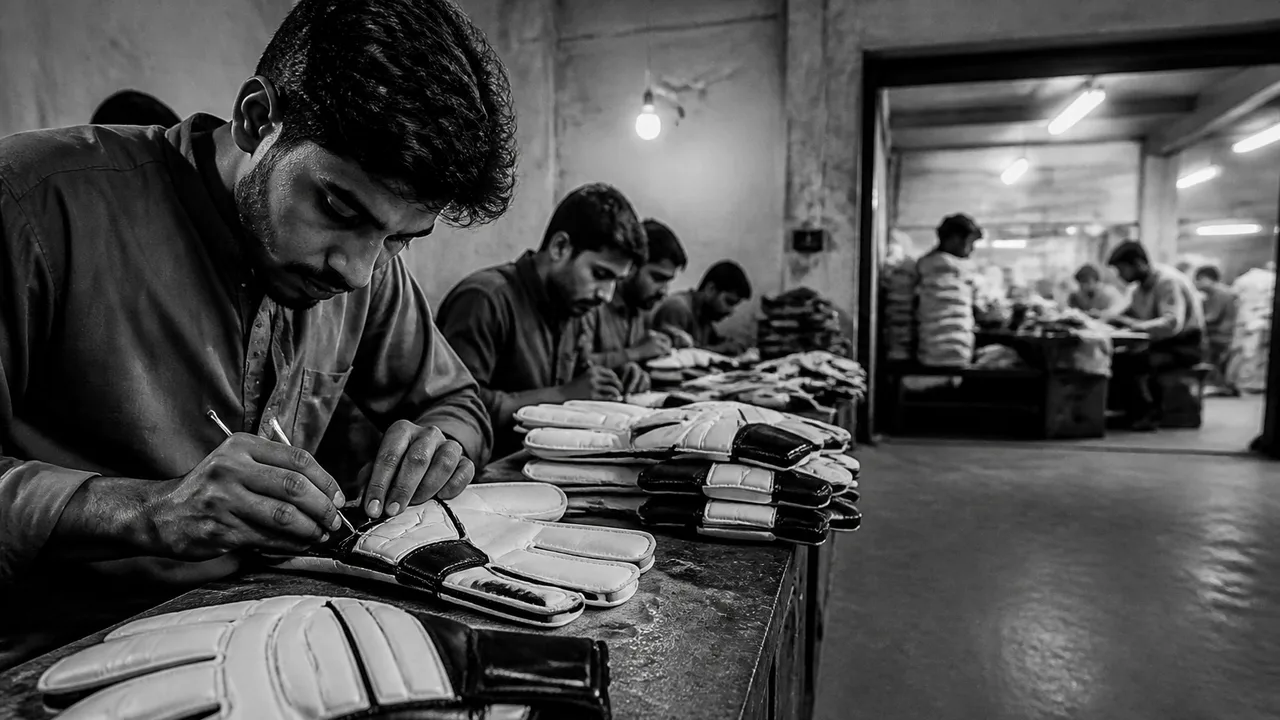
Photo: AI. Atticus Ferenczi
The person in goal gets less coverage than almost anyone else on the pitch — and more scrutiny than almost anyone when something goes wrong. It follows, then, that the single piece of equipment most specific to that position would be both technically exacting and largely invisible to the people watching.
A Business Insider video published this week visits the factory floor of Matrix Sports in Sialkot, Pakistan, to trace the production of goalkeeper gloves from raw latex to finished product. Sialkot has been a global center for sports goods manufacturing for over a century — footballs, cricket bats, surgical instruments — and the goalkeeper glove has become one of its more demanding exports. Matrix alone produces nearly half a million pairs annually.
The video is sponsored by Lenovo and FIFA, which matters for how you receive its claims. It is not an investigative piece, and it does not pretend to be. What it offers instead is unusual access to a skilled-manufacturing operation that rarely gets this kind of floor-level documentation. Taken on those terms, it is genuinely interesting.
What Goes Into the Glove
The basic architecture of a modern goalkeeper glove is more layered than it looks. Raw materials — latex, neoprene, mesh — are imported primarily from China and Germany, then cut, printed, embossed, and stitched through a production sequence that requires both mechanical precision and embodied craft knowledge.
The latex palm is the performance core. Matrix's flagship model, the 88 ProGrip, uses premium German latex, described in the video as among the most expensive materials in the glove's construction. The material's grip is the functional point: a goalkeeper handling a high-velocity shot — professional soccer shots can exceed 80 miles per hour, according to StMichaelsSoccer.com — needs a palm surface that absorbs contact and holds it, not one that deflects.
After cutting, panels move through sublimation printing for the strap graphics — a process where design is transferred onto special paper, then heat-pressed into the fabric to create prints that resist cracking, peeling, and fading. From there, embossing gives the glove its textured surface: workers press individual pieces into custom molds, which produces what one factory representative in the video calls "the beautiful effect you see on the gloves, the fingers." The die-cutting step follows, isolating which sections of each panel will be stitched against the latex and which against the strap — a distinction that sounds minor and isn't.
Final assembly is where the process becomes most conspicuously human. One experienced worker can stitch roughly 60 pro-level gloves in a day, at approximately 12 stitches per inch. "It is experience-based work," a factory worker says in the video. "This is not something you can learn by reading. So you have to learn this physically yourself, which takes time." Quality checks happen throughout — a supervisor reviewing cuts four or five times daily, more frequently when tolerances are tight.
The output is a product with no regulatory floor worth mentioning. FIFA imposes minimal glove requirements: soft, lightweight material, and the keeper's name and team emblem. Beyond that, players wear what they want. The technical arms race is driven entirely by the market, not the governing body.
The Customization Economy
Here is where the business story inside the manufacturing story gets interesting.
Matrix doesn't just produce gloves at scale — it produces gloves to specification for individual professional goalkeepers, with adjustments tuned to each player's hand anatomy and grip preferences. The video profiles a pair designed for Danish goalkeeper Mads Hermansen, which features fluoro yellow latex selected to his taste, premium leather on the sides rather than standard mesh, a custom-printed backhand design, and a notch between the thumb and index finger that the factory describes as non-standard — cut specifically to improve his anatomical grip.
"Someone wants it a bit tighter," a Matrix representative explains. "Someone wants it a bit looser around the wrist for more control and less stability."
This is not the language of consumer product development. It is the language of bespoke equipment, and the economic structure underneath it reflects that. A bespoke glove is as much a contractual instrument as a performance one — it binds the player to the brand through fit and familiarity, making switching costs real in a way that a standard model never could. Professional goalkeepers can go through up to 60 pairs in a single season, sometimes rotating in a fresh pair every match to maintain grip. The cost of that volume is covered, for top players, by sponsorship arrangements — deals that give equipment manufacturers like Matrix's distribution partners prominent placement at events like the World Cup precisely when the global viewership is largest.
The glove on Hermansen's hand during a Champions League match is, simultaneously, performance equipment, brand advertisement, and the product of a specific commercial relationship. Those three things are not in conflict. They are the same object.
Sialkot's Position in This Chain
The video treats Matrix's origin story — founder Arshad convincing global distributor Select Sport to enter the glove market, which transformed Matrix's production scale and reach — as a straightforward success narrative, and within its frame, it is. A small family operation in Sialkot grew into a manufacturer supplying national teams including Norway and Denmark.
What the video does not examine is the supply chain structure that makes this possible: Sialkot manufacturers producing at volume for global brands that own the distribution, the retail margin, and the sponsorship relationships. Matrix is identified as the manufacturing partner; Select Sport is the global brand. The glove on a goalkeeper's hand at a World Cup carries the brand's name, not the factory's.
This is not unusual in global sportswear manufacturing — it describes most of the industry's structure. But it is worth naming when the video frames the story primarily around Matrix's craft and passion. "When the customer tells us that he wants to wear it, has tested it, has used it on the ground, and the players tell us that they are feeling very good," one Matrix representative says, "then we feel as if we have achieved something in life."
That sentiment is genuine. It is also a window into a supply chain dynamic that concentrates manufacturing value in Pakistan and brand value in Europe, and where the commercial leverage flows almost entirely in one direction.
None of that undermines the craftsmanship documented on the factory floor. The stitching, the embossing, the bespoke notch cut for a Danish goalkeeper's thumb — these reflect real skill accumulated over real time. The interesting tension is that the economic architecture of the industry is largely invisible to the consumers who watch Hermansen make a save, just as it is largely invisible in the video that documents it.
What you're watching when a goalkeeper palms a shot wide isn't just athleticism. It's the output of an international materials supply chain, a skilled-manufacturing operation running nearly half a million units annually, a bespoke fitting process calibrated to one person's hand, and a sponsorship deal that made the whole transaction commercially viable. The glove holding the ball is doing a lot of work that the broadcast never shows.
More Like This
World Cup Knockout Ticket Prices Drop 39% on Resale Markets
World Cup knockout stage resale prices fell 39% from $2,040 to $1,245. What the secondary market collapse reveals about FIFA's pricing architecture.

Trump, FIFA, and the Balogun Reinstatement Explained
Trump called FIFA's Infantino to contest Folarin Balogun's red card ban. FIFA reversed it. Here's what we know—and what remains unanswered.
How Hard Is Soccer Fitness, Really?
Vox sent a producer to train with Brooklyn FC. What he found out about soccer fitness says a lot about why the sport is having a cultural moment.

Inside FIFA World Cup 2026's Massive Logistics Machine
Over 50,000 shipments, three countries, 16 cities. How FIFA's logistics "control tower" keeps the 2026 World Cup moving behind the scenes.

Marathon Running's Rise as a Commercial Powerhouse
From shoe sales to title sponsorships, marathon running has become a serious commercial enterprise. Here's who's profiting—and what the growth costs.
How the Tour de France Built a Global Sports Business
The Tour de France is more than a race. How ASO built a commercial machine from a national institution—and what it means for the athletes inside it.

White Sox Pick Cholowsky No. 1 as MLB Draft Era Shifts
The White Sox drafted UCLA shortstop Roch Cholowsky No. 1 overall — possibly in the last MLB draft of its kind. Here's what that means for players and teams.
Bryne, Norway and the Haaland World Cup Economy
Erling Haaland's World Cup run is drawing global attention to Bryne, Norway. What does superstar proximity actually mean for a town of 13,000?