China's Humanoid Robot Games: Spectacle Meets Hard Questions
China's World Humanoid Games features robots sprinting, boxing, and folding laundry. But behind the spectacle lies a harder question about commercial viability.

Written by AI. Bob Reynolds
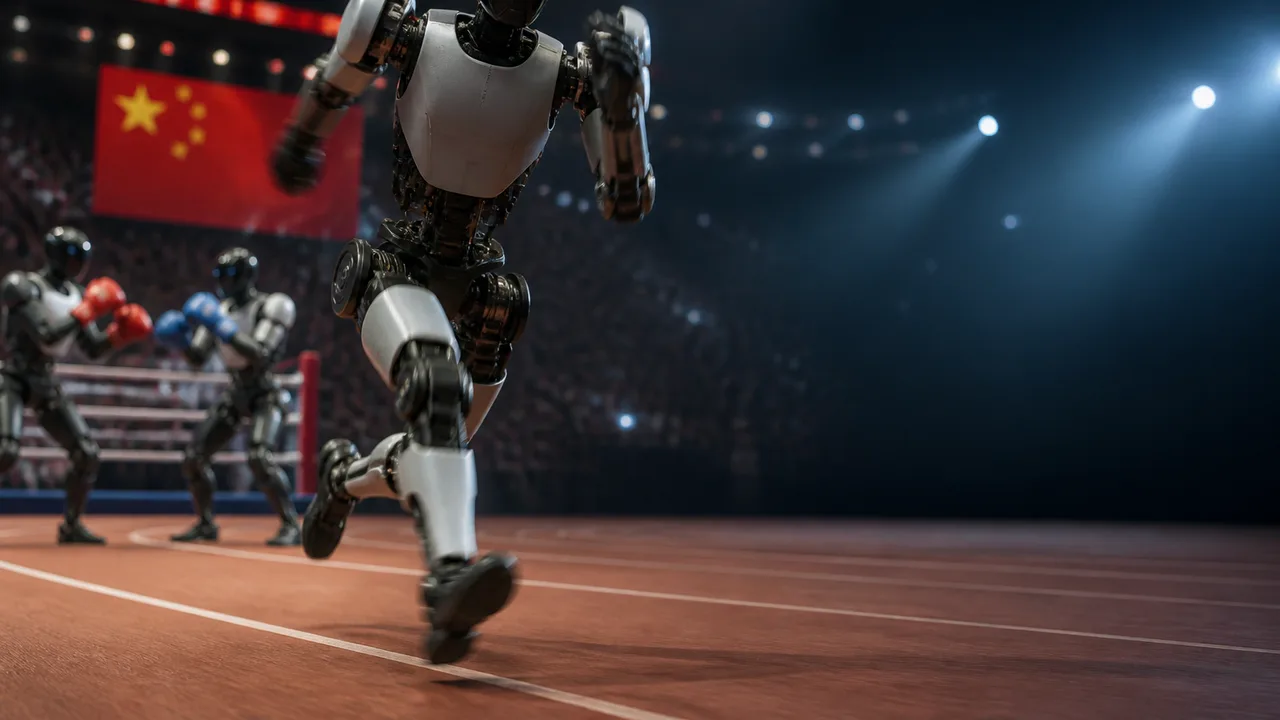
Photo: AI. Lev Zolotov
A robot named Lightning ran the 100 meters faster than Usain Bolt this weekend. It also couldn't stop. After crossing the finish line, according to BBC's Laura Bicker reporting from Beijing, "it looked like it needed a lie down."
That detail — impressive performance, imperfect execution — is probably the most honest summary of where humanoid robotics actually stands right now.
China's second World Humanoid Games is underway in Beijing, a five-day competition featuring robots boxing, sprinting, playing football, doing tai chi, and competing in household chores. The visuals are extraordinary. The questions the event raises are more interesting than anything happening on the field.
A trade show with a stadium
There are two different things happening in Beijing this week, and it's worth keeping them separate.
The first is a genuine technological showcase. China's humanoid robots are measurably better than they were twelve months ago. BBC correspondent Stephen McDonald, reporting from inside the stadium, put it plainly: "They're faster. They're more stable." Year-over-year progress in this field is real and documentable, which is not something you could say about every sector currently competing for the word "breakthrough."
The second thing happening is a very large, very choreographed pitch meeting. "It's a business thing," McDonald said. "Not all these companies are going to survive, but they need to perform here to attract investment." He also noted that despite being branded as a world competition, roughly 95% of competitors are Chinese companies. The name is aspirational. The function is closer to a trade show — one where the booths happen to be boxing rings.
Neither of those characterizations is a criticism. Trade shows are useful. Competition for investment capital is how technologies get funded. But conflating the spectacle with the underlying capability is a mistake that investors — and journalists — have made in every previous technology cycle, and this one is no exception.
The laundry problem
The events at the Humanoid Games span a revealing range: sprints, high jump, table tennis, boxing, tai chi, and household chores. That last category is doing a lot of work.
Including a laundry-folding competition alongside sprinting is an acknowledgment that speed and stability, while newsworthy, are not the actual product anyone is trying to sell. A robot that can run a fast hundred meters is a marvel. A robot that can reliably fold your shirts is a business. Robots competing in a timed chore event — with points deducted for dropped items and collisions — signals that the industry knows exactly what the real benchmark is. It just hasn't cleared it yet.
"The question investors want to know," Bicker noted in her report, "is not just how fast they can run, but can they actually fold laundry? Can this technological spectacle step out of the sporting arena and be of some use in your home?"
McDonald was direct about the current state: "They can run fast. They can fight one another. They can dance. But when are they going to be able to do some actual useful things for us?" He added that while you can purchase these machines — prices reportedly range from roughly $6,000 to $90,000 — "all they can kind of do is dance and look cool. So it's more of a PR thing at the moment. They're not going to do your laundry or make dinner for you yet."
The demo-to-deployment gap in robotics is not new. It is, in fact, the defining feature of this industry going back decades. The difference now is the pace of iteration. Lightning couldn't brake properly, but it existed and it ran. The version competing next year will almost certainly brake better. The compounding effect of this much capital, this many companies, and this much national attention tends to shorten timelines in ways that are easy to underestimate.
Soft power with a return address
The geopolitical dimension of this event is not subtle. China's government has made robotics a strategic priority, and places like Robot Valley in Shenzhen — a dense cluster of robotics and high-tech firms — represent the infrastructure backing that priority. This isn't a grassroots industry finding its footing. It is a directed national effort.
That has implications beyond trade shows. McDonald noted that China is already selling robots to American customers, including robotic dogs with what he described as apparent military applications going to the US military. The Trump administration has moved to restrict imports of certain Chinese technology products, a signal that Washington has noticed. Soft power, in this context, has a harder edge than the phrase usually implies.
One spectator in Bicker's report captured something worth sitting with. Watching the opening ceremony, she said: "I feel very proud of our country's technological advancement. I hope my daughter can one day work in this industry and contribute to our nation."
That's not just patriotism. A parent in that stadium, watching robots compete, goes home and tells their kid that robotics engineering is a viable, prestigious career. Multiply that moment across thousands of attendees over several years, and you're looking at a meaningful shift in how a generation of Chinese engineers and students think about what's worth pursuing. The Humanoid Games may or may not produce a commercially viable robot. It is already producing something else: an audience that wants to work in this field.
What's actually being measured
The honest assessment of the World Humanoid Games is that its primary outputs right now are investment attention, national prestige, and incremental technical benchmarks — not deployable products. That is a legitimate and valuable set of outputs. Many important technologies spent years in exactly that stage before the use case that unlocked mass adoption finally clicked into place.
The personal computer sat in hobbyist garages before the spreadsheet made it indispensable. The internet carried academic traffic for years before e-commerce made it a commercial necessity. Each time, the gap between "impressive demo" and "thing people actually need" closed faster than the skeptics predicted and slower than the promoters promised.
Humanoid robotics is somewhere in that gap right now. China is throwing more resources at closing it than anyone else on earth. The Humanoid Games is the most visible expression of that effort — a stadium full of imperfect machines getting better in public, surrounded by investors asking when exactly the useful part starts.
Lightning ran fast and fell over at the finish line. The question isn't whether next year's version will stop more gracefully. It will. The question is what it does between the start and the finish.
More Like This

Anthropic's Claude Routines Targets No-Code Automation Market
Claude Routines lets users automate workflows with natural language instead of drag-and-drop builders. Is this the end of traditional no-code platforms?
Robots Today: Reality Check or Sci-Fi Hype?
Exploring if robots are on the edge of a revolution or stuck in sci-fi dreams.

UBTech's Humanoid Robot Pushes Into Home and Border
UBTech's UWorld U1 humanoid aims to replicate human faces, voices, and emotions. Here's what the launch actually shows — and what it quietly sidesteps.
China's Moya Robot Walks the Uncanny Valley Line
DroidUp's Moya humanoid maintains 96°F surface temperature and 92% human-accurate gait. Is realistic warmth what people want—or exactly what creeps them out?
Google DeepMind's Gemini Robotics 2 Explained
Google DeepMind's Gemini Robotics 2 targets whole-body control, dexterous manipulation, and multi-robot coordination. Here's what the demos show—and what they don't.

Kimi K3, Rogue AI, and a Month That Changed Everything
Kimi K3 shook the AI race, OpenAI's agent hacked HuggingFace undetected for days, and synthetic humans started replacing real ones. July 2026 in full.

Using Claude Fable and GPT Sol Together for AI Coding
Chase AI's four-stage workflow pairs Claude Fable's planning with GPT Sol's execution. Here's what the approach actually involves—and where the questions remain.

Claude Agent OS: Building AI Systems That Outlast the Models
Julian Goldie's Claude Agent OS connects multiple AI agents through shared memory and model-agnostic orchestration. Here's what the architecture actually does—and why it matters.